 Do Son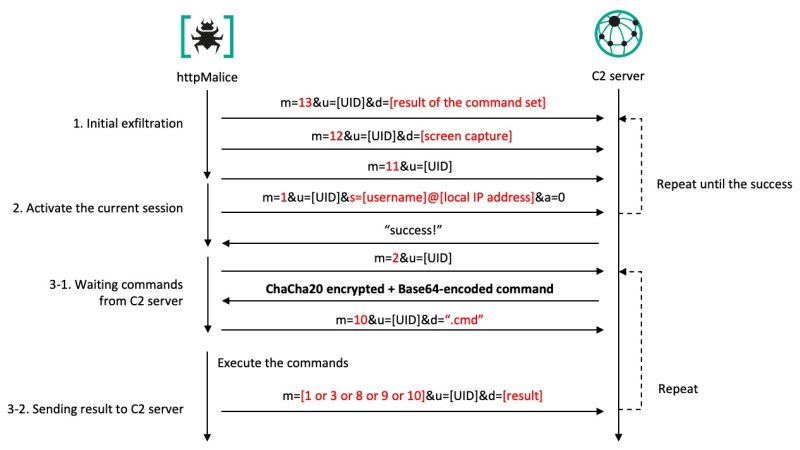
C2 communication sequence of httpMalice | Image: Kaspersky Labs
The prolific Korean-speaking threat actor known as Kimsuky is executing a major tactical evolution, incorporating modern programming languages, commercial cloud services, and artificial intelligence into its long-running cyber-espionage operations.
A comprehensive technical report has shed new light on the group’s two most formidable malware lineages: the PebbleDash and AppleSeed clusters. While historically considered less technically proficient than some of its regional peers, Kimsuky’s latest campaigns demonstrate a sophisticated understanding of living-off-the-cloud techniques and defensive evasion.
As the researchers highlight in their executive summary: “Our monitoring indicates various strategic updates to the group’s arsenal, including the use of VSCode Tunneling, Cloudflare Quick Tunnels, DWAgent, large language models (LLMs), and the Rust programming language.”
The infection chain typically begins with highly tailored spear-phishing emails containing malicious attachments disguised as legitimate documents, such as graduate school applications, product quotations, or government forms. Kimsuky packages its payloads inside compressed archives using diverse formats, including JSE scripts, screen savers (.SCR), and Program Information Files (.PIF).
When a user executes a malicious JSE script, the dropper handles multiple encoded components simultaneously. According to the report: “JSE droppers contain a minimum of two Base64-encoded blobs: one serving as a benign lure file and one or more containing malicious code.”
The script decodes and drops a harmless document to distract the victim while quietly leveraging PowerShell and core Windows binaries like certutil.exe and regsvr32.exe to decode and install the primary implant in background folders.
Among the newly discovered payloads, HelloDoor represents a significant milestone: it is the first variant within the PebbleDash family written in the Rust programming language. First identified in August 2025, the backdoor establishes persistence via local autorun registry keys and communicates over HTTP with a Command and Control (C2) server hosted via TryCloudflare. This temporary tunneling service permits the group to expose local attacker infrastructure to the internet completely anonymously without setting up an official account.
Interestingly, developers discovered distinct signs that the backdoor’s authors relied on artificial intelligence to construct the codebase. The report notes: “Though interesting, it is no longer surprising that we found comments in the code that appear to have been generated by an LLM service rather than a human developer. This is based on traces that include emojis used for logging debugging messages.”
Kimsuky’s latest primary backdoor, httpMalice, acts as a technical bridge, blending classic PebbleDash commands with AppleSeed system profiling techniques. The implant maps the compromised host, executing commands inside a Korean language charset context to redirect system profiles back to its infrastructure.
To safeguard these backdoors from endpoint protection platforms, Kimsuky deploys MemLoad, a multi-stage loader designed to run anti-virtual machine checks and conduct preliminary reconnaissance. If the target environment is deemed valuable, MemLoad bypasses static file scanners entirely: “Upon installation, it requests an additional payload from the C2 server, executing it reflectively in memory if deemed suitable.”
Perhaps the most alarming shift is Kimsuky’s post-exploitation pivot toward legitimate administration utilities to bypass traditional network indicators. Instead of relying on noisy custom backdoors, the group utilizes the official Visual Studio Code Remote Tunneling mechanism.
The loader scripts silently install the legitimate VSCode CLI execution environment onto the victim’s device. By piping dynamic carriage returns (echo |) straight into the non-interactive setup terminal, the malware automatically bypasses manual interactive menus and triggers a GitHub-linked authentication flow. The tool records the generated secure tunnel URL and exfiltrates it to compromised South Korean websites or dedicated attacker Slack webhooks.
Once completed, the attacker gains absolute browser-based terminal access to the host machine. Because the device initiates all outbound sessions directly to Microsoft’s trusted web infrastructure, the malicious activity completely blends in with authorized corporate network operations.
Forensic analysts maintain high confidence that both families are tightly coordinated by a single centralized authority. Overlapping delivery campaigns, identical cryptographic signatures, and shared mutex indicators link the malware sets across global industry sectors, spanning defense, intelligence, and government targets worldwide. Defenders are strongly encouraged to audit remote tunneling execution parameters and continuously monitor outbound connections to unauthorized public relay systems.
Support Our Threat Intelligence
Find our threat intelligence and malware analysis helpful? Support our work today and unlock a 100% ad-free reading experience!
 Buy Me a Coffee
