CVE-2026-52924 PoC Exploit Disclosed: 9.8 CVSS Linux Root Privilege Escalation
 Do Son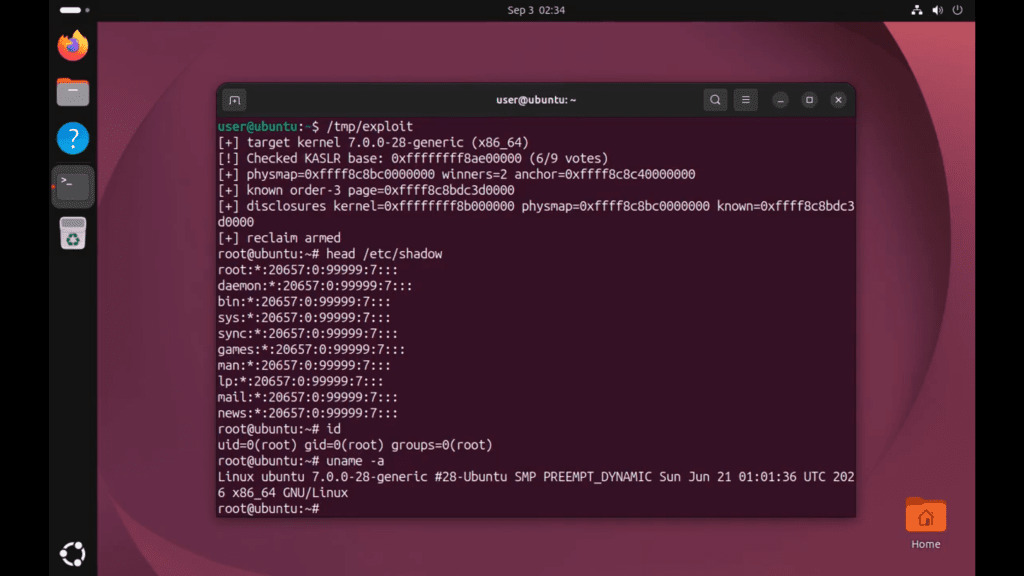
Security team NebuSec published technical details and functional exploit code for a critical Linux flaw. This Linux CVE-2026-52924 flaw triggers a use-after-free memory state within the kernel network stack. Upstream maintainers initially classified the bug as a denial-of-service issue. However, the published proof-of-concept shows that attackers can obtain full root privileges.
- CVE: CVE-2026-52924
- CVSS: 9.8 (Critical · CVSSv3)
- Product: Linux
- Affected: 5bbbbe32a43199c2b9ea5ea66fab6241c64beb51, 4.15
- Impact: sctp: purge outqueue on stale COOKIE-ECHO handling
- Status: No confirmed exploitation yet
- Patched in: 84b7a319105db2f917ccdcf502bdc866082b1285, f46e1d1a758878f0d22c4fbbd1bf42bb7165d1e8, 3c0741a441a7df7099d7ca6a64a6a0de09c677c8, 2afc9e684dc7fecf73db1edc937ebbc47b4b68dc (+12 more)
- EPSS: 0.5% (30-day)
- Action: Update to 84b7a319105db2f917ccdcf502bdc866082b1285, f46e1d1a758878f0d22c4fbbd1bf42bb7165d1e8, 3c0741a441a7df7099d7ca6a64a6a0de09c677c8, 2afc9e684dc7fecf73db1edc937ebbc47b4b68dc (+12 more) now
Why It Matters
This vulnerability introduces severe system security risks for enterprise servers. Attackers can escape standard user constraints and seize control of vulnerable hosts. Consequently, an unprivileged user can compromise server confidentiality and alter critical system files. In their public disclosure, researchers at NebuSec posted a video demonstration on X showing complete local root compromise. Furthermore, public exploit code increases the danger of rapid automation by threat actors. While security researchers confirmed the working exploit, telemetry shows no confirmed wild exploitation yet.
Today's exploit is for the latest Ubuntu 26.04, a 9-year-old OOB in SCTP: CVE-2026-52924.
It was introduced in Oct 2017 and fixed upstream in Jun 2026.
Discovered and exploited by the NebuSec security pipeline.
EXP source: https://t.co/3XVCKU1fPL pic.twitter.com/1KwTxvWPju
— Cyber Meowfia (@cybermeowfia) September 4, 2026
How the Attack Works
The flaw resides within the Stream Control Transmission Protocol handling routines. Specifically, the bug appears when the kernel processes a Stale Cookie error during connection setup. During this event, the kernel rolls an association back to a waiting state. Consequently, the stream update function frees the previous stream table without clearing cached pointers. Later, the protocol dequeue scheduler accesses this freed memory block. This sequence triggers a slab use-after-free condition. Security researchers at CyberMeowfia released a public proof-of-concept repository detailing this exact execution path.
Affected Versions
The upstream bug dates back to code introduced in October 2017. Therefore, the Linux CVE-2026-52924 vulnerability affects multiple long-term kernel branches. Testing verified the flaw on Ubuntu kernel version 7.0.0-28.
Patch and Mitigation Steps
Upstream developers resolved the issue by purging the association outqueue during stale cookie events. This update drops pending transmission state and clears scheduler pointers. Linux administrators should update system kernels immediately to protect against local privilege escalation. Alternatively, administrators can disable the protocol module if systems do not require SCTP services.
Support Our Threat Intelligence
Find our vulnerability reports and weekly recaps helpful? Support our work today and unlock a 100% ad-free reading experience!
 Buy Me a Coffee
