Zero-Day Alert: The “Red Sun” Vulnerability Turning Microsoft Defender into a Hacker’s Tool
 Do Son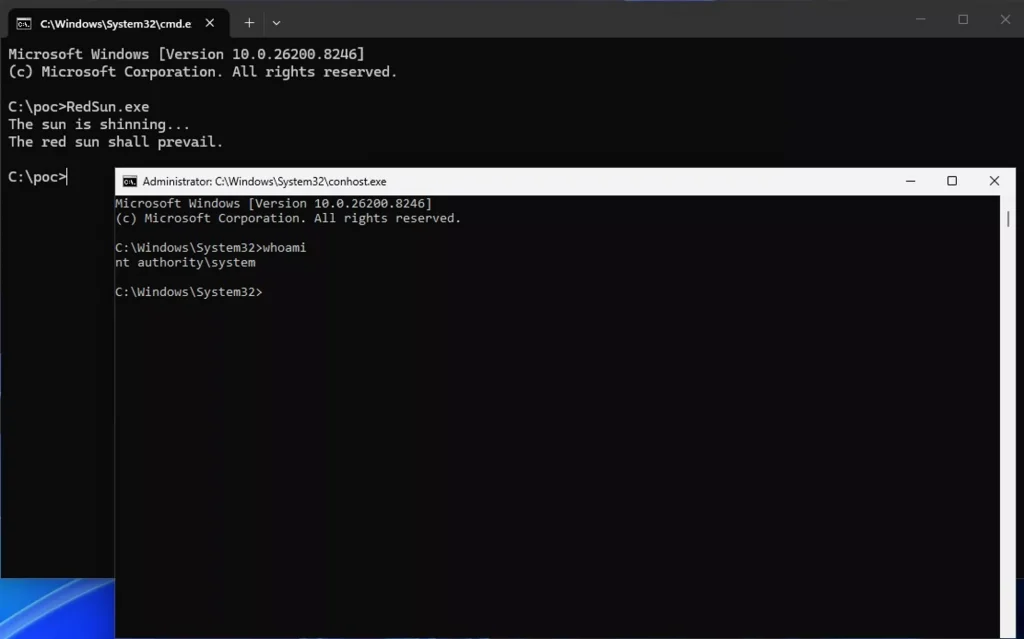
Microsoft Defender, formerly designated as Windows Defender, serves as the quintessential security suite for Windows 10 and 11. In the absence of third-party antivirus solutions, Microsoft orchestrates essential systemic safeguards through this platform, leveraging cloud-based heuristics to neutralize malicious software.
Too many Microsoft alerts in your inbox? Switch to one weekly digest, sorted by severity.
Try Team free for 14 daysHowever, researchers have unearthed a critical vulnerability within the software, evocatively dubbed “Red Sun.” This flaw empowers an adversary to overwrite vital system files with malicious payloads, thereby facilitating local privilege escalation. Paradoxically, the very sentinel designed to protect the system serves as a springboard for hackers to secure administrative hegemony.
Significantly, the researcher credited with this discovery—operating under the pseudonym Chaotic Eclipse—had previously identified another security flaw designated as “BlueHammer.” Due to a fractious dispute with the Microsoft Security Response Center (MSRC), the researcher opted for full public disclosure. This lack of coordination has precipitated a scenario where threat actors have already begun weaponizing the vulnerability in active campaigns.
The “Red Sun” anomaly arises from Microsoft Defender’s erratic behavior when processing potentially malicious files demarcated with “cloud tags.” Under specific conditions, the software may inadvertently restore or rewrite a malicious file to its original directory on the disk. By exploiting this defect, proof-of-concept code can circumvent Defender’s defensive perimeter to supplant system files, granting the malware elevated privileges—a flaw with profound security implications.
Notably, this exploit does not necessitate kernel-level vulnerabilities, memory corruption, or the subversion of Defender’s internal logic. Instead, it manipulates a complex race condition emerging from the interaction between Defender’s update workflow, the Volume Shadow Copy Service, Windows Cloud File APIs, and opportunistic locking. While each process functions legitimately and according to specification, their orchestration in a specific, deviant sequence triggers the vulnerability. When coupled with “BlueHammer,” the potential for systemic devastation is markedly amplified.
At present, these vulnerabilities remain public and unremediated—devoid of patches, CVE identifiers, or formal coordination. This impasse stems from a fundamental disagreement between the researcher and the MSRC regarding the severity of the flaws, with the latter purportedly reluctant to categorize them as critical security issues, which directly impacts the allocation of bug bounties.
The researcher has accused Microsoft’s security team of undermining the independent research community rather than fostering a collaborative environment. Chaotic Eclipse is not alone in this grievance; several other specialists have expressed similar frustrations, occasionally resulting in the preemptive disclosure of flaws before a fix can be implemented.
The current suite of vulnerabilities comprises three distinct threats: Red Sun, BlueHammer, and UnDefend. With the proof-of-concept code now in the public domain, adversaries are reverse-engineering the exploits to launch targeted assaults. The veracity of these flaws is beyond dispute, as numerous independent analysts have verified their authenticity through rigorous testing. Consequently, Microsoft faces an urgent imperative to remediate these vulnerabilities and re-evaluate the systemic failures within the MSRC that have alienated the security research community.
Researchers have also identified potential in-the-wild threats targeting BlueHammer, Red Sun, and a third vulnerability named UnDefend.
Support Our Threat Intelligence
Find our vulnerability reports and weekly recaps helpful? Support our work today and unlock a 100% ad-free reading experience!
 Buy Me a Coffee
