Stealthy New Remcos RAT Variant Evades Detection Using Innovative Staging Layers
 Do Son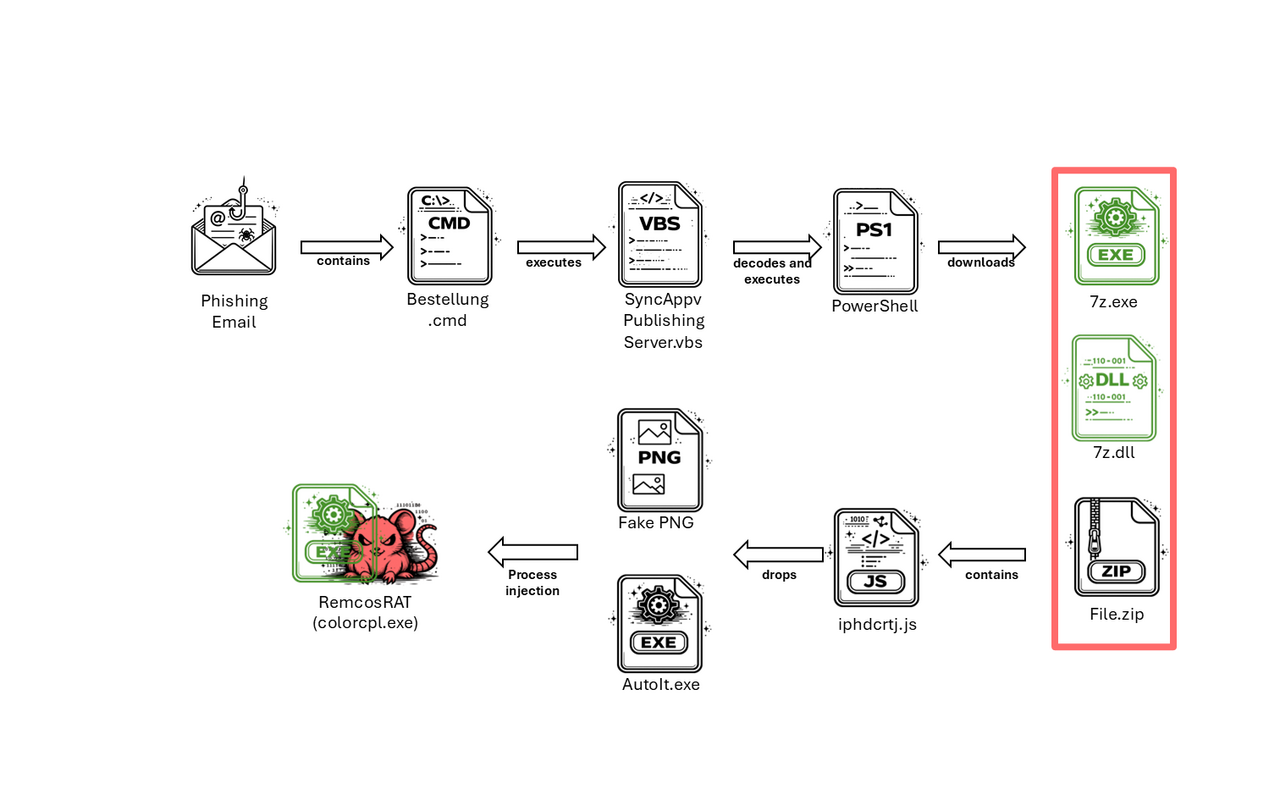
Remcos RAT variant Infection Chain | Image: G DATA
Advanced Phishing Campaigns Exploit Windows Administrative Tools
Security researchers recently uncovered a highly sophisticated software compromise spreading across corporate networks. Specifically, G Data Analysts discovered a new Remcos RAT variant infection chain that utilizes unique evasion tactics. This automated campaign blends malicious processes directly into normal operating system tasks. To accomplish this, the operators rely heavily on legitimate system administration files as proxies. Consequently, traditional perimeter defense mechanisms fail to flag the suspicious behaviors. Security teams must update their network tracking parameters immediately to contain this expanding threat.
Exploit Vectors and Legitimate System Abuse
To begin with, the intrusion pipeline starts through an unconventional email distribution vector. The malicious file lands inside a target inbox pretending to be a typical corporate transaction sheet. According to the published analysis, “The infection begins with a phishing email containing a malicious Windows batch file named Bestellung.CMD as an attachment.”
Furthermore, running this batch utility executes an un-monitored scripting component natively. The software calls a hidden administrative component to bypass host validation restrictions. The report explicitly states: “It then invokes SyncAppvPublishingServer.vbs, which is a legitimate Microsoft App-V component commonly present in enterprise Windows environments.” Therefore, this strategy effectively masks the initial download sequence from local antivirus monitors.
Payload Staging and Tool Deployment
Subsequently, the active script initiates a silent terminal download loop. The hidden process connects to cloud storage nodes to retrieve compressed helper tools. Specifically, the pipeline drops legitimate archiving utilities onto the host disk to ensure reliable local execution. In addition, the installer extracts an obfuscated configuration file containing encrypted data blocks.
Interestingly, these automation commands look remarkably clean to analysts. The technical brief notes that “These characteristics suggest that the script may have been generated or refined using AI-assisted tools, which have become increasingly common in script development.” Consequently, these machine-made indicators successfully lower the risk of early detection.
In Memory Injection via DonutLoader Shellcode
After unpacking the core archives, the malware moves into an advanced code injection stage. The application drops an active interpreter along with a fake graphic file. Although the graphic element looks completely normal, it contains hidden script parameters. The program decodes these items at runtime via a simple single-byte mathematical conversion.
Ultimately, this hidden process launches the final attack phase directly inside system memory. The loader leverages a specialized position-independent execution stub known as DonutLoader shellcode. The writeup details the architecture change: “This shifts Remcos RAT’s loader architecture away from managed .NET execution toward a more portable, runtime-independent in-memory payload delivery model.” As a result, the active payload completely subverts classic memory verification protocols.
Defensive Strategies and Remediation Guidelines
Defenders must deploy strict checking models to identify these runtime anomalies. Standard signature detection tools cannot easily capture in-memory injection sequences. Therefore, security teams should block unapproved script executions originating from public user directories. Administrators can also monitor unusual process arguments attached to native operating system binaries.
Finally, isolating outbound network connections traveling to untrusted cloud storage portals neutralizes this new Remcos RAT variant early. Timely discovery stops the payload before data exfiltration occurs. Enforcing these rigid boundary controls protects enterprise environments from sophisticated script-based intrusions.
Support Our Threat Intelligence
If you find our CVE report and cybersecurity news helpful, consider supporting our work.
 Buy Me a Coffee
PayPal
Buy Me a Coffee
PayPal

