 Do Son
TL;DR
Xint researchers have named a set of five NGINX vulnerabilities NGINX2Root, and they say each one has a working exploit. The worst, CVE-2026-123007, lets an unauthenticated attacker run commands on servers with HTTP/2 enabled. F5 fixed all five on November 18, 2026, in NGINX 1.31.9 and 1.30.7.
NGINX2Root covers flaws in HTTP/2, HTTP/3, the resolver and the mail proxy, each rated 9.2 under CVSS 4.0. Xint chained the HTTP/2 bug with a separate Linux kernel flaw to reach root on the host. A public proof-of-concept exists for CVE-2026-123007, but no exploitation in the wild has been confirmed.
- Total: 5 CVEs
- Severity: 5 Critical
- Actively exploited: None confirmed
- Highest severity: 9.2 (Critical · CVSSv4) — CVE-2026-123007
- Action: Apply the latest security updates now
Notable CVEs
| CVE | CVSS (CVSSv4) | Type | Fixed in | Status |
|---|---|---|---|---|
| CVE-2026-123007 | 9.2 | NGINX ngx_http_v2_module | 37.3.0.1, 37.0.8.1, 1.31.9 (+1) | Not exploited |
| CVE-2026-123633 | 9.2 | NGINX ngx_http_v2_module | 1.31.9, 1.30.7, 37.2.0.1 (+1) | Not exploited |
| CVE-2026-123634 | 9.2 | NGINX resolver | 37.3.0.1, 37.0.8.1, 1.31.9 (+1) | Not exploited |
| CVE-2026-121810 | 9.2 | NGINX ngx_http_v3_module | 37.3.0.1, 37.0.8.1, 1.31.9 (+1) | Not exploited |
| CVE-2026-113425 | 9.2 | NGINX ngx_mail_proxy_module | 37.3.0.1, 37.0.8.1, 1.31.9 (+1) | Not exploited |
Why It Matters
From Web Request to Host Root
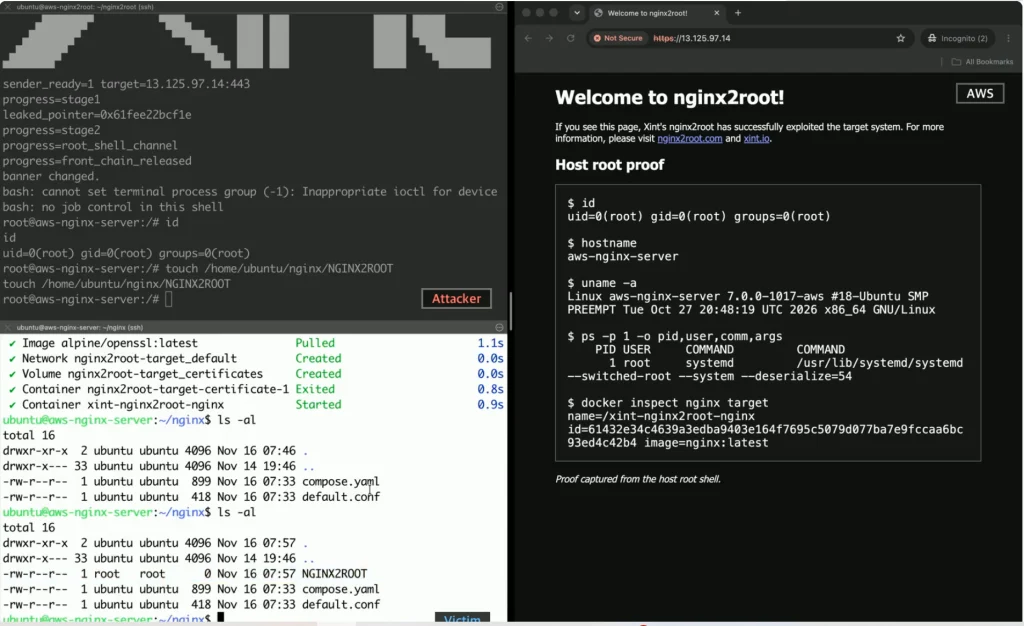
The NGINX2Root disclosure site says the HTTP/2 flaw “can be chained with a separate Linux kernel vulnerability to reach host root, remotely and without authentication.” The kernel bug sits in the SCTP protocol code. The site does not name its CVE ID.
Millions of Servers in Range
The HTTP/2 code path dates back to NGINX 1.9.5 in 2015. According to Xint, a November 10 Shodan snapshot found 11.8 million of 11.94 million version-identifiable NGINX hosts in the affected range. However, Xint stresses that this is “a measure of version prevalence, not a count of exploitable endpoints.” Many hosts may not expose HTTP/2 or may run backported fixes.
Moreover, Xint cites W3Techs data showing NGINX powers about 30% of websites with an identifiable web server. Xint also reports that 88.6% of Fortune 500 companies use NGINX.
A Public Exploit Already Exists
Rapid7 researcher Stephen Fewer found CVE-2026-123007 independently. He released a proof-of-concept exploit on GitHub that shows unauthenticated RCE against an NGINX 1.31.8 Docker image. As a result, NGINX2Root needs immediate attention.
How the Attack Works
HTTP/2 Flow Control (CVE-2026-123007)
The F5 advisory for CVE-2026-123007 says “the flow control window can exceed the allowed threshold.” That error leads to a heap buffer overflow. Xint describes the next steps at a high level. The attacker corrupts the send window, leaks memory addresses, and overwrites “the pointer to a cleanup function that runs when a connection closes.” Commands then run with NGINX worker privileges.
Still, the attack has limits. The Rapid7 analysis says it needs “approximately 128 GB of HTTP/2 data.” It also depends on a specific x86-64 glibc copy routine.
The Other Four NGINX2Root Flaws
- CVE-2026-123633: an HTTP/2 use-after-free when NGINX proxies to a backend and runs “low on worker_connections,” per the F5 HTTP/2 proxy advisory
- CVE-2026-123634: a resolver use-after-free that needs variable server names plus SSI or mirror subrequests, per the F5 resolver advisory
- CVE-2026-121810: an HTTP/3 use-after-free that “depends on conditions beyond the attacker’s control,” per the F5 HTTP/3 advisory
- CVE-2026-113425: a mail proxy use-after-free triggered by “a specially crafted mail session,” per the F5 mail proxy advisory
F5 says code execution through these bugs works only “on systems with Address Space Layout Randomization (ASLR) disabled or when the attacker can bypass ASLR.” Otherwise, they crash the worker.
Found With AI Help
Xint says a researcher pointed a new Xint capability at about 50,000 lines of NGINX code. Within 90 minutes, it flagged high-severity issues. The researcher himself found the HTTP/2 bug. After that, Xint says its tool found the other four “with no human guidance.” The team includes Soomin Shin, Joohyun Park, Tim Becker and Yves Bieri.
Affected Versions
- NGINX Open Source 1.31.0 to 1.31.8: fixed in 1.31.9
- NGINX Open Source 1.30.6 and earlier: fixed in 1.30.7 (each flaw’s start version differs)
- NGINX Plus 37.1.0 to 37.2.0.1: fixed in 37.3.0.1
- NGINX Plus 37.0.0 to 37.0.7.1: fixed in 37.0.8.1
- NGINX Plus R34 to R36: no fix listed
For the HTTP/2 RCE, Xint lists five conditions. The version must fall between 1.9.5 and 1.31.8, and the build must include the HTTP/2 module. In addition, an active listener must accept HTTP/2 from outside, and no vendor backport may be in place.
Patch and Mitigation
Upgrade to NGINX 1.31.9 or 1.30.7, or to NGINX Plus 37.3.0.1 or 37.0.8.1. Then restart NGINX. Xint warns that a reload “does not load the new binary.”
If You Cannot Patch Yet
- Disable HTTP/2 on every affected listener. On 1.25.1 and later, use the http2 off directive. On older releases, remove http2 from the listen directive.
- Next, confirm from outside that the server no longer negotiates HTTP/2.
- For CVE-2026-123634, F5 advises you to “avoid using SSI or mirror directives” with variable server names.
- For CVE-2026-113425, F5 says to “restrict listeners to trusted networks.”
Also, check distribution packages and container images with your vendor, since some backport fixes without changing the version string. Finally, track the Linux kernel SCTP fix separately, because NGINX2Root uses that flaw to reach root.
Support Our Threat Intelligence
Find our vulnerability reports and weekly recaps helpful? Support our work today and unlock a 100% ad-free reading experience!
 Buy Me a Coffee
