 Do Son
TL;DR
Rapid7 and F5 disclosed CVE-2026-123007 on November 18, 2026, and a working exploit is already public. The flaw enables NGINX remote code execution over HTTP/2 without a login. Rapid7 published a full technical write-up, and its researcher released proof-of-concept code on GitHub the same day.
An integer underflow in NGINX’s HTTP/2 flow control can corrupt worker memory and lead to code execution. Rapid7 rates it 9.2 under CVSS 4.0, while F5 gives it 8.1 under CVSS 3.1. A public PoC exists, but no exploitation in the wild has been confirmed.
- CVE: CVE-2026-123007
- CVSS: 9.2 (Critical · CVSSv4)
- Product: F5 NGINX Plus
- Affected: 37.1.0, 37.0.0, R33, 1.31.0, 1.30.0, 1.9.5
- Impact: NGINX ngx_http_v2_module vulnerability
- Status: No confirmed exploitation yet
- Patched in: 37.3.0.1, 37.0.8.1, 1.31.9, 1.30.7
- Action: Update to 37.3.0.1, 37.0.8.1, 1.31.9, 1.30.7 now
Why It Matters
The Exploit Is Public
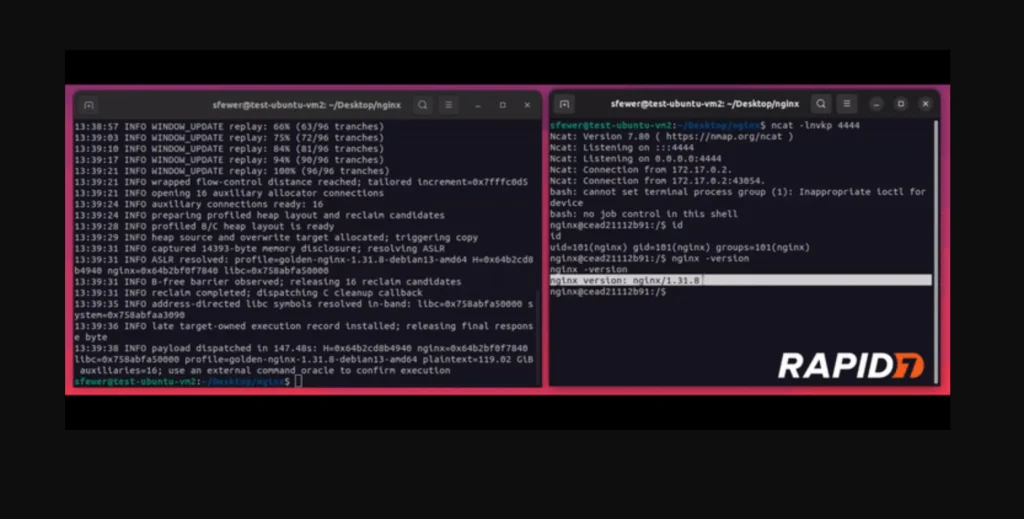
Stephen Fewer of Rapid7 found the bug. His CVE-2026-123007 proof-of-concept repository contains a minimal trigger script and a full exploit. The exploit “demonstrate[s] unauthenticated RCE” against a vulnerable NGINX 1.31.8 Docker image. As a result, attackers no longer need to rebuild the attack from scratch.
NGINX Sits at the Edge
NGINX commonly runs as a web server, reverse proxy and load balancer. Many of them enable HTTP/2 over TLS. So any NGINX remote code execution bug in that path deserves fast attention.
Real Limits on Attacks
Still, the attack is not easy. According to the Rapid7 analysis of CVE-2026-123007, it “requires a significant amount of network traffic to be transmitted, approximately 128 GB of HTTP/2 data.”
That takes about two minutes on a 10 Gbit/s link and 17 minutes on 1 Gbit/s. However, NGINX closes connections after one hour by default. Rapid7 says a link slower than about 300 Mbit/s “will not be able to succeed.” Moreover, a proxy in front of NGINX will likely break the attack.
How the Attack Works
A Flow-Control Accounting Error
HTTP/2 lets a client tell the server how much response data it may send. NGINX tracks that credit in counters for each stream and for the whole connection. The protocol caps the connection credit at about 2 GB.
The bug starts when queued response data gets cancelled. NGINX returns the reserved credit without checking the cap. Next, NGINX closes a stream after a settings error but keeps the connection open. RFC 9113 requires the whole connection to close in that case.
From Underflow to Memory Corruption
With the counter above the cap, a later safety check underflows. The client can then push the counter to a huge value. NGINX eventually reads that value as a negative length for a response buffer.
Rapid7 explains the outcome: “The resulting memory corruption can disclose data, interrupt service, and execute code with the nginx worker process’s permissions.” Its exploit first leaks memory addresses, then overwrites a callback to run a command.
Build Requirements
The known exploit depends on a specific glibc memcpy routine. That routine runs on x86-64 CPUs with the avx512f and avx512vl features. Rapid7 notes that “alternative RCE exploitation strategies may be viable, but none are currently known.”
Meanwhile, the CVE record from F5 says the bug “typically” ends with a worker crash. Code execution is possible “on systems with Address Space Layout Randomization (ASLR) disabled or when the attacker can bypass ASLR.” Code runs as the worker, not as root.
Affected Versions
Only configurations that use HTTP/2 are affected. Rapid7 lists these vulnerable and fixed releases:
- NGINX Open Source 1.31.0 to 1.31.8: fixed in 1.31.9
- NGINX Open Source 1.9.5 to 1.30.6: fixed in 1.30.7
- NGINX Plus 37.1.0 to 37.2.0.1: fixed in 37.3.0.1
- NGINX Plus 37.0.0 to 37.0.7.1: fixed in 37.0.8.1
- NGINX Plus R34 to R36: no fix listed
Note that F5’s CVE record lists NGINX Plus R33 and later as affected, without a fix for older lines.
Patch and Mitigation
Upgrade NGINX Open Source to 1.31.9 or 1.30.7, and NGINX Plus to 37.3.0.1 or 37.0.8.1. F5’s record lists no workaround. Check the F5 security advisory K000163926 for the latest guidance.
While You Patch
- Patch internet-facing NGINX servers with HTTP/2 enabled first.
- Move NGINX Plus R34 to R36 to a supported, fixed release.
- Watch for repeated worker crashes, which can signal attack attempts.
- Track the CISA KEV catalog, which did not list this CVE as of November 17.
Finally, remember that the PoC lowers the bar for this NGINX remote code execution flaw. Patch now, before attackers adapt it to other builds.
Support Our Threat Intelligence
Find our vulnerability reports and weekly recaps helpful? Support our work today and unlock a 100% ad-free reading experience!
 Buy Me a Coffee
