NVIDIA Unveils First Blackwell Wafer Made in US at TSMC Arizona Fab, Marking Production Milestone
 Do Son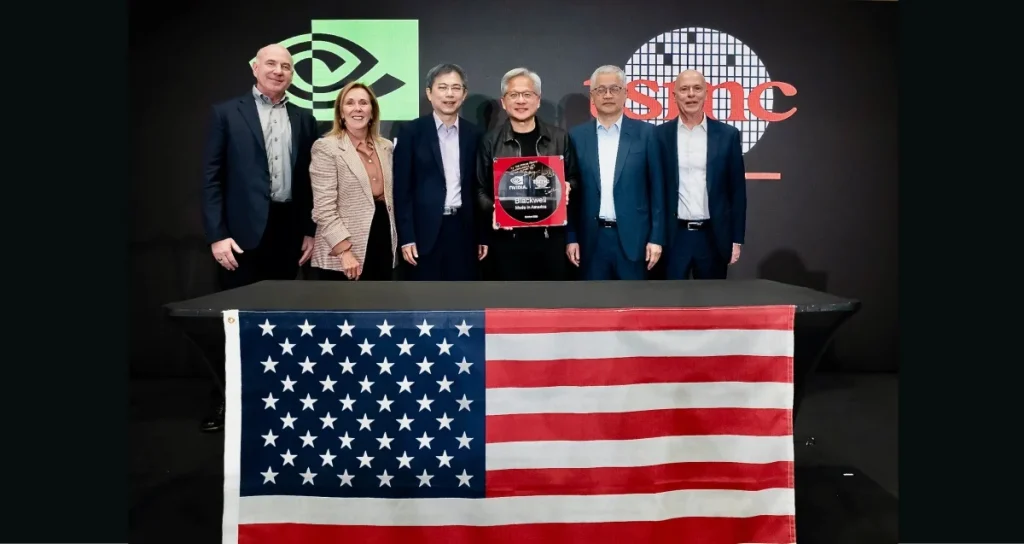
NVIDIA recently announced a milestone of profound symbolic significance, as CEO Jensen Huang personally unveiled the first Blackwell wafer manufactured on U.S. soil during a celebratory event. This wafer forms the very foundation of NVIDIA’s next-generation AI chip, produced at TSMC’s state-of-the-art semiconductor facility (Fab 21) located in Phoenix, Arizona.
This moment not only signifies that the Blackwell architecture is ready to enter volume production within the United States, but also marks a crucial stride in NVIDIA’s effort to bolster America’s domestic chip manufacturing capabilities and ensure the resilience of critical supply chains.
During the event, Huang underscored the historical importance of this collaboration, declaring: “This is a historic moment for several reasons. It’s the very first time in recent American history that the single most important chip is being manufactured here in the United States by the most advanced fab, by TSMC, here in the United States.”
His words highlighted the pivotal role of the Blackwell platform in the ongoing AI revolution. Since its debut in 2024, NVIDIA has emphasized that Blackwell will drive transformative change across the AI industry. Nearly every major tech titan—including Amazon (AWS), Google, Meta, Microsoft, and OpenAI—has committed to adopting this next-generation architecture for their large-scale language model training and inference infrastructures.
According to NVIDIA’s earlier data, the Blackwell platform delivers up to 25-fold cost and energy efficiency improvements compared to the preceding Hopper architecture (e.g., H100) for specific AI workloads. Ensuring an uninterrupted supply of this “strategic” chip has thus become NVIDIA’s foremost priority.
The TSMC Arizona facility, responsible for producing Blackwell wafers, represents a cornerstone of TSMC’s strategy under the U.S. CHIPS Act, aimed at diversifying global manufacturing and mitigating geopolitical risk. Despite encountering construction delays and cost challenges, the successful output of NVIDIA’s next-generation wafer serves as a powerful testament to TSMC’s operational maturity and production capability.
Currently, Fab 21 in Arizona primarily employs 4nm (N4/N4P) process technology, while NVIDIA’s Blackwell GPUs—such as the B100 and B200—utilize a customized 4NP process, aligning perfectly with the plant’s technical roadmap. The fact that NVIDIA, one of TSMC’s most significant clients, chose to premiere its wafer production there underscores the depth of their partnership in advanced process technologies.
NVIDIA stated that the strategic intent behind this collaboration is to strengthen its domestic manufacturing capabilities. With Blackwell wafers now being produced in TSMC’s Arizona fab, NVIDIA noted that it will be “better positioned to insulate itself from shifting tariffs and escalating geopolitical tensions.”
In recent years, the intensifying U.S.–China tech war and trade frictions have drawn attention to the risks of semiconductor supply chains concentrated in Asia—especially Taiwan. For NVIDIA, its high-end AI chips are not merely commercial products but strategic assets, tightly regulated by the U.S. government with strict export controls to certain nations.
Thus, establishing a U.S.-based production line for cutting-edge AI chips provides NVIDIA with a critical safeguard—both in fulfilling government requirements for domestic manufacturing and in mitigating potential supply chain disruptions in the future.
As the Blackwell architecture officially enters mass production, NVIDIA’s focus extends beyond merely meeting the surging global demand for AI chips—it also aims to expand its manufacturing footprint across the United States.
Earlier this year, NVIDIA disclosed plans to invest up to $500 billion in building a comprehensive AI infrastructure ecosystem within the U.S. This monumental initiative will not be achieved in isolation but through close collaboration with partners such as TSMC, Foxconn, and other key suppliers.
From upstream wafer fabrication (TSMC) to midstream chip packaging (CoWoS) and downstream server assembly (Foxconn), NVIDIA is clearly orchestrating a strategy to replicate and localize critical segments of the AI supply chain within America—creating a more resilient and self-sustaining industrial ecosystem.
The unveiling of the Blackwell wafer in Arizona marks a defining move in NVIDIA’s grand strategic blueprint, symbolizing the dawn of a new era for U.S.-based semiconductor manufacturing.
Related Posts:
- Intel Prepares Massive Layoffs: Up to 20% of Foundry Division Workforce Cut Starting July 2025
- NVIDIA Q1 Revenue Soars to $44.1 Billion Amid AI Boom, Blackwell Adoption
- India’s Chip Ambition: First “Made in India” Semiconductor & 6 New Fabs by 2025
- Arizona Woman Jailed 8.5 Years for Running $17M “Laptop Farm” Enabling North Korean IT Spies
- LockBit Strikes: TSMC Faces $70M Ransomware Threat
Support Our Threat Intelligence
Find our tech and OS security coverage helpful? Support our work today and unlock a 100% ad-free reading experience!
 Buy Me a Coffee
