Skip to content
October 13, 2026
  • Bluesky
  • Facebook
  • Linkedin
  • Mastodon
  • RSS
  • Twitter
  • Youtube

Daily CyberSecurity

Zero-hour alerts. Unmatched analysis.

Primary Menu
  • Home
  • CVE Data
    • CVE Watchtower
    • Top Exploited CVEs
    • CVE Stats by Vendor
    • Q2 2026 Report
    • CVE Alerts
    • CVE Alert Settings
    • Pricing
  • Cyber Criminals
  • Data Leak
  • Free Tools
    • CVSS 3.1 Calculator
    • Certificate Viewer
    • DNS Lookup
    • Encoder & Hash Generator
    • IP / Subnet Calculator
    • Whois Lookup
  • Linux
  • Malware
  • Vulnerability
  • Submit Press Release
  • Weekly Recap
Light/Dark Button
  • Home
  • News
  • Malware
  • Nvidia’s leaked code-signing certificate is used by hackers to sign malware
  • Malware

Nvidia’s leaked code-signing certificate is used by hackers to sign malware

Do Son March 7, 2022 3 minutes read
Nvidia certificate malware
Add Daily CyberSecurity as a preferred source on Google

The South American hacker group is currently gradually releasing the confidential data stolen from NVIDIA, and the latest leak is the code signing certificate used by NVIDIA. The code signing certificate is used to sign the software to prevent it from being tampered with. If the software is tampered with, the signature will automatically become invalid and the verification cannot be continued. All kinds of software and drivers released by NVIDIA have dedicated digital signatures, which can be verified by Microsoft and provide security protection.

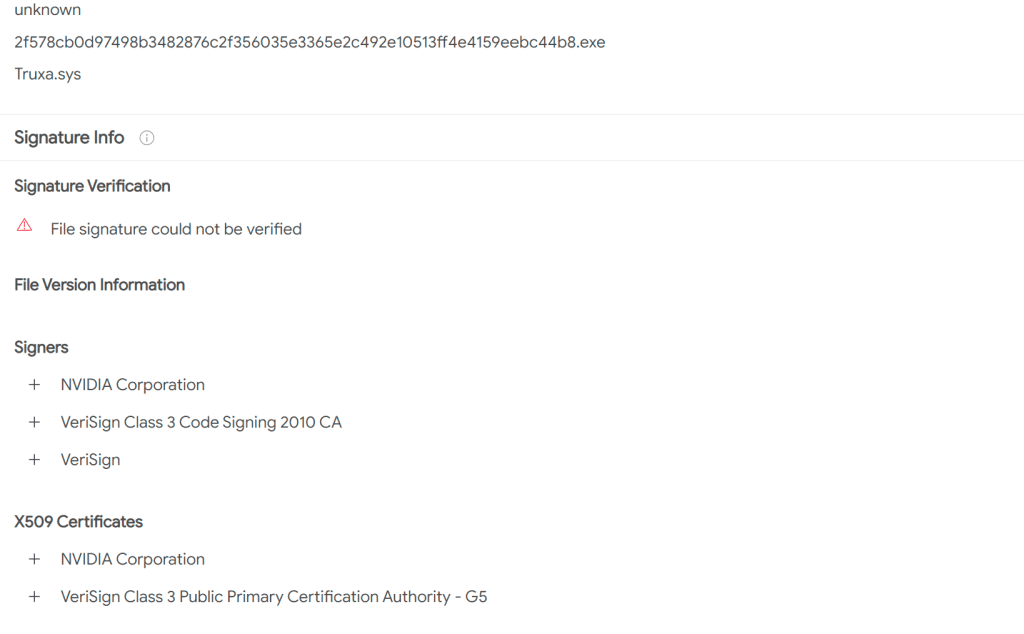
It has to be said that these hackers exploited various vulnerabilities very quickly. Only a few days after the code signing certificate was leaked, hackers began to use the certificate to sign malware. Of course, hackers are not using normal software to sign, and security researchers have found multiple pieces of malware that carry Nvidia’s code-signing certificate.

The classification statistics found that the software currently signed with NVIDIA’s code signing certificate includes malware, backdoors, remote access Trojans, and other types. Microsoft Defender won’t pop up a warning when users open the malware, and the UAC popup will display Nvidia’s company name. Therefore, it can be expected that a large number of malicious software will use NVIDIA signatures and pretend to be various crack software or activation tools to induce users to download and install.
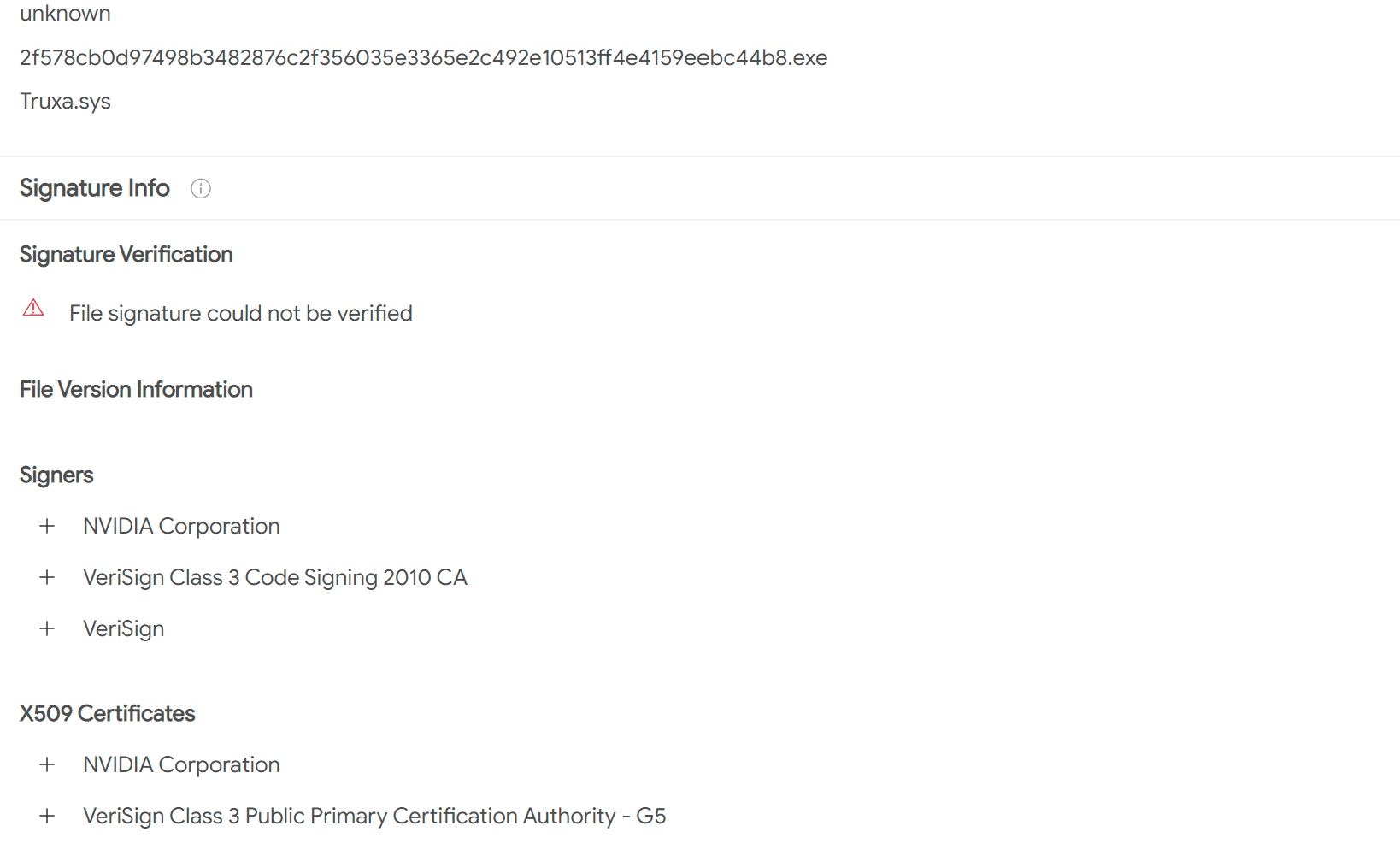
Image: virustotal

Because it is a valid signature, it is very confusing, which may cause serious harm, and both Microsoft and NVIDIA are currently actively dealing with it.

It should be emphasized that although Microsoft Defender does not currently pop up a warning, it will kill the identified malware directly. There is a simpler and more convenient way to directly revoke the NVIDIA certificate. As long as it is revoked, these malwares will be directly blocked when the users try to open them. But for now, Microsoft can’t add Nvidia certificates to the revocation list, because once added, a lot of Nvidia’s existing software will be affected. So at present, we can only wait for NVIDIA to quickly deploy the new certificate and replace various software packages, and then apply for revocation of the digital signature after the replacement is completed.

At present, this problem is more difficult for Microsoft to deal with, mainly relying on Microsoft antivirus software to automatically identify and block signed malware. But Microsoft also provides a way for enterprise administrators to use application control policies to restrict enterprise users to downloading and installing only specific Nvidia drivers. However, this operation is more troublesome for individual users. Individual users can only maintain the status quo and do not download software of unknown origin. In addition, users must install and enable security software.

Related coverage

  • Your car spies on you: a malware against your privacy
  • Qwizzserial: Telegram-Driven Android SMS Stealer Infects 100,000 Devices
  • Information-Stealing ViperSoftX Malware Targets Cryptocurrencies and Password Managers Across the Globe
  • Cybersecurity Alert: Python Libraries Exploited for Malicious Intent
  • ComfyUI Under Attack: “Pickai” C++ Backdoor Compromises 700+ AI Image Generation Servers Globally
  • Ragnar Locker Ransomware: Key Developer Behind Bars in Major Raid
Track all actively exploited CVEs →

Support Our Threat Intelligence

Find our threat intelligence and malware analysis helpful? Support our work today and unlock a 100% ad-free reading experience!

Buy Me a Coffee Logo Buy Me a Coffee
Select your plan
Free Pro Team

Hover over a plan to see its benefits.

Get Zero-Hour Vulnerability Alerts

Critical CVEs, CVSS scores, and PoC updates — straight to your inbox every week.

We respect your inbox. Unsubscribe anytime.

SHARE
Share on FacebookShare on XShare on LinkedInShare on TelegramShare on BlueskyShare on Mastodon
Written by
@DdoS Β· Security Researcher

Do Son

Do Son is the Founder and Editor of SecurityOnline.info. Working in cybersecurity since 2013, he reports on vulnerabilities, malware, and emerging threats, providing timely analysis to help organizations and individuals stay ahead of evolving risks.

Tags: malware nvidia Nvidia certificate malware

Search

Translation

CVE ALERTS
πŸ“ˆ

EPSS Spike Alerts
Catch risk spikes before they make headlines.

🎯

Custom EPSS/CVSS
Set score thresholds to effectively filter noise.

πŸ›‘οΈ

Exploit Intel
Real-world exploit signals beyond the KEV catalog.

πŸ™

GitHub Issues
Auto-create alert tickets without duplication.

πŸ“¬

Weekly Digest
Clean summaries, eliminating email spam.

🏷️

Watchlist Groups
Tag vulnerabilities by team (Infra/AppSec/SOC).

πŸ”€

Smart Routing
Route chat channels based on severity levels.

🚨

RBP Tracker
Early warning detection and tracking system.

Subscribe – $7/mo or try free for 14 days β†’

🚨 Active Exploits in the Wild

  • CVE-2026-102255CVSS 10.0
    A Pre-authentication SSRF vulnerability exists in the SMA1000 Appliance Work Place interface due to an unintended alternate access...
    Admin intel📅 Updated: Oct 9, 2026
  • CVE-2026-105133CVSS 6.9
    A vulnerability was detected in Ahsay AhsayCBS up to 10.3.2. This affects the function checkSysPwd of the file...
    Admin intel📅 Updated: Oct 9, 2026
  • CVE-2023-22894CVSS 4.9
    Strapi through 4.5.5 allows attackers (with access to the admin panel) to discover sensitive user details by exploiting...
    CISA KEV📅 Added to KEV: Oct 8, 2026
  • CVE-2016-3081CVSS 8.1
    Apache Struts 2.3.19 to 2.3.20.2, 2.3.21 to 2.3.24.1, and 2.3.25 to 2.3.28, when Dynamic Method Invocation is enabled,...
    CISA KEV📅 Added to KEV: Oct 8, 2026
  • CVE-2015-3306CVSS 10.0
    The mod_copy module in ProFTPD 1.3.5 allows remote attackers to read and write to arbitrary files via the...
    CISA KEV📅 Added to KEV: Oct 8, 2026
  • CVE-2015-5477CVSS 7.5
    named in ISC BIND 9.x before 9.9.7-P2 and 9.10.x before 9.10.2-P3 allows remote attackers to cause a denial...
    CISA KEV📅 Added to KEV: Oct 8, 2026
  • CVE-2021-3199CVSS 9.8
    Directory traversal with remote code execution can occur in /upload in ONLYOFFICE Document Server before 5.6.3, when JWT...
    CISA KEV📅 Added to KEV: Oct 8, 2026
  • CVE-2026-94504CVSS 7.2
    Ninja Forms 3.15.3 stores an anonymous non-RTE textarea value and renders it without safe HTML encoding in the...
    Admin intel📅 Updated: Oct 7, 2026
Powered by CVE Watchtower

Critical Vulnerabilities

  • CVE-2026-108598CVSS 9.3
    Floci 1.1.0 before 2.2.0 contains a code injection vulnerability in VtlTemplateEngine that allows unauthenticated attackers to execute commands...
    📅 Updated: Oct 13, 2026
  • CVE-2026-108549CVSS 9.2
    cc-connect through 1.5.0 contains a missing authentication vulnerability in the MAX platform adapter webhook mode in platform/max/max.go that...
    📅 Updated: Oct 13, 2026
  • CVE-2026-108268CVSS 9.1
    Enclave OS Virtual runs container workloads inside confidential virtual machines with end-to-end attestation. Prior to tdx-v0.2.43 and tdx-gpu-v0.6.27,...
    📅 Updated: Oct 13, 2026
  • CVE-2026-108265CVSS 9.1
    Enclave OS Mini is a Rust-based runtime for confidential applications inside Intel SGX enclaves. Prior to wasm-v0.40.0, the...
    📅 Updated: Oct 13, 2026
  • CVE-2025-50398CVSS 9.8
    Mercury D196G d196gv1-cn-up_2020-01-09_11.21.44 is vulnerable to Buffer Overflow in the function sub_404CAEDC via the parameter fac_password.
    📅 Updated: Oct 13, 2026
  • CVE-2025-50401CVSS 9.8
    Mercury D196G d196gv1-cn-up_2020-01-09_11.21.44 is vulnerable to Buffer Overflow in the function sub_404CAEDC via the parameter password.
    📅 Updated: Oct 13, 2026
  • CVE-2025-62863CVSS 9.8
    Ampere AmpereOne AC03 devices before 3.5.9.3, AmpereOne AC04 devices before 4.4.5.2, and AmpereOne M devices before 5.4.5.1 allow...
    📅 Updated: Oct 13, 2026
  • CVE-2025-62864CVSS 9.8
    Ampere AmpereOne AC03 devices before 3.5.9.3, AmpereOne AC04 devices before 4.4.5.2, and AmpereOne M devices before 5.4.5.1 allow...
    📅 Updated: Oct 13, 2026
Powered by CVE Watchtower

Daily CyberSecurity

  • About SecurityOnline.info
  • Advertise with us
  • Announcement
  • Contact
  • Contributor Register
  • Login
  • Disclaimer
  • DCMA
  • Privacy Policy
  • About SecurityOnline.info
  • Advertise on SecurityOnline.info
  • Contact Us

When you purchase through links on our site, we may earn an affiliate commission. Here’s how it works

  • CVE Watchtower
  • CVE Statistics by Vendor 2026
  • Q3 2026 Report
  • Top Exploited CVEs
  • Bluesky
  • Facebook
  • Linkedin
  • Mastodon
  • RSS
  • Twitter
  • Youtube
Β© 2017 - 2026 Daily CyberSecurity. All Rights Reserved.