
 Do Son
Seagate has unveiled its next-generation edge-enterprise storage solutions — the Seagate Exos 4U100 and 4U74 JBOD systems...
Latest news

In August, Google announced that beginning next year, it would introduce sideloading verification in select regions —...

Palo Alto Networks has issued a security advisory for a newly discovered denial-of-service (DoS) vulnerability affecting several...

GitLab has released a new round of security updates for both Community Edition (CE) and Enterprise Edition...

Dell has issued a security advisory warning customers of a critical severity vulnerability affecting Dell Data Lakehouse...

 cybernewswire
Singapore, Singapore, 13th November 2025, CyberNewsWire

Google has announced the launch of a new cloud-based architecture called Private AI Compute, designed to enable...

Elastic has issued two security advisories addressing two vulnerabilities in Kibana, the visualization and analytics dashboard component...

A newly disclosed vulnerability in Wolfram Cloud version 14.2 — tracked as CVE-2025-11919 — could allow attackers...

Researchers from the AhnLab Security Intelligence Center (ASEC) have discovered a new malware campaign that abuses a...

UNC1151 employed DLL loaders that downloaded an encrypted JPG file, which was then decrypted to deploy a final payload executable.
Successful exploitation of the CVE-2024-4332 vulnerability could lead to unauthorized information disclosure or modification

Security researcher Zeyad Azima has recently published a proof-of-concept exploit code for the CVE-2024-27348 vulnerability

Tenable Research has uncovered a significant vulnerability within Microsoft Azure's Service Tags functionality

Due to the critical severity of vulnerabilities CVE-2024-29972, CVE-2024-29973, and CVE-2024-29974, Zyxel has made patches available

A security researcher has published details and proof-of-concept (PoC) code for a macOS CVE-2024-27822 vulnerability

CVE-2024-21512 stems from a Prototype Pollution vulnerability that could be exploited for remote code execution.
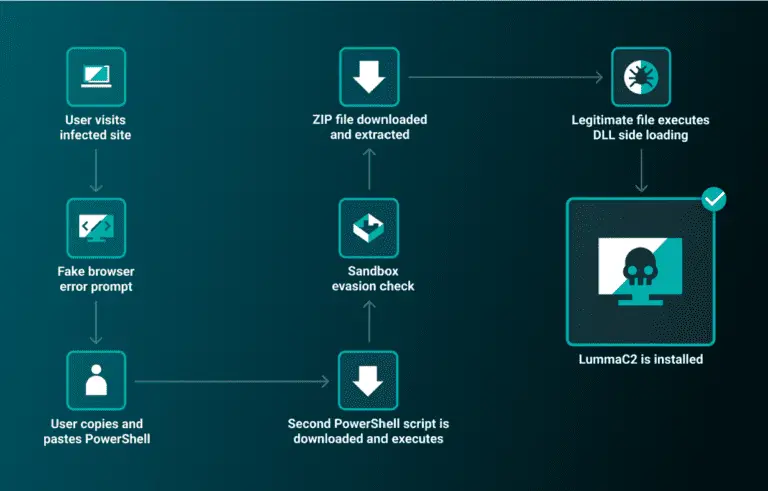
The ReliaQuest Threat Research Team has unveiled a new execution technique used in the ongoing ClearFake campaign

Tracked as CVE-2024-3584, this flaw carries a near-perfect CVSS score of 9.8, underscoring the potential for severe exploitation.

This multi-stage malware strategy ultimately delivers the notorious "Cobalt Strike" payload, establishing communication with a C2 server

The identified flaw, cataloged as CVE-2024-5404 with a CVSS score of 9.8, affects the "Forgot Password" function of the Moneo IIoT platform

WordPress, the world's most popular CMS, is facing a wave of targeted attacks exploiting critical vulnerabilities in several plugins

CVE-2024-36104 could allow remote attackers to execute arbitrary code on affected systems, potentially leading to full system compromise

A significant security vulnerability has been uncovered in the widely-used node-ip npm package, which is designed to...

Censys observed 13,802 internet hosts exposing either a CloudGuard instance, Quantum Security, or Quantum Spark gateway

Hugging Face, a leading provider of open-source machine learning and AI tools, disclosed a security breach affecting its Spaces platform

CVE-2024-3820, rated with a maximum severity score of 10 (CVSS 10), could allow attackers to inject malicious SQL code

BlueDelta even managed to bypass two-factor authentication and CAPTCHA challenges by leveraging compromised Ubiquiti routers

CVE-2024-32850 with a CVSS score of 9.8 (Critical), allows attackers to execute commands remotely or gain unauthorized administrative access.

Designated as CVE-2024-35204, this vulnerability has been assigned a CVSS score of 8.4, indicating its high severity

Krasimir Konov, malware analyst at Sucuri, exposes how hackers are leveraging Telegram's unique features to execute sophisticated website attacks

A new banking Trojan named "CarnavalHeist" is targeting Brazilian users, exploiting the country's festive spirit to steal financial data