CVE-2025-11919: Wolfram Cloud Vulnerability Exposes Users to Privilege Escalation and Remote Code Execution
 Do Son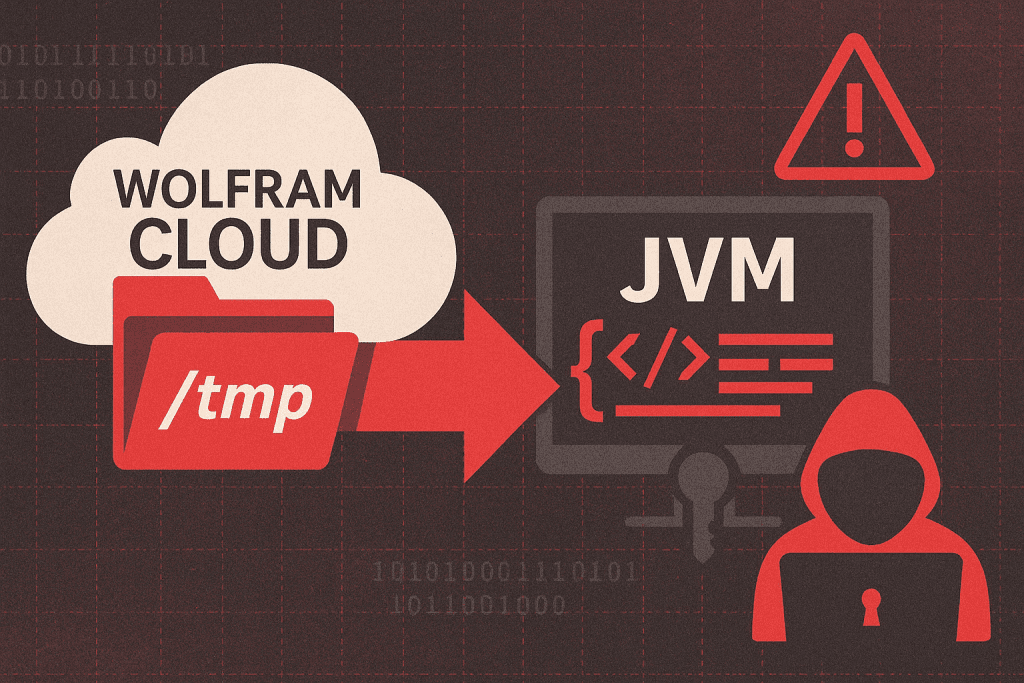
A newly disclosed vulnerability in Wolfram Cloud version 14.2 — tracked as CVE-2025-11919 — could allow attackers to achieve privilege escalation, information exfiltration, and remote code execution (RCE) within multi-tenant cloud environments.
According to the CERT Coordination Center (CERT/CC), the flaw arises from improper handling of temporary directories within the platform’s Java Virtual Machine (JVM), exposing users to potential compromise from other tenants sharing the same cloud instance.
“Wolfram Cloud version 14.2 allows Java Virtual Machine (JVM) unrestricted access to temporary resources in the /tmp/ directory of the cloud environment which may result in privilege escalation, information exfiltration, and remote code execution,” CERT/CC stated in its advisory.
Wolfram Cloud — widely used for notebook-based computation, data science, and application publishing — operates as a multi-tenant cloud platform, meaning multiple users share resources within the same instance.
Within this architecture, temporary files are stored under a shared /tmp/ directory with access permissions applied to isolate users. However, CERT/CC notes that the JVM initialization process introduces a dangerous flaw:
“A newly discovered race condition allows attackers to poison the classpath via the shared /tmp/ directory during JVM initialization,” the report explained.
By exploiting this race condition, an attacker can inject malicious code into the JVM’s classpath at just the right time — before another user’s session completes initialization. If successful, this allows the attacker to execute arbitrary code with the privileges of the victim’s process.
The issue is particularly severe in multi-tenant environments because the temporary directories of other users may be accessible, depending on the timing of access attempts and the host’s file permission enforcement.
CERT/CC attributes the vulnerability to how the hosting platform manages virtual environment access to temporary files.
“The cause is the implementation of the virtual environment by the hosting platform which manages access to temporary files in a multi-tenant cloud environment,” the note stated.
Although most /tmp/ directories do not contain sensitive data, certain files — including JVM initialization components — may be left unprotected, providing a vector for attackers to manipulate execution behavior.
This weakness could enable attackers to poison initialization files or inject unauthorized code, thereby obtaining access to resources belonging to other tenants.
CERT/CC assessed the flaw’s severity under the Stakeholder-Specific Vulnerability Categorization (SSVC) framework as “Technical Impact = Total.” This classification represents the most severe outcome possible.
“The vulnerability gives the adversary total control over the behavior of the software or total disclosure of all information on the affected system,” CERT/CC explained.
CERT/CC credited Peter Roberge of Pointer Cybersecurity for discovering and reporting the flaw responsibly.
To address the issue, CERT/CC recommends that all users update to Wolfram Cloud version 14.2.1, which includes improved handling of temporary directories and enhanced isolation for JVM instances.
Related Posts:
- Critical Flaws Found in Partner Software: Default Admin Passwords & XSS Allow RCE on Government Systems
- Discord’s Decisive Shift: Temporary File Links to Thwart Malware Spread
- Is Your iOS 26 Battery Draining? Here’s Why
- Microsoft Warns of High CPU Usage in Classic Outlook
Support Our Threat Intelligence
Find our vulnerability reports and weekly recaps helpful? Support our work today and unlock a 100% ad-free reading experience!
 Buy Me a Coffee
