Privacy Alert: Meta to Use User-AI Conversations to Target Ads Across Facebook and Instagram
 Do Son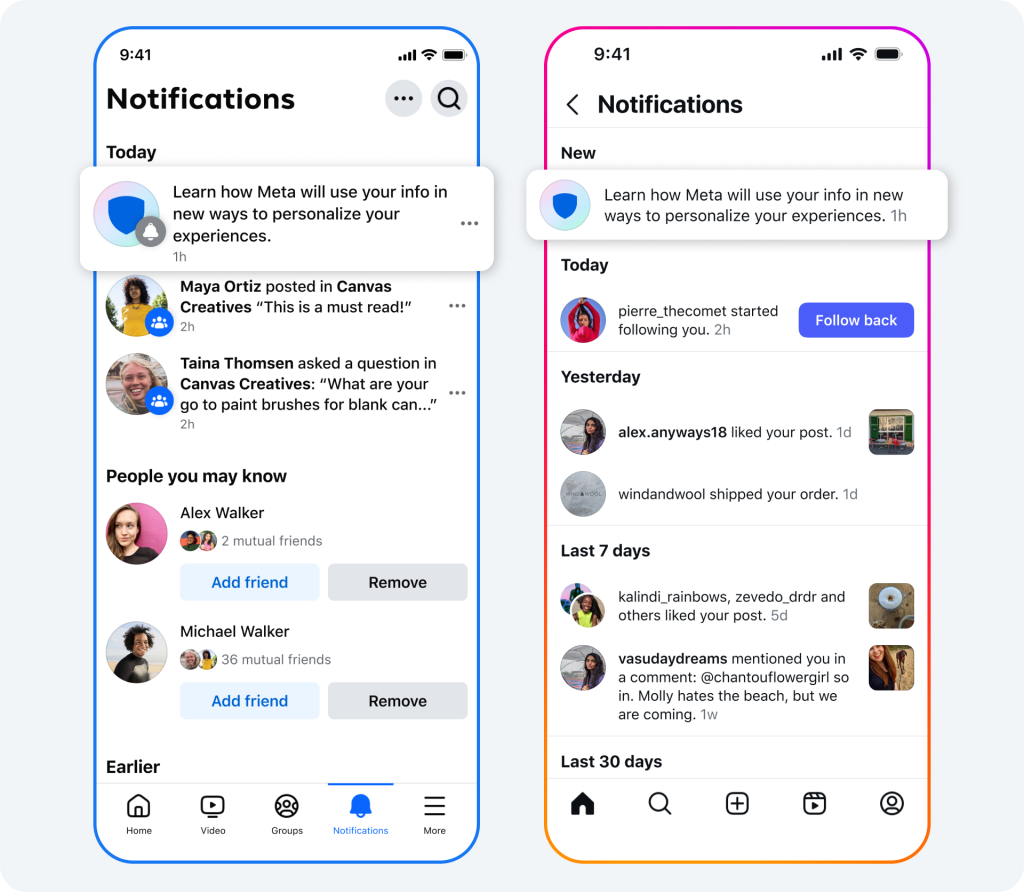
As AI chatbots continue their steady rise in popularity, Meta has announced that it will begin collecting user–AI conversation data to refine its advertising and content recommendation systems. The policy will take effect on December 16, 2025, with users being notified via in-app alerts and email beginning October 7.
According to Meta, future interactions between users and its AI chatbots will be incorporated into its advertising algorithms as a source of input data, enabling more “personalized” content and advertising across Facebook and Instagram. For instance, if a user discusses hiking with the AI, they may soon see hiking group suggestions, friends’ trekking posts, or advertisements for boots and gear appear in their feed.
Meta’s Privacy Policy Manager, Christy Harris, told Reuters: “People’s interactions with AI will become one of the data sources further shaping personalization of both content and advertising.”
This form of behavior-driven targeted advertising is not unprecedented — browsing histories, shopping activity, and social interactions have long formed the backbone of precision ad targeting. However, one-to-one conversations have traditionally been regarded as a more private sphere. By incorporating AI dialogue into its data streams, Meta once again pushes the boundary between privacy and commercial interests.
The Wall Street Journal reports that the new policy offers no “opt-out” option. In other words, anyone using Meta’s AI chat services will have their conversations automatically included in advertising datasets.
Meta stresses that the AI will not collect content related to “religious beliefs, sexual orientation, political affiliation, health conditions, race or ethnicity, philosophical beliefs, or trade union membership.” Still, experts broadly advise users to avoid discussing sensitive information with the AI.
The rollout will cover most regions globally, though the European Union and South Korea are excluded at launch — likely due to the strict data protection regimes of GDPR and South Korea’s personal information laws.
Industry analysts view this move as evidence that AI conversations are no longer merely tools of interaction, but are becoming a vital next-generation data source. It signals a shift in which the “context of AI usage” is being actively converted into commercial value, and may soon form the cornerstone of precision advertising.
As many commentators have observed, AI chatbots may present themselves as friendly assistants, but they remain deeply embedded in the machinery of data collection and monetization. Meta’s policy serves as a reminder that every exchange with AI may leave a trace — one that can ultimately be leveraged as part of the company’s advertising revenue.
For users hoping AI would evolve into a private “personal assistant,” this shift may come as a disappointment. For Meta, however, it is likely a necessary step — a way to extend its advertising-driven business model and carve out new growth amid intensifying competition in the AI arena.
Related Posts:
- ChatGPT Exposed: OpenAI’s Sharing Feature Leaks Private Conversations to Google Search
- Privacy Fail: Grok Chatbot Exposes 370,000 Private Conversations
- OpenAI Is Now Scanning Conversations and Reporting Harmful Content to Police
- Google Unleashes “Search Live”: Converse with AI in Real-Time for Mobile Search
- 100,000 ChatGPT Chats Exposed: Why a New Feature Backfired on OpenAI
Support Our Threat Intelligence
Find our tech and OS security coverage helpful? Support our work today and unlock a 100% ad-free reading experience!
 Buy Me a Coffee
