Red Sea Crisis Halts Major Fiber Projects: Meta’s 2Africa & Google’s Blue-Raman Delayed
 Do Son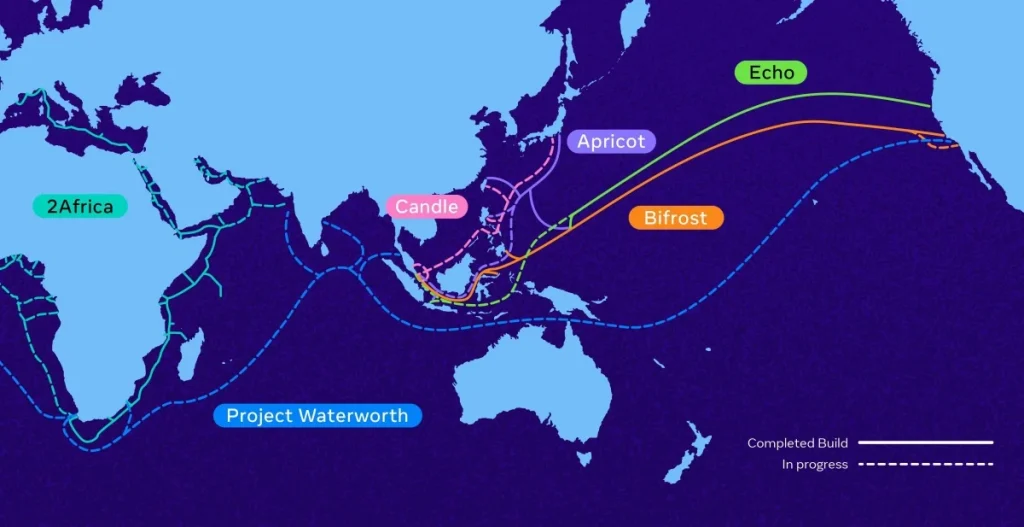
According to a recent report from Bloomberg, two long-planned, high-priority subsea cable projects backed by Meta and Google are facing delays as a result of escalating tensions in the Red Sea region. A Meta spokesperson attributed the setbacks to “a combination of operational challenges, regulatory hurdles, and geopolitical risk.”
The core of the problem lies in the southern Red Sea, where construction teams have reportedly encountered repeated missile attacks launched by Houthi militants — a group widely believed to be supported by Iran — forcing crews to halt work or reroute planned segments.
Meta’s 2Africa cable system, announced in 2020, is an immense 28,000-mile (roughly 45,000-kilometer) project designed to encircle the African continent, expand fiber-optic connectivity across the region, and link Africa with Europe and Asia. Yet ongoing conflict in the southern Red Sea, along with difficulties obtaining essential permits from local authorities, has left an entire section of the cable still unfinished.
Google’s Blue-Raman intercontinental cable system is facing similar obstacles. Announced in 2021 and originally slated to go live in 2024, the system was intended to connect France, Italy, India, Israel, Jordan, Saudi Arabia, and Oman. Google has not yet provided an updated deployment timeline.
The interruption affects not only infrastructure development in emerging markets but also the operating costs of the companies behind these massive projects.
Alan Mauldin, research director at Telegeography, explains: “They’re unable to monetize these investments by carrying traffic across the cables, and are instead forced to purchase capacity on alternative routes to meet their near-term bandwidth needs.”
The report notes, however, that the Red Sea crisis is not expected to affect two other major cabling initiatives previously announced by Google and Meta. These include Google’s new Atlantic-side route connecting Togo to Europe, and Meta’s forthcoming global cable system designed to link five continents without traversing the Red Sea.
While subsea cables remain one of the most powerful methods for delivering global fiber connectivity, the latest disruptions underscore the sector’s inherent fragility — easily shaken by geopolitical conflict, natural disasters, severe weather, and even routine human activity such as fishing.
Related Posts:
- Houthi Influence Campaign: Deceptive Tactics on Facebook Target Israel and Gulf States
- Red Sea Cable Cuts Cause Azure Outage and Global Traffic Disruptions
- Nearly 240,000 fiber router exist authentication bypass flaw that can be remotely attacked
Support Our Threat Intelligence
Find our tech and OS security coverage helpful? Support our work today and unlock a 100% ad-free reading experience!
 Buy Me a Coffee
