 Do Son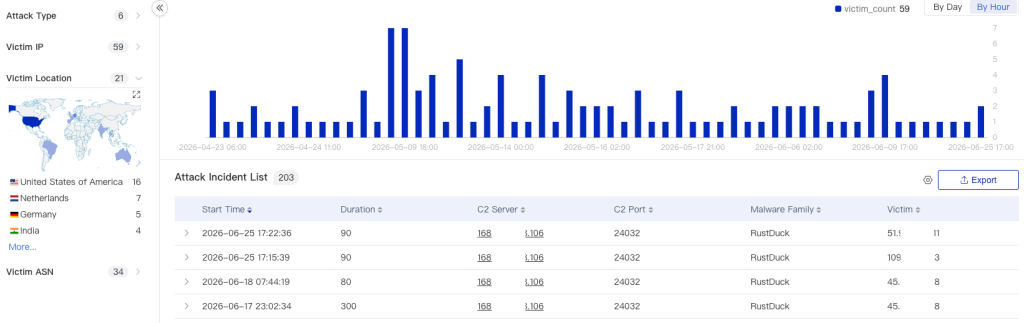
Image: Xlab
At a Glance
| Malware family | RustDuck |
|---|---|
| Threat actor | Unattributed |
| Targets / victims | IoT devices, web apps, and enterprise servers; 59 victim IPs and 203 attack incidents in XLab telemetry |
| Delivery vector | Weak-password brute-forcing (Telnet/SSH) and multiple RCE exploits |
| Key capabilities | Large-scale DDoS, two-stage loading, encrypted C2, strong anti-analysis |
| Source | XLab (QiAnXin) |
TL;DR
Researchers at XLab have detailed a new DDoS botnet named RustDuck. The malware uses a two-stage loader-and-core design and is migrating from C to Rust. Its speed of evolution, not its raw size, is the reason to watch it closely.
Why It Matters
RustDuck stays smaller than mainstream botnets for now. However, XLab warns that “its speed of technological evolution deserves significant attention.” The move to Rust hardens the code and complicates reverse engineering. As a result, defenders face a moving target rather than a fixed one. Cross-platform support lets it hit routers, cameras, and servers alike. That reach turns modest infections into meaningful attack power.
Delivery and Spread
The RustDuck botnet spreads through a mix of weak credentials and code-execution flaws. XLab describes a blend of “weak passwords + IoT vulnerabilities + Web RCE.” Attackers brute-force Telnet and SSH logins first. Then they exploit devices from vendors such as TP-Link, Ruijie, and ZTE.
The operators also target Android ADB, ThinkPHP, Jenkins, and YARN. In addition, they reuse several older CVEs to widen the attack surface. XLab observed more than 20 IP addresses spreading the malware. One implant source stood out as the most active node.
Infection Chain
The loader hides its payload inside a normal-looking ELF file. Loading code sits at the front. Compressed core data and a config block ride along as overlay at the tail. On launch, the loader decrypts and decompresses that core, then runs the second stage.
XLab clustered the loader into four evolutionary variants. Each step swaps the encryption or compression scheme. Early builds used simple XOR routines, while the newest reaches for the ChaCha20 stream cipher. This churn shows a developer tuning the malware in near real time. Dynamic constants in some builds also block easy static decryption. So batch analysis across samples stays hard for researchers.
Command-and-Control Behaviour
The Rust core raises the bar on communication security. It derives session keys with HKDF-SHA256 and refreshes a time-based key every ten minutes. That rotation counters replay attacks and long-term traffic auditing.
A Noise-style handshake then authenticates each bot before commands flow. Afterward, the channel switches to AES-GCM with separate uplink and downlink keys. The command set covers DDoS attacks, hot updates, status checks, and dynamic C2 switching. All of this defeats simple plaintext traffic decryption on the network side.
Anti-Analysis Tricks
RustDuck scores its environment before it runs. It hunts for tools such as Wireshark, gdb, and frida. It also checks TracerPid, VM MAC prefixes, and honeypot config files. When the risk score passes a set threshold, the malware wipes traces and exits.
Detection and Defense
Strong, unique credentials block the primary entry path. Beyond that, teams should patch the exploited IoT and web components without delay. Network monitoring should flag repeated Telnet and SSH brute-force attempts. Sandbox teams should note the malware’s habit of exiting when it senses analysis tools. No public attribution to a known actor exists yet, so the RustDuck botnet remains an unnamed but active operation.
Support Our Threat Intelligence
Find our threat intelligence and malware analysis helpful? Support our work today and unlock a 100% ad-free reading experience!
 Buy Me a Coffee
