 Do Son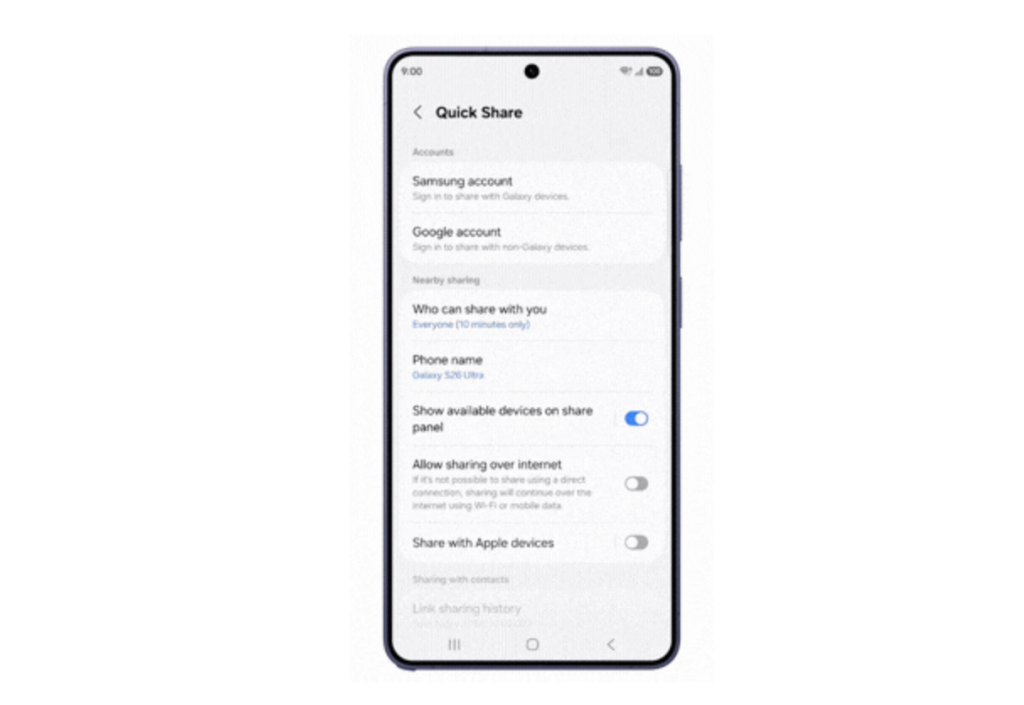
Samsung has recently affirmed that, commencing this week, it shall systematically dispatch an update to its flagship Galaxy S26 vanguard, formally endowing the native “Quick Share” architecture with seamless compatibility with Apple’s AirDrop protocol. Mirroring the capabilities of Google’s Pixel 9 and Pixel 10 lineages, this integration shatters the historic file-sharing bastion that has long segregated the iOS and Android dominions. Consequently, Galaxy denizens shall be empowered to effortlessly and directly exchange high-fidelity imagery and digital archives with proximate iPhone, iPad, or Mac proprietors.
According to official promulgations from Samsung, this transformative update—christened “Share with Apple devices”—shall inaugurate its deployment on the twenty-third of March, debuting first within the South Korean market for patrons of the Galaxy S26, S26+, and S26 Ultra. Subsequently, an expansive array of territories—encompassing the United States, Europe, Hong Kong, Japan, Latin America, Southeast Asia, and Taiwan—is slated to receive this digital fortification “later this week.”
Patrons wielding antecedent Galaxy apparatuses, such as the S25 lineage, need not succumb to dismay; Samsung has solemnly pledged within its decree that this functionality shall eventually proliferate to “a multitude of auxiliary Galaxy devices,” although a definitive chronological roadmap and comprehensive roster of supported hardware remain undisclosed at this present juncture. It is profoundly noteworthy that, in a subtle divergence from the methodology employed by the antecedent Pixel apparatuses, Samsung has elected against inaugurating this cross-platform AirDrop capability as a default configuration.
Upon the receipt of this systemic rejuvenation, Galaxy S26 proprietors are compelled to manually navigate the labyrinth of settings—specifically, “Settings > Connected devices > Quick Share”—to actively ignite the nascent “Share with Apple devices” provision. Concurrently, Samsung imparts a crucial admonition: to guarantee a frictionless transmission, Galaxy patrons must entreat the receiving iPhone proprietor to momentarily recalibrate their AirDrop reception privileges to encompass “Everyone.” Conversely, should a digital artifact be dispatched from an Apple construct to a Samsung apparatus, the Galaxy terminal must be vigilant in ensuring its Quick Share architecture is attuned to a receptive state. The paramount catalyst propelling this functionality is, in truth, Google’s overarching strategic grand design, dedicated to forging a profound, foundational symbiosis betwixt the Android and iOS ecosystems.
Following the triumphant proclamation last year that its sovereign Quick Share architecture had achieved compatibility with Apple’s AirDrop protocol, Google initially integrated this marvel into its proprietary Pixel 10 and Pixel 9 lineages; recently, Samsung formally heralded its own intent to adopt this capability. Furthermore, a constellation of Chinese smartphone purveyors—encompassing Xiaomi, OPPO, and vivo—have likewise affirmed their impending support. This collective mobilization promises to render the future dissemination of mobile photography profoundly more effortless, entirely obviating the tedious necessity of antecedent brand verification betwixt users; fundamentally, the AirDrop protocol shall serve as the universal conduit for reciprocity.
Whilst the collaboration with Samsung regarding this technology is not bound by exclusivity, it brilliantly leverages Samsung’s colossal hegemony within the global smartphone bazaar to attract a vastly broader constituency of users. It is widely anticipated that the ensuing proliferation of this functionality across numerous Chinese brands will fundamentally eradicate the historic tribulations that once plagued the direct, frictionless exchange of digital archives and visual memories betwixt Android apparatuses and Apple creations.
Support Our Threat Intelligence
Find our tech and OS security coverage helpful? Support our work today and unlock a 100% ad-free reading experience!
 Buy Me a Coffee
