 Do Son
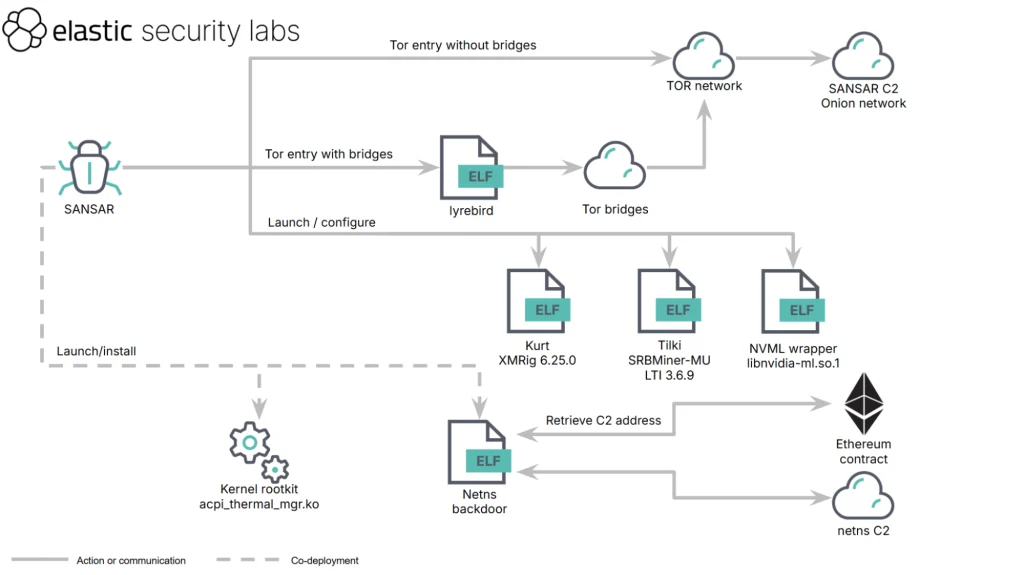
Execution flow of SANSAR diagram | Image: Elastic Security Labs
TL;DR
Elastic Security Labs uncovered an intrusion cluster tracked as REF3364 that deploys SANSAR Linux malware across GPU servers used for artificial intelligence workloads. After breaching an unauthenticated Ray job agent, the attacker installed a Rust orchestrator, a kernel rootkit, a GPU telemetry spoofing library, and an Ethereum-backed backdoor across three Linux hosts. Furthermore, this REF3364 SANSAR Linux malware toolkit hides its CPU and GPU miners by reporting zero percent graphics utilization to system administrators.
Delivery and Attribution
Between October 22 and October 25, 2026, an attacker targeted a Linux server running Ray, an open-source framework widely used to distribute Python and AI model training jobs across GPU clusters. Although the Ray head node dashboard listened only on the local loopback address, the Ray job agent remained exposed to the internet without authentication. As the Elastic Security Labs report explains, “The job agent remained reachable from the internet and accepted job submissions without authentication. The attacker used this interface to execute commands through Ray.”
External probes hit the Ray logs on October 22, followed on October 24 by a job that ran nvidia-smi and sent the server’s GPU inventory to an external host. On October 25, the intruder submitted a Python reverse-shell job, appended an SSH public key to the local account’s authorized_keys file, and escalated to root to deploy the toolkit across three Linux GPU machines.
Confirmed Versus Suspected Attribution
Confirmed attribution tracks this specific intrusion set under the Elastic reference identifier REF3364, which infected three confirmed Linux GPU hosts. While confirmed attribution does not link REF3364 to a previously named group, suspected attribution points to a Turkish-speaking developer or operator. Specifically, the toolkit stages files inside a folder named /opt/vadi_ and names its binaries after Turkish words for animals: sansar (marten), kurt (wolf), and tilki (fox). Moreover, the kernel rootkit C source code contains Turkish inline comments such as “Tum gizli isimleri kontrol et” (“Check all hidden names”) and uses the Turkish variable name deneme (“test”) inside its GPU spoofing library.
Infection Chain
Once root access was secured, the operator staged seven components under /opt/vadi_. For CPU mining, the toolkit drops XMRig 6.25.0 under the name kurt. For GPU mining, it deploys the official Linux build of SRBMiner-MULTI 3.6.9 under the name tilki. To blind administrators running nvidia-smi, the installer compiles a modified NVIDIA Management Library wrapper (libnvidia-ml.so.1) from local C source code and replaces the genuine library while saving a hidden backup.
NVML Telemetry Spoofing and Kernel Rootkit
When monitoring tools query the GPU, the wrapper passes the call to the real NVIDIA library but alters the returned structure before handing it back. As the researchers noted, “It forwards queries to the genuine NVIDIA library, then alters selected results: GPU utilization is reported as 0%, while temperature and power are replaced with random readings of 36 to 46 degrees Celsius and 100 to 200 watts.”
To hide the user-space components, the attacker builds a Linux kernel module named acpi_thermal_mgr.ko via Dynamic Kernel Module Support (DKMS) and embeds an initramfs loader so the rootkit survives reboots. Using Linux Function Tracer (ftrace) hooks on system calls like getdents64, openat, and kill, the rootkit hides the kurt and lyrebird processes, conceals matching directories and network sockets, and blocks termination signals unless the caller is the sansar manager process itself.
Command-and-Control and Backdoor Behavior
At the center of the SANSAR Linux malware toolkit sits sansar, a Rust client (version 0.1.3) that checks /proc/self/status for debuggers and runs a 1,000-iteration timing loop before decoding a 62-byte onion address using bitwise rotation and a 32-byte XOR mask. It connects to its Tor controller on port 9051 using the Rust Arti library, operating either directly or through the Lyrebird 0.8.1 pluggable-transport helper using seven WebTunnel and three obfs4 bridges.
During registration, the client queries four public IP lookup services, runs nvidia-smi, and authenticates using a 40-byte timestamp and HMAC-SHA256 digest. Over the binary Tor protocol, SANSAR processes 16 message types that start or update miners, launch history-free interactive Bash pseudo-terminals, and run raw IPv4 TCP SYN stress tasks.
Alongside the Tor client, the operator registers a separate systemd service backdoor named netns. echoing blockchain dead-drop techniques documented in Elastic’s 2026 PHANTOMPULSE research, netns sends JSON-RPC eth_call requests to a hardcoded Ethereum smart contract to retrieve an encoded IPv4 address. It then connects to that controller over plain TCP port 8080 and listens for SHELL commands to spawn outbound Bash reverse shells to operator-chosen hosts.
Defense and Detection Guidance
Organizations operating GPU clusters for AI training and inference must never expose Ray job agent ports or dashboards to the public internet without strict authentication and network access controls. Defenders hunting for the REF3364 SANSAR Linux malware toolkit should check for staging folders like /opt/vadi_, unauthorized DKMS source directories under /usr/src/acpi_thermal_mgr-1.0/, and unexpected initramfs boot entries. Furthermore, administrators should verify the cryptographic integrity of libnvidia-ml.so.1, look for hidden backup files such as /usr/lib/.libnvidia-ml.so.1.backup, and monitor outbound traffic for unauthorized Tor bridge connections or public Ethereum RPC calls originating from GPU compute nodes.
Support Our Threat Intelligence
Find our threat intelligence and malware analysis helpful? Support our work today and unlock a 100% ad-free reading experience!
 Buy Me a Coffee
