TikTok’s “Scam-Yourself” Trap: How AuraStealer Malware Tricks Users into Hacking Their Own PCs
 Do Son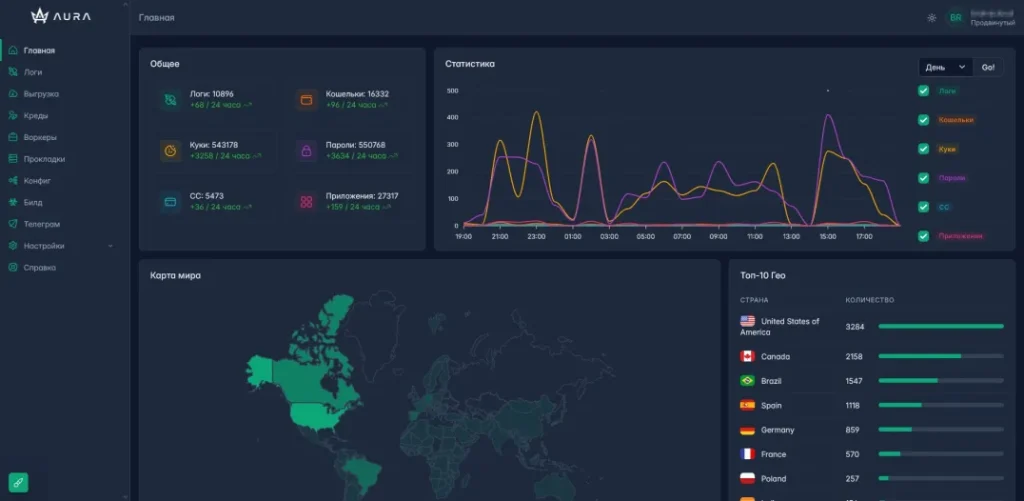
AuraStealer’s web panel overview | Image: Gen Threat Labs
A deep-dive analysis by Gen Digital (Gen Threat Labs) has unveiled AuraStealer, an emerging Malware-as-a-Service (MaaS) that is rapidly gaining traction in underground forums by leveraging a devious distribution tactic known as “Scam-Yourself.”
Active since July 2025, AuraStealer is being marketed as a high-efficiency tool capable of draining data from Windows systems ranging from Windows 7 to 11. However, researchers have found that behind its aggressive marketing lies a malware that is as flawed as it is dangerous.
Unlike traditional malware that relies on silent drive-by downloads or infected email attachments, AuraStealer often requires the victim to be an active participant in their own compromise. The campaign heavily utilizes social engineering on platforms like TikTok, disguising malicious instructions as helpful tech tutorials.
Victims are lured in by videos promising free activation of expensive software. “In these videos, victims are lured by an apparently easy tutorial promising free activation of otherwise paid software,” the report explains.
The trap is sprung when the user follows the video’s instructions to open a system terminal. “Viewers are instructed to manually retype and run a displayed command in an administrative PowerShell, which, however, instead of activating the software, quietly downloads and executes the malicious payload”.
Under the hood, AuraStealer is designed to be a nightmare for security researchers. It employs a suite of complex obfuscation techniques intended to break the tools analysts use to dissect code.
“To hinder both static and dynamic analysis, AuraStealer employs a wide range of anti-analysis and obfuscation techniques, including indirect control flow obfuscation and exception-driven API hashing”.
The malware uses indirect control flow, meaning it breaks the linear path of code execution, calculating the destination of its next “jump” only at the very last second. Additionally, it hides its interaction with the Windows operating system by intentionally triggering errors—exceptions—that are then caught by a custom handler to execute the desired command, a technique designed to confuse automated sandboxes.
Despite being a newcomer, AuraStealer boasts an extensive “shopping list” of data it targets. It claims to steal from over 110 browsers and 70 applications.
According to the analysis, it targets “sensitive data from both Chromium-based and Gecko-based browsers,” as well as “cryptocurrency wallets from desktop applications and browser extensions”.
Perhaps most notably, the malware attempts to bypass modern security defenses like Application-Bound Encryption (ABE) in Chromium browsers. It does this by spawning a browser instance in a suspended state and injecting code to decrypt the keys—though researchers noted this feature “does not work reliably across all of them, suggesting that the product has not yet reached a fully polished state”.
While the developers of AuraStealer are selling subscriptions for up to $585 a month, Gen Digital’s analysis suggests the malware’s bark may be worse than its bite. The heavy obfuscation creates patterns that defenders can spot, and its implementation contains errors that leave it exposed.
“Contrary to the advertised claims, AuraStealer still contains multiple flaws that undermine its stealth and evasion capabilities, offering clear detection opportunities for defenders”.
As the malware continues to evolve with a committed development team, users are reminded that if an online tutorial asks them to paste code into a terminal window to get something for free, they are likely about to pay a much higher price.
Related Posts:
- Homeland Security finds cell phone spy equipment in Washington
- TikTok Ban Postponed: App Back on US App Stores and Play Store
- TikTok Hit by Zero-Day Attack: High-Profile Accounts Compromised
Support Our Threat Intelligence
Find our threat intelligence and malware analysis helpful? Support our work today and unlock a 100% ad-free reading experience!
 Buy Me a Coffee
