The Central Brain: Qualcomm Unveils Agentic AI and Dual-Elite Platforms at CES 2026
 Do Son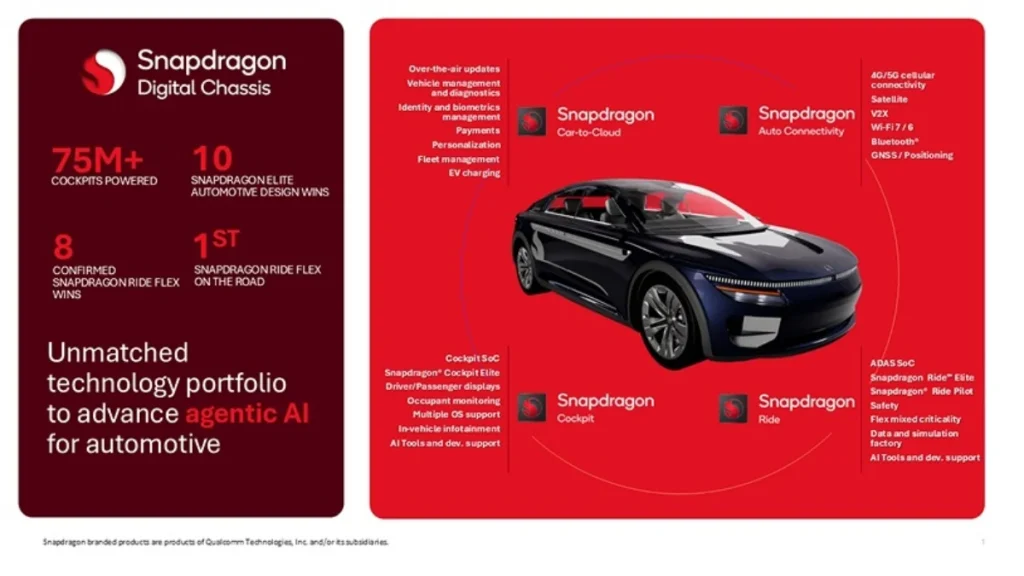
At CES 2026 this year, Qualcomm once again demonstrated its commanding presence in the automotive sector. Beyond highlighting the steadily rising global adoption of its Snapdragon Digital Chassis, the company placed particular emphasis on the convergence of Agentic AI and software-defined vehicles (SDVs).
Qualcomm not only announced a further expansion of its long-standing partnership with Google, but also revealed several major collaborations with automakers and top-tier suppliers. These included Leapmotor’s plan to launch the world’s first mass-production vehicle powered by a dual Snapdragon Elite platform, as well as a deepened alliance with ZF in high-end autonomous driving compute.
The Qualcomm–Google partnership now spans more than a decade, and this latest phase centers on tighter integration between Qualcomm’s Snapdragon Digital Chassis and Google’s automotive software stack. The shared objective is to simplify the deployment of next-generation AI experiences, enabling automakers to bring new AI-driven capabilities to market more rapidly.
With the introduction of Agentic AI, future in-vehicle systems will no longer merely wait for commands. Instead, they will deliver more personalized and proactive intelligent experiences through multimodal interaction—combining voice, touch, and visual inputs. On the hardware front, Qualcomm and Leapmotor jointly unveiled the world’s first central domain controller built on dual Snapdragon Elite (SA8797P) automotive platforms.
This system will debut in Leapmotor’s flagship D19 model. Leveraging the combined compute power of two Snapdragon Elite chips, the controller unifies the intelligent cockpit, advanced driver-assistance systems (ADAS), body controls such as lighting and climate, and the vehicle gateway into a single, consolidated system.
- Immersive display and perception: The platform supports up to eight displays, including multiple 3K and 4K panels, along with 18-channel audio. On the sensing side, it accommodates 13 cameras, radar, and LiDAR, enabling more than 30 advanced driver-assistance features.
- Deep hardware–software integration: Through parallel processing across the Qualcomm Oryon CPU, Adreno GPU, and Hexagon NPU, the system can simultaneously run large AI models for the cockpit and multimodal models for driving assistance.
Beyond Leapmotor, Qualcomm also announced significant progress in autonomous driving and connectivity:
- ZF ProAI supercomputer: Qualcomm and ZF unveiled a scalable ADAS solution built on the ZF ProAI supercomputer powered by the Snapdragon Ride platform. This system delivers automated driving capabilities ranging from Level 2 to Level 3, integrating Snapdragon Ride Pilot and camera-based AI perception to enable features such as automated lane changes and urban driving assistance.
- Next-generation cockpit for Toyota RAV4: Qualcomm revealed a collaboration with Toyota under which the new RAV4 will adopt a next-generation Snapdragon Cockpit platform, delivering AI-driven features that anticipate driver needs and adapt in real time.
- The first automotive 5G RedCap modem: To broaden vehicle connectivity, Qualcomm introduced the Snapdragon A10 5G Modem-RF—the industry’s first automotive 5G RedCap (Reduced Capability) modem. Designed for lower power consumption and cost, it delivers essential vehicle-to-everything services and accelerates the widespread adoption of 5G connectivity across the automotive industry.
Taken together, Qualcomm’s CES 2026 announcements signal a clear strategic shift: from supplying individual “cockpit chips” or “connectivity chips” to delivering a highly integrated “central computing brain” for vehicles.
Leapmotor’s dual-chip D19 architecture exemplifies this transformation, breaking down the traditional separation between cockpit and autonomous driving systems to achieve true cross-domain integration. Moreover, Qualcomm’s strong emphasis on Agentic AI underscores a broader shift in in-vehicle competition—from sheer smoothness and performance toward proactive, service-oriented intelligence.
Related Posts:
- SAP’s July 2025 Patch Day Brings 27 New Notes, Multiple Critical RCE & Deserialization Flaws (CVSS 10.0)
- Snapdragon 8 Elite Gen 5 Unveiled: The Fastest Mobile Chip Powers Next-Gen Agentic AI
- Qualcomm’s March 2025 Security Bulletin Addresses Critical Flaws Across Multiple Products
- The Ten-Year Car: Qualcomm and Google Unveil the Future of AI-Powered Mobility
Support Our Threat Intelligence
Find our tech and OS security coverage helpful? Support our work today and unlock a 100% ad-free reading experience!
 Buy Me a Coffee
