The Ten-Year Car: Qualcomm and Google Unveil the Future of AI-Powered Mobility
 Do Son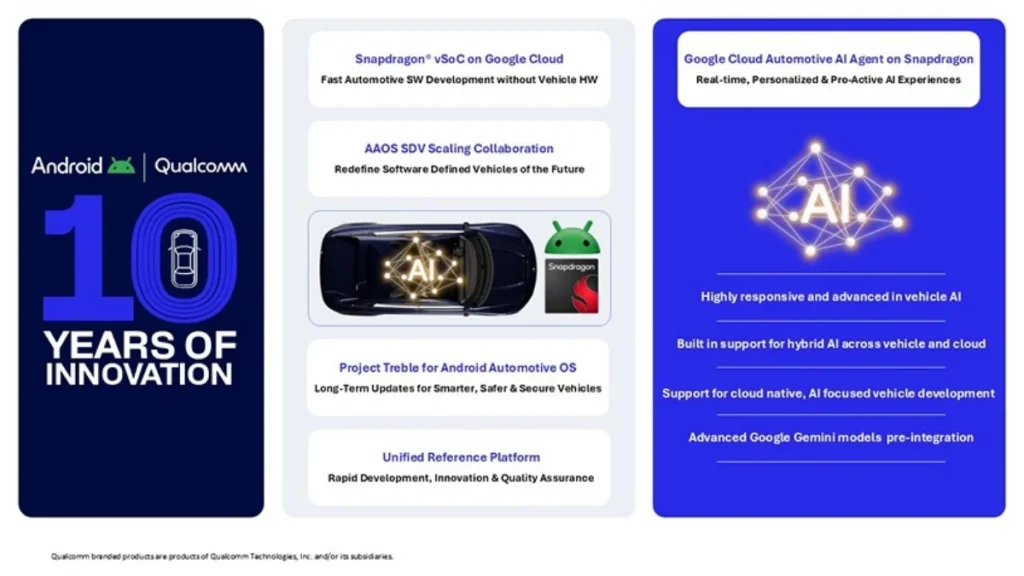
At CES 2026 this year, Qualcomm announced a deepening of its decade-long strategic alliance with long-standing partner Google. The expanded collaboration targets the development of software-defined vehicles (SDVs), the deployment of in-vehicle agentic AI, and fully integrated cloud-native development environments—an effort aimed at setting a new benchmark for the future of intelligent mobility.
At the heart of this partnership is the seamless integration of Qualcomm’s Snapdragon Digital Chassis with Google’s automotive software stack and cloud capabilities, enabling automakers to more rapidly deliver intelligent vehicles that are highly personalized, continuously evolving, and secure by design.
The expanded collaboration spans several key areas:
- Generative AI redefining the mobility experience: Building on the previously announced Gemini Enterprise for Automotive, the two companies showcased a flexible architecture that combines on-device and cloud-based models. This enables “vehicle-to-cloud” connectivity, empowering in-car AI with real-time predictive and responsive capabilities—such as more intuitive and proactive assistants.
- A unified reference platform to accelerate innovation: Qualcomm and Google are developing a unified reference platform to align the roadmaps of Snapdragon Cockpit platforms and Google’s Android Automotive OS (AAOS). The partners have already begun collaboration around the future Android 17 release, a move expected to significantly shorten development cycles while improving software quality for automakers.
- Scaling AAOS for SDVs: As a primary partner, Qualcomm will deliver pre-integrated and optimized AAOS SDV software. This architecture supports digital instrument clusters, over-the-air updates, and AI-driven fleet insights, allowing manufacturers to deploy a unified software stack across multiple vehicle models while rapidly differentiating features.
- Cloud-native development and Project Treble: Qualcomm is introducing a Snapdragon virtual system-on-chip (vSoC) on Google Cloud. Powered by Google Cloud’s Arm-based Axion processors, this environment allows developers to design and validate automotive software entirely in the cloud—using nothing more than a laptop browser, without requiring physical hardware.
In addition, the long-running Project Treble initiative between Qualcomm and Google will provide automakers using Snapdragon Cockpit platforms with up to ten years of critical software update support, addressing Android version fragmentation and long-term security challenges. Patrick Brady, Google’s Vice President of Engineering, noted that the collaboration fuses Google’s leading AI software capabilities with Qualcomm’s hardware integration to create a unified, scalable vehicle platform. Qualcomm Senior Vice President Nakul Duggal emphasized that the partnership will enable automakers to innovate at unprecedented speed while unlocking the full potential of agentic AI.
Taken together, Qualcomm and Google are effectively defining a “reference answer” for SDV development.
Historically, automakers developing intelligent cockpits have struggled with the painful integration of hardware and operating systems, followed by the ongoing burden of Android version maintenance. Qualcomm’s ten-year update commitment through Project Treble—combined with cloud-based vSoC development that decouples software from hardware—represents a powerful enabler for traditional automakers navigating digital transformation.
More importantly, as AI assistants become a standard feature inside vehicles, the deep coupling of Google’s Gemini models with Snapdragon compute platforms positions the “Google-native” smart cockpit experience as a formidable contender in the coming years—potentially emerging as the preferred choice for non-Tesla automakers.
Related Posts:
- Qualcomm and Google Partner to Bring AI to the Car
- Blackberry introduced Jarvis service to Increase Automakers’ Cybersecurity
- Qualcomm’s March 2025 Security Bulletin Addresses Critical Flaws Across Multiple Products
Support Our Threat Intelligence
Find our tech and OS security coverage helpful? Support our work today and unlock a 100% ad-free reading experience!
 Buy Me a Coffee
