The Internet Rewired: Cloudflare 2025 Review Unveils the AI Bot War and a 19% Traffic Surge
 Do Son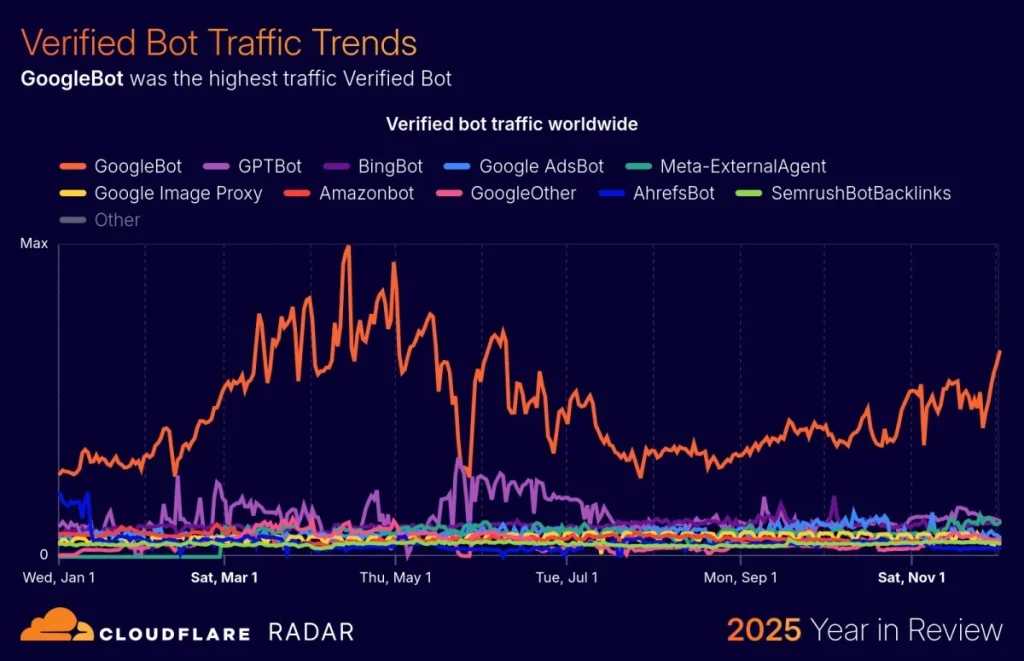
Image: Cloudflare
Cloudflare has released its sixth annual Year in Review, outlining the defining trends shaping the global internet in 2025. The report reveals that, amid the explosive growth of artificial intelligence, the online world is undergoing an unprecedented transformation: global internet traffic rose by 19% year over year, while an intense “AI bot war” has erupted across the web.
Cloudflare CEO Matthew Prince remarked that the internet is not merely evolving—it is actively reshaping the world. This year, he noted, marked significant milestones in cybersecurity while exposing mounting pressures on traditional business models.
In the AI arena—the sector drawing the greatest attention—competition has expanded beyond model performance to encompass data acquisition itself. The report highlights that Google’s web crawlers vastly outpace those of all competitors, making Google the single largest source of automated internet traffic worldwide. This suggests that, in order to train models such as Gemini, Google is harvesting online data at an extraordinary scale.
Among the most popular online services, Google and Meta retained their first and second positions for the fourth consecutive year. In generative AI, ChatGPT continued to dominate without serious challenge. Cybersecurity trends, however, took a troubling turn: whereas attackers once focused primarily on financial institutions and technology giants, 2025 saw civil society organizations and non-profits become the most frequently targeted sector for the first time.
The reasons are stark and straightforward. Such organizations often hold highly sensitive user data, operate with comparatively limited security resources, and present attractive targets for extortion. At the same time, the scale of cyber warfare has escalated sharply. Cloudflare reports that it mitigated more than 25 record-breaking DDoS attacks this year alone. In anticipation of future threats—particularly the prospect of quantum computers breaking today’s cryptographic systems—network defenses are rapidly evolving. According to the report, 52% of all human-generated internet traffic is now protected by post-quantum cryptography, meaning that more than half of global data transmissions are already hardened against emerging risks.
Yet the causes of internet disruptions extend beyond accidents. While outages caused by physical incidents such as cable cuts fell by 50%, human factors played a far greater role. Nearly half of major global internet disruptions were triggered by government actions—often linked to censorship or social control—while outages related to power failures doubled.
In terms of speed and quality, European countries stood out, with average download speeds exceeding 200 Mbps. Spain, in particular, ranked first globally for overall network quality. Taken together, Cloudflare’s findings capture two extremes of the modern internet in 2025: extraordinary advancement alongside profound fragility.
On one hand, the rapid adoption of post-quantum encryption demonstrates how swiftly the technology sector can respond to future risks. On the other, the dominance of Google’s crawlers underscores the insatiable appetite of AI models for data—an appetite that is increasingly straining global bandwidth. Meanwhile, the shift toward targeting non-profit and civil society organizations reveals a darker reality: in an era of AI-assisted attacks, the barriers to cybercrime are lower and ethical constraints weaker than ever. Future cyber conflicts may no longer be limited to knocking servers offline, but may instead revolve around the wholesale seizure of data, influence, and privacy.
Related Posts:
- Beyond Compliance: Broadcom’s New Private Cloud Tools Secure AI Workloads
- AI Browser War: Amazon Demands Perplexity’s Comet AI Stop Automated Purchasing
- Web of Deceit: Unmasking the Hidden Threat of Stockpiled Domains
Support Our Threat Intelligence
Find our threat intelligence and malware analysis helpful? Support our work today and unlock a 100% ad-free reading experience!
 Buy Me a Coffee
