The Win-DDoS Epidemic: New Flaws Weaponize Windows Domain Controllers for Massive DoS Attacks, PoC Releases
 Do Son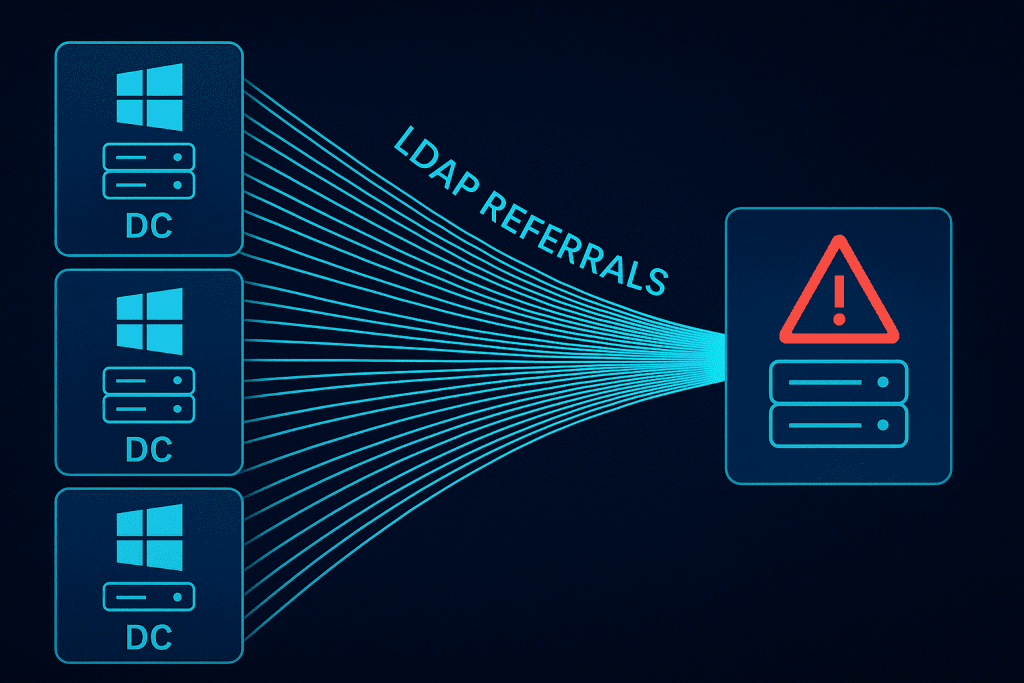
SafeBreach Labs researchers have uncovered a new class of denial-of-service (DoS) vulnerabilities in Microsoft Windows that could enable attackers to weaponize critical infrastructure — without ever breaching a single device. Their findings, published in a recent report, reveal “zero-click, unauthenticated vulnerabilities that allow attackers to crash these systems remotely if they are publicly accessible”, breaking long-held assumptions about enterprise DoS risks.
Running Infra, AppSec, and SOC teams? Tag Microsoft alerts by team automatically.
Try Team free for 14 daysThis latest research builds on SafeBreach’s earlier work on LDAPNightmare (CVE-2024-49113), a flaw discovered by Yuki Chen that allowed attackers to crash unpatched domain controllers (DCs) without authentication. The team realized that “DCs are a key component in most organizations’ Active Directory network — denying service of a DC… could have the potential to completely halt the operations of a victim organization.”
By probing deeper into Windows’ LDAP client code, SafeBreach discovered a novel amplification technique dubbed Win-DDoS. This attack manipulates the LDAP referral process to turn tens of thousands of publicly accessible DCs into a high-bandwidth botnet — all without malware, purchased infrastructure, or a detectable footprint.
“We were able to create Win-DDoS, a technique that would enable an attacker to harness the power of tens of thousands of public DCs around the world… all without leaving a traceable footprint,” the report states.
The research targeted two major “blind spots” in Windows code:
- Client-side code — where servers implicitly trust responses from any server they are directed to.
- Transport-agnostic wrapped server code — where developers rely on frameworks like RPC that abstract away networking, often omitting safeguards against classic server risks.
By chaining these weaknesses, the team developed several attacks, including:
- CVE-2025-32724 — Referral Overflow: Massive LDAP referral lists cause LSASS to crash, forcing a reboot or BSOD.
- CVE-2025-49716 — NetLogon RPC Abuse: Using a “stateless RPC” technique to rapidly exhaust memory on DCs.
- CVE-2025-26673 — TorpeDoS: A single machine can simulate a DDoS flood by pre-binding thousands of RPC sessions.
- CVE-2025-49722 — SpoolSV Printer Enumeration: An authenticated attack that can crash every Windows machine in a domain.
Perhaps the most alarming takeaway is that attackers can “manipulate the Windows platform itself into becoming both the victim and the weapon” — for example, by making DCs in one country flood targets in another, potentially to frame a government.
The Win-DDoS technique is particularly dangerous because it:
- Uses existing, legitimate infrastructure (public DCs).
- Requires no compromise of bots.
- Can be executed with a single command.
- Delivers massive bandwidth potential.
SafeBreach Labs published the proof-of-concept exploit code for these flaws.
Related Posts:
- Hacking the Cloud: Undetectable Crypto Miner on Azure
- PoC Exploit Released for Zero-Click Vulnerability CVE-2024-49113 in Windows
- Adobe Acrobat and Reader Multiple Security Vulnerabilities
- Sensitive information about U.S. House members and staff are being sold
- Nearly two-thirds of the surveillance camera network in Washington, DC, was hijacked by Romanian ransomware suspects
Support Our Threat Intelligence
Find our vulnerability reports and weekly recaps helpful? Support our work today and unlock a 100% ad-free reading experience!
 Buy Me a Coffee
