North Korean Trigram Campaign Targets Web3 Developers Using ClickFix and 50 Spoofed Brands
 Do Son
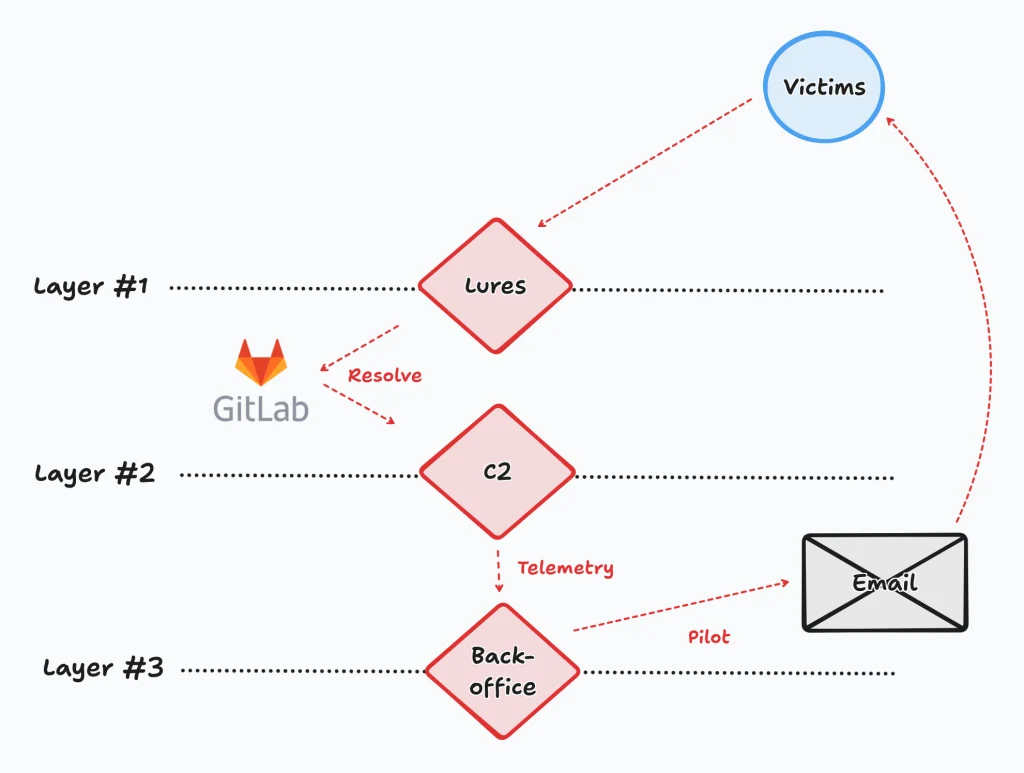
Infrastructure architecture, from hooks to back-office operator | Image: Stormshield
TL;DR
Security researchers exposed a three-tier infrastructure powering the Trigram campaign, an industrialized operation targeting cryptocurrency and AI developers. Linked to North Korean threat actors, this North Korean Trigram campaign impersonates roughly 50 tech brands and uses clipboard hijacking to deploy cross-platform malware. Furthermore, exposed back-office servers revealed how the operators scrape GitHub profiles, track victims in real time, and monitor stolen digital assets.
What Happened in the Operation
Threat actors launched a multi-scenario phishing operation using fake job portals, tech conference invitations, and parcel tracking pages. According to an investigation into the Trigram campaign by Stormshield’s Cyber Threat Intelligence team, the attacks begin with emails offering remote software engineering roles paying between $120,000 and $160,000 per year. When a candidate visits the decoy website, client-side JavaScript blocks mobile devices and checks for a cookie named cn_ip_restricted=1, which disables the site for restricted IP addresses.
Desktop users on Windows, macOS, or Linux are prompted to submit an application form and enter a one-time referral code on an anti-spam verification page. Next, the page asks the applicant to copy and run a harmless curl command in their terminal to sign a cryptographic nonce. Once executed, the page displays a fake error message: “Operation timeout. Please try again. Nonce Refreshed.”
Clipboard Hijacking and Cross-Platform Droppers
Behind the scenes, that fake timeout triggers a ClickFix clipboard substitution. When the victim clicks the copy button or presses Ctrl+C a second time, JavaScript replaces the harmless text with a malicious command ending in a newline character so it runs immediately upon pasting. Depending on the operating system, the command downloads and executes a hidden script (verify_w for Windows or verify_m for macOS and Linux).
The dropper script decodes a Base64 payload, checks for Node.js version 18 or higher, and downloads a portable Node.js v20.18.1 runtime if needed. It then fetches a 50 KB JavaScript payload named install_guard.js. Instead of hardcoding command-and-control (C2) addresses, the script queries a public GitLab repository (such as gitlab.com/up-indexings/tasks) acting as a dead-drop relay. Finally, the payload deploys the OverLord infostealer to harvest browser passwords, cryptocurrency wallets, and system credentials via fake password prompts.
Who Is Behind the Activity
Stormshield assesses with high confidence that the North Korean Trigram campaign is a direct continuation of UNK_DeadDrop, a North Korea-aligned cluster tracked by Proofpoint since April 2026. By analyzing exposed backend servers, researchers connected three separate threat reports from Proofpoint, SafeDep, and Genians into a single operation.
“Trigram is a large-scale campaign that impersonates about 50 brands in the blockchain and AI sectors, to trick developers into executing an infostealer themselves,” Stormshield researchers wrote. Notably, the decoy sites delivered the full code for the operators’ tracking console whenever a user visited the /ops-7f3k9m path. Inside that code, a file named superAdmin.ts granted root privileges to eros1030109@gmail.com, an email address previously linked by Genians in August 2026 to North Korea’s Kimsuky group.
Additionally, a debug error on a Django server at 170.205.30.27 (port 8000) exposed the group’s campaign management suite, dubbed rms-platform. That configuration contained a MongoDB username (silviattech1129_db_user) that matched the exact author handle behind the October 31, 2026 supply-chain compromise of the antd-img-crop npm package (98,000 weekly downloads) reported by SafeDep. The same decoy domain used for fake AI conference invitations (icagllmbt.space) also hosted the malicious build scripts for that hijacked npm package.
Impact and Industrialized Scale
Across roughly 200 mapped indicators of compromise hosted largely on Advin Services, the operators spoofed around 50 Web3 and AI brands, including Ritual, Mina, Metis, Mantle, Linea, Fuel, and Webflow. A third decoy cluster briefly impersonated logistics carriers DHL, DPD, and Aramex. Meanwhile, the fake ICAGLLMBT 2027 Tokyo conference portal offered targets a $1,000 airdrop if they transferred their invitation to a colleague, turning victims into unwitting distributors.
Inside rms-platform, documentation Containing copy-pasted AI assistant responses and a Gemini API key showed how operators scrape developer profiles via the GitHub API. To bypass spam filters, the platform distributed phishing emails across more than 50 Resend API keys, 13 Brevo keys, Mailgun, and Smartlead. Operators also integrated FullStory session recording to replay victim mouse movements and used API keys for Etherscan, Basescan, Polygonscan, Solscan, and Tronscan to monitor and claim cryptocurrency wallets.
How Developers and Organizations Can Stay Protected
To defend against the Trigram campaign, software developers must never copy and paste terminal commands from recruitment portals, conference registration pages, or CAPTCHA prompts. “No legitimate company will ever ask you to run a terminal command as part of a hiring process,” warned one targeted designer quoted in the report. Furthermore, engineering teams should audit Visual Studio Code projects for malicious .vscode/tasks.json files configured to run scripts automatically when a folder is opened. Finally, network administrators should block connections to Advin Services IPs (193.160.32.10, 170.205.29.83, and 170.205.30.27), monitor for unexpected portable Node.js downloads, and restrict access to *.ink and *.xyz lookalike recruitment domains.
Support Our Threat Intelligence
Find our threat intelligence and malware analysis helpful? Support our work today and unlock a 100% ad-free reading experience!
 Buy Me a Coffee
