Trusted Tool, Hidden Threat: Official EmEditor Installer Hijacked to Push Malware
 Do Son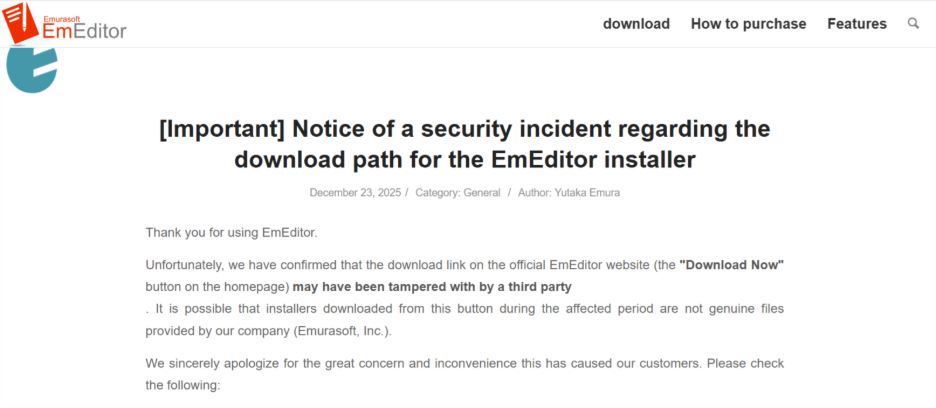
EmEditor posting an advisory regarding the compromise to their webpage
A compromised installer for EmEditor, a text editor trusted by developers worldwide, has been used to distribute sophisticated malware. TrendAI Research has uncovered a campaign where attackers hijacked the official download page of the U.S.-based software vendor, deploying a malicious MSI package capable of stealing credentials and executing lateral movement across victim networks.
The incident surfaced in late December 2025. “Companies using Windows-based, third-party software distributed through public download channels are exposed to this risk,” the researchers warn.
The timing of the attack was calculated for maximum impact and minimum detection. “The timing also suggests that the attackers might have taken advantage of the year-end holiday period, when reduced staffing or more relaxed routines can increase the likelihood of security lapses”.
EmEditor’s developer, Emurasoft, issued an emergency advisory confirming that “the download link on the official EmEditor website… may have been tampered with by a third party”. For an unknown period, users clicking the “Download Now” button were served a trojanized installer instead of the genuine software.
The infection process begins the moment the compromised installer is run. The attackers modified the MSI package’s CustomAction script to “spawn a PowerShell command to retrieve its first-stage code” from a deceptive URL, EmEditorjp[.]com.
This first-stage payload is a masterclass in obfuscation. It connects to additional command-and-control (C2) servers—EmEditorgb[.]com and EmEditorde[.]com—to download the main malware modules . These domains were crafted to look like legitimate regional mirrors for the software, blending in with normal network traffic.
Once established, the malware performs a “fingerprinting” routine to assess its environment. Interestingly, it includes a strict “geofencing” check that terminates the infection if the victim is located in specific countries, including Armenia, Belarus, Georgia, Kazakhstan, and Kyrgyzstan.
This behavior provides a strong clue about the attackers’ origins. “We assess that the threat actors are likely of Russian origin, or those from the Commonwealth of Independent States (CIS),” the report states. This exclusion list aligns with a “common pattern observed among groups from this region, where ‘friendly’ countries are excluded to reduce legal and operational risk”.
The malware is not just a simple downloader; it is a multi-stage espionage tool. Its capabilities include:
- Credential Theft: Harvesting sensitive login data from the infected machine.
- Defense Evasion: It explicitly disables PowerShell Event Tracing for Windows (ETW) to blind security monitoring tools.
- Lateral Movement: Preparing the ground for “follow-on intrusion” to spread deeper into the corporate network.
Because the malicious behavior is “deferred until after installation,” it can effectively bypass early detection mechanisms, increasing the “dwell time” attackers have to roam the network undetected.
Organizations are urged to check their logs for traffic to the identified malicious domains (EmEditorjp[.]com, EmEditorgb[.]com, EmEditorde[.]com, and cachingdrive[.]com) and verify the integrity of any EmEditor installers downloaded in late December 2025 .
As the report concludes, “CISOs should check whether activities originating from trusted installers and developer tools are consistently monitored” to prevent becoming the next victim of a supply chain compromise.
Related Posts:
- EmEditor Compromised: “WALSHAM” Imposter Poisons Official Installer with Spyware
- Microsoft Announces Critical Change to .NET Installer Distribution Domains
- Cracked Software: A Gateway to Malware and Data Theft
- Chrome Installer Bug: ARM Version Delivered to x86 Users
- Node.js Misused in Malvertising Campaigns to Deliver Stealthy Malware
Support Our Threat Intelligence
Find our threat intelligence and malware analysis helpful? Support our work today and unlock a 100% ad-free reading experience!
 Buy Me a Coffee
