 Do Son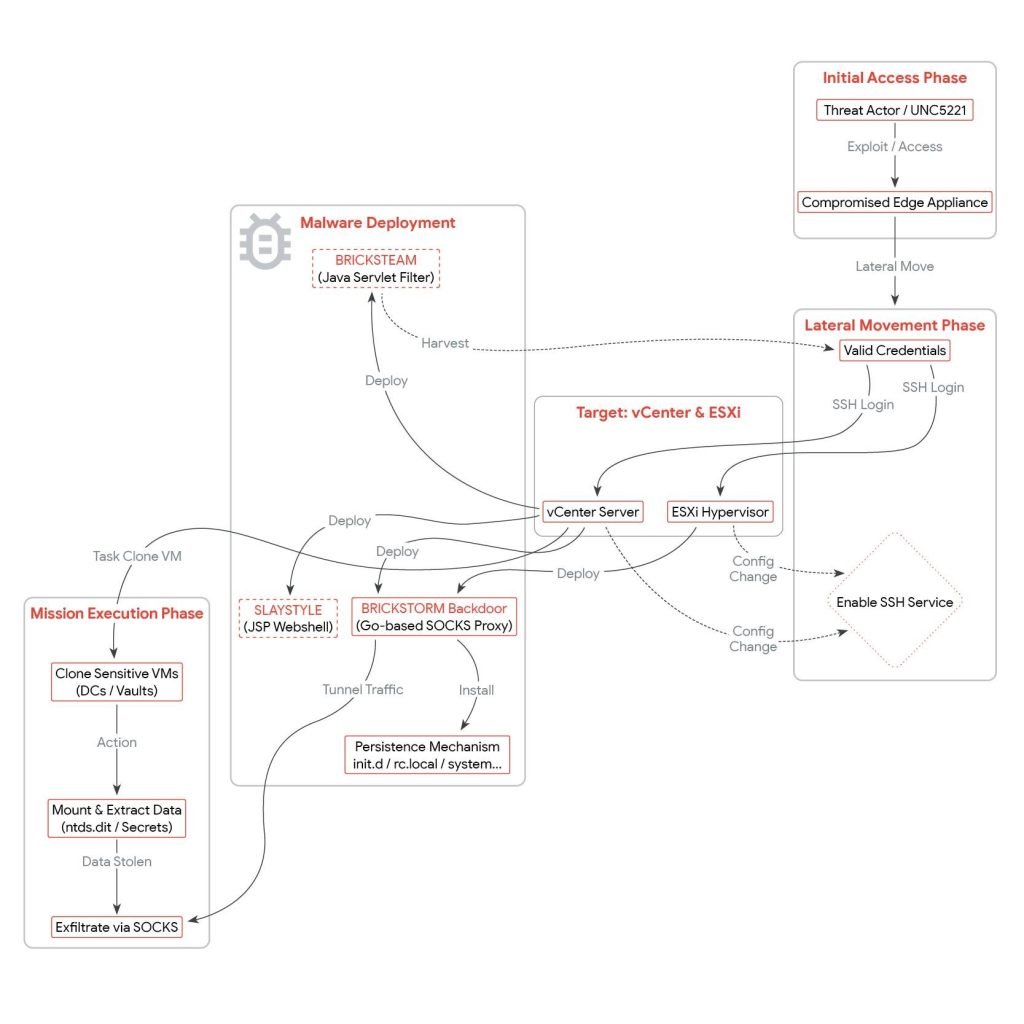
BRICKSTORM vSphere attack chain
A new deep-dive report from Mandiant (part of Google Cloud) explores the evolving threats facing the VMware vSphere ecosystem, where attackers are successfully operating beneath the reach of traditional security tools.
The primary target of these operations is the vCenter Server Appliance (VCSA) and ESXi hypervisors. By establishing persistence at the virtualization layer, threat actors can effectively disappear from view.
As Mandiant researchers explain:
“By establishing persistence at the virtualization layer, threat actors operate beneath the guest operating system where traditional security protections are ineffective. This strategy takes advantage of a significant visibility gap”.
Because these control planes do not support standard Endpoint Detection and Response (EDR) agents, they have historically received much less security focus than traditional workstations or servers, allowing attackers to remain “dormant” for an average of 393 days.
Interestingly, these intrusions are rarely the result of a “zero-day” software bug. Instead, the report highlights that the threat actor, tracked as BRICKSTORM, relies on exploiting fundamental weaknesses in identity design and security architecture.
Once administrative control is gained, the attackers deploy specialized malware like BRICKSTEAM, a Java Servlet Filter that allows them to harvest credentials and deploy further malicious payloads across the entire vSphere environment.
To close this visibility gap and evict these “ghost” operators, Mandiant recommends a series of aggressive hardening strategies:
- Encrypted Logging: Organizations should move away from insecure UDP/514 logging and enforce TCP with TLS encryption (Port 6514) for all syslog traffic.
- Certificate Validation: VCSA and ESXi hosts must be configured to validate the SSL certificates of remote syslog servers to prevent man-in-the-middle attacks.
- Custom Shell Bridging: Administrators should consider an agentless bridge at the Photon OS level. This transforms the VCSA from a passive appliance into an “active sensor” capable of streaming real-time kernel-level alerts.
- Extended Retention: Given the long dwell times of these actors, remote syslog repositories should maintain at least 400 days of logs to allow for historical correlation of a compromise.
The Mandiant report serves as a wake-up call for organizations that have focused their security purely on the “guest” operating systems while leaving the “host” infrastructure unmonitored.
As the analysis concludes:
“By operating within these unmonitored areas, attackers can establish long-term persistence and gain administrative control over the entire vSphere environment”.
Turning the virtualization layer into a “hardened” and “transparent” part of the security stack is no longer optional—it is a requirement for surviving the next generation of infrastructure-level attacks.
Support Our Threat Intelligence
Find our threat intelligence and malware analysis helpful? Support our work today and unlock a 100% ad-free reading experience!
 Buy Me a Coffee
