 Do Son

At a Glance
| Actor or Group | Volant Manticore, suspected Iran-nexus spy group |
|---|---|
| Activity Type | Spear-phishing, login theft, RMM abuse, and custom malware |
| Targets or Victims | Cyprus airlines, telecoms, state bodies, and Saudi clinics |
| Scale | Active from Sept. 2025 to Nov. 2026 in Cyprus and Saudi Arabia |
| Jurisdiction / Status | Active regional threat; no public arrests or charges |
TL;DR
Check Point Research found Volant Manticore, a suspected Iranian spy group active since September 2025. The crew uses a new IPFS-based KuboShell backdoor, the Homa Framework, and legal remote tools. After hitting Cyprus for months, the group pivoted to Saudi healthcare targets in September 2026.
What Happened
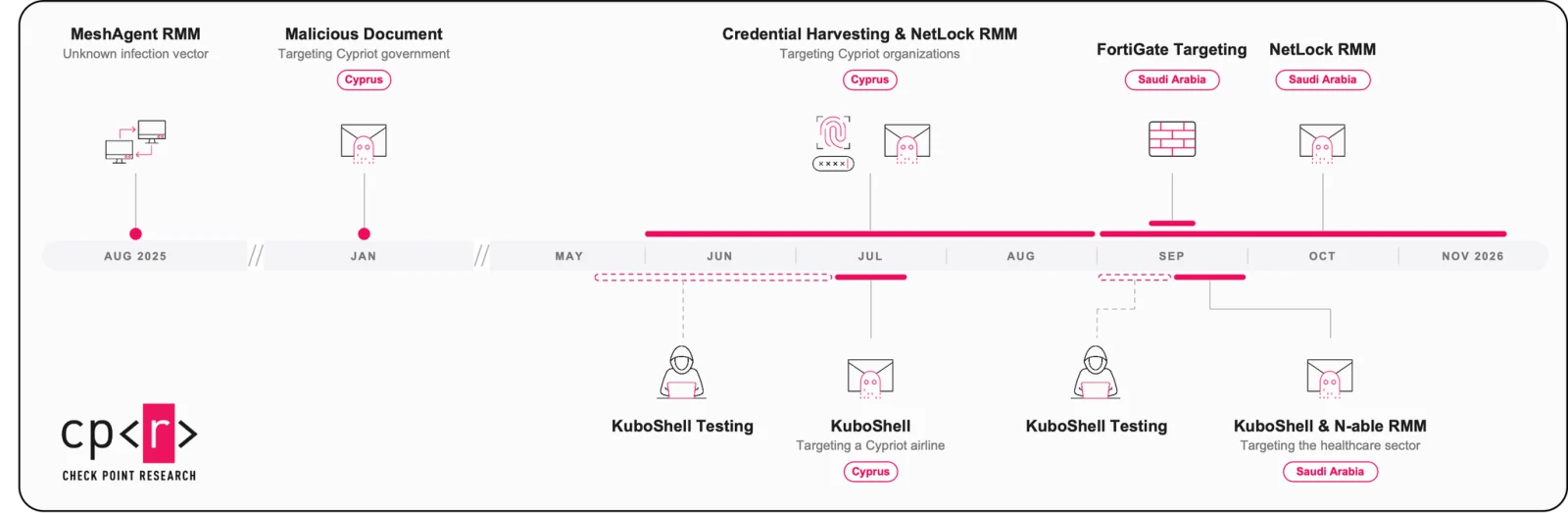
Analysts first spotted Volant Manticore in July 2026 when a fake resume hit VirusTotal. In its full technical report, Check Point Research traced the lure to a Cyprus airline flying to Israel. The fake CV used an AI persona named “Athena Marinou” to push a Catbox link holding the KuboShell backdoor.
KuboShell and the Homa Framework
KuboShell is a 64-bit Windows tool that uses IPFS for command traffic. Rather than calling a normal server, it uses the Pinata API with a built-in key. First, it grabs the host MAC address and posts a short check-in file. Next, it checks Pinata every 60 seconds for hidden PowerShell tasks and sends results back.
Operators use KuboShell as a quick check before they load deeper tools. Once they trust a host, they drop the Homa Framework, a three-stage script chain. Stage 1 pulls a loader in RAM from 185.205.187[.]109:8000. Stage 2 decodes a script with XOR, and Stage 3 runs a steady web loop every 10 seconds.
Past Lures and Commercial RMM Tools
Alongside custom code, Volant Manticore pairs fake login sites with legal remote tools like NetLock RMM, N-able RMM, and MeshCentral. Earlier, in January 2026, the crew sent a Word file named Military Heritage Proposal.doc to a likely Cypriot state target. When a user enabled macros, the code hid inside a new Word task and killed other Word windows so the app looked dead.
Then, in September 2026, the crew fast-tracked attacks on Saudi Arabia. They sent broad lures like “WhatsApp Images” and “AI_Healthcare_Seminar.zip” to push NetLock RMM, N-able RMM, and KuboShell. Check Point Research saw leftover debug strings and a Cyprus domain reused for Saudi hosts. Those slips point to a rushed shift.
Who Is Behind It
Check Point Research holds high trust that Volant Manticore is an Iran-nexus group. They also hold medium trust that it has past ties to Iran’s MOIS spy agency. The team wrote, “While we identified multiple links to MuddyWater, we assess that Volant Manticore likely consists of former MuddyWater operators who branched off from the group and currently operate as a separate threat cluster.”
Clear clues back this view. Task logs match Iran’s UTC+3:30 workday and a Thursday-Friday weekend. Also, a Saudi KuboShell build held the path F:\homa\, naming a famed Persian bird. Meanwhile, Homa’s Stage 3 client copies MuddyWater’s old MuddyC2Go code in URI shape and loop style. As Brandefense noted, tracking both groups apart helps teams avoid blind spots in Cyprus and Saudi Arabia.
Impact and Scale
Check Point Research thinks Volant Manticore is the first Iranian group to treat Cyprus as a top spy target. They noted, “The island’s deepening defensive and energy ties with Israel and Greece, and its role as a hub for Western military operations in the region, make it a natural target for Iranian intelligence collection.”
In Saudi Arabia, the pivot to clinics and hospitals tracks rising clashes between Saudi Arabia and Iran-backed Houthis. Operators also ran tests on VirtualBox, VMware, and Azure labs with Fortinet SSL VPN apps. That setup hints they may use stolen VPN logins to enter victim sites directly.
What Comes Next and How to Stay Safe
Analysts expect Volant Manticore to keep hitting Saudi targets while the Houthi clash stays hot. Meanwhile, Cyprus will likely stay a steady focus. Check Point Research warned, “Treating Volant Manticore as part of MuddyWater could therefore lead to blind spots, particularly for organizations in Saudi Arabia and Cyprus.”
Steps for Network Defenders
First, block or watch outbound calls to Pinata IPFS hubs and known C2 hosts like 185.205.187[.]109. Second, alert on rogue NetLock RMM, N-able RMM, or MeshCentral installs. Third, block Word macros by default and watch for AccessVBOM registry edits. Finally, per Spectrum Security and Brandefense tips, match odd lures with hidden PowerShell runs and Fortinet VPN logins to catch the KuboShell backdoor fast.
Support Our Threat Intelligence
Find our threat intelligence and malware analysis helpful? Support our work today and unlock a 100% ad-free reading experience!
 Buy Me a Coffee
