Critical Flaws in Hiawatha Web Server Could Allow Authentication Bypass and RCE
 Ddos
Ddos 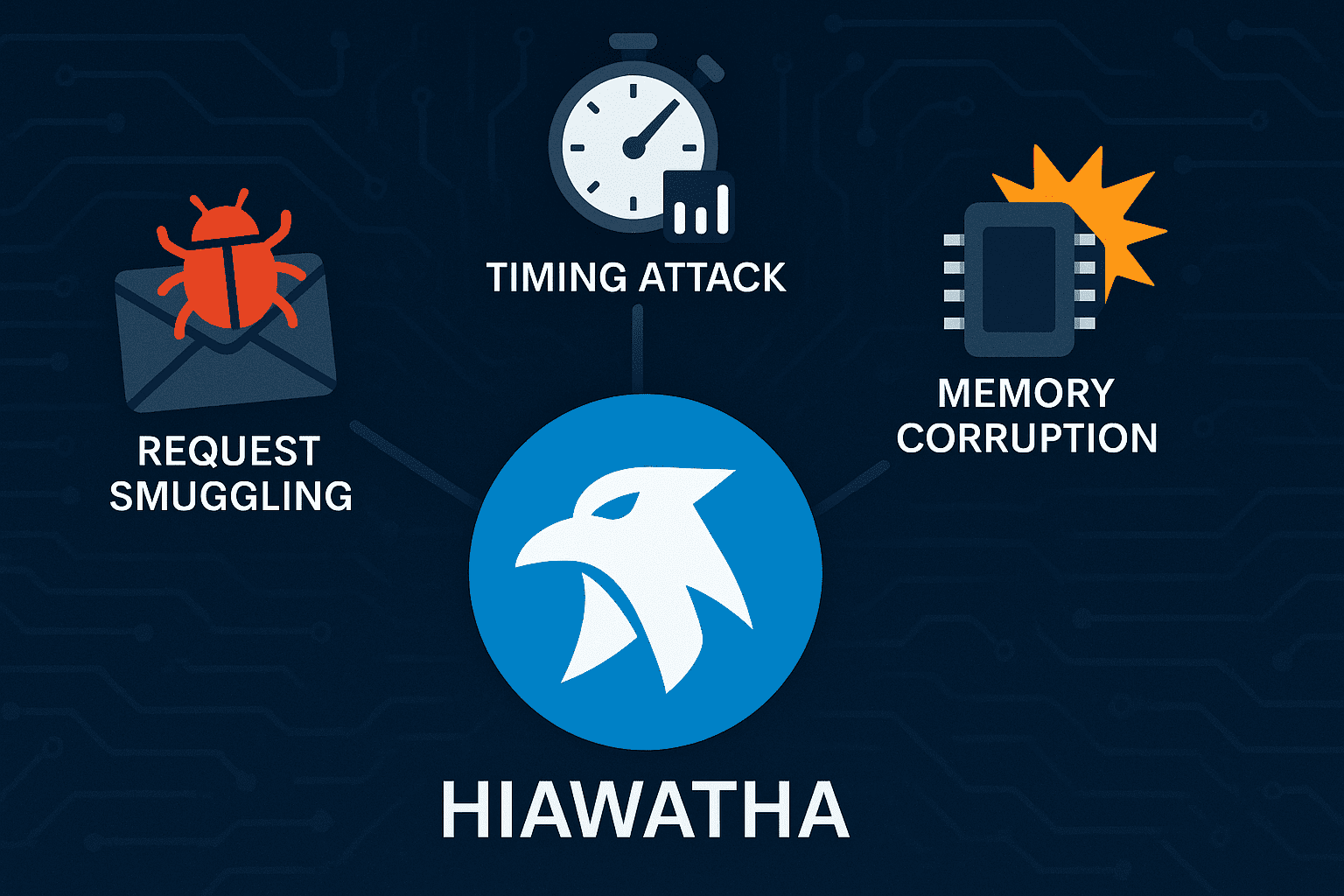
The CERT Coordination Center (CERT/CC) has issued a vulnerability note highlighting three serious flaws in the Hiawatha web server, a lightweight open-source alternative to Apache and Nginx. These vulnerabilities could allow attackers to bypass authentication, hijack sessions, or even execute arbitrary code.
Hiawatha is a security-focused, open-source web server designed for performance and simplicity, supporting Windows, macOS, and Linux. Hiawatha is an open source webserver with security, easy to use and lightweight as the three key features. It supports among others (Fast)CGI, IPv6, URL rewriting and reverse proxy and has security features no other webserver has, like blocking SQL injections, XSS, CSRF and exploit attempts. Hiawatha runs perfectly on Linux, BSD and MacOS X.
Although the project is no longer actively supported, the developer has acknowledged the reported flaws and confirmed that fixes and mitigations will be included in the next release.
The first vulnerability, CVE-2025-57783, is a request smuggling flaw caused by improper header parsing in the fetch_request function of versions 8.5 through 11.7. CERT/CC explains: “This vulnerability allows an unauthenticated attacker to smuggle requests and access restricted resources managed by the server.”
Attackers exploiting this flaw could bypass authentication controls, hijack user sessions, or inject malicious payloads into crafted requests. Given its unauthenticated nature, this bug poses a serious risk for exposed servers.
The second vulnerability, CVE-2025-57784, affects the Tomahawk management component of Hiawatha. The flaw arises from insecure use of the strcmp function in the handle_admin function. CERT/CC notes: “This vulnerability allows a local attacker to access the management client.”
By carefully measuring response times for failed login attempts, an attacker could infer correct password characters one by one, eventually gaining administrative access. While this type of attack may be time-consuming, it can be highly effective if combined with automation.
The third flaw, CVE-2025-57785, impacts versions 10.8.2 through 11.7. CERT/CC describes it as “a double free in the XSLT show_index function… [which] may result in corrupt data leading to the execution of arbitrary code.”
Double free errors occur when the same block of memory is released twice, leading to corruption. In web server contexts, this can allow attackers to execute arbitrary code, potentially taking full control of affected servers.
CERT/CC emphasizes the risk severity: “Exploiting the request smuggling vulnerability may result in attackers bypassing authentication, hijack user sessions or inject malicious payloads into requests.” Similarly, the timing attack could reveal administrator credentials, while the double free bug could open the door to remote code execution.
Administrators are urged to apply the updated version as soon as it is released by the Hiawatha developer. Until then, organizations should consider minimizing exposure of Hiawatha servers to untrusted networks and monitoring for suspicious traffic.
Related Posts:
- Critical Flaws Found in Partner Software: Default Admin Passwords & XSS Allow RCE on Government Systems
- PDQ Deploy Vulnerability Exposes Admin Credentials: CERT/CC Issues Advisory
- MadeYouReset: New HTTP/2 Flaw Threatens to Cripple Servers with DDoS Attacks
- AI Jailbreaks Expose Systemic Vulnerability in Generative AI Platforms
- SMM Vulnerabilities in Gigabyte UEFI Firmware Expose Systems to Stealthy Attacks
Support Our Threat Intelligence
If you find our CVE report and cybersecurity news helpful, consider supporting our work.
 Buy Me a Coffee
PayPal
Buy Me a Coffee
PayPal
