 Do Son

TL;DR
Security researchers exposed the AuditTeam OpsAgent ransomware campaign, which compromises organizations across at least seven countries and demands an “Audit & Consulting fee” to prevent data leaks. Notably, the attackers use a custom post-exploitation framework rewritten from C++ to Rust. They disable endpoint defenses with a signed antivirus driver before encrypting databases and files. Even though GitHub removed the group’s dead-drop repository in November 2026, newer AuditTeam OpsAgent ransomware implants remain active.
What Happened in the Forced Audit Campaign
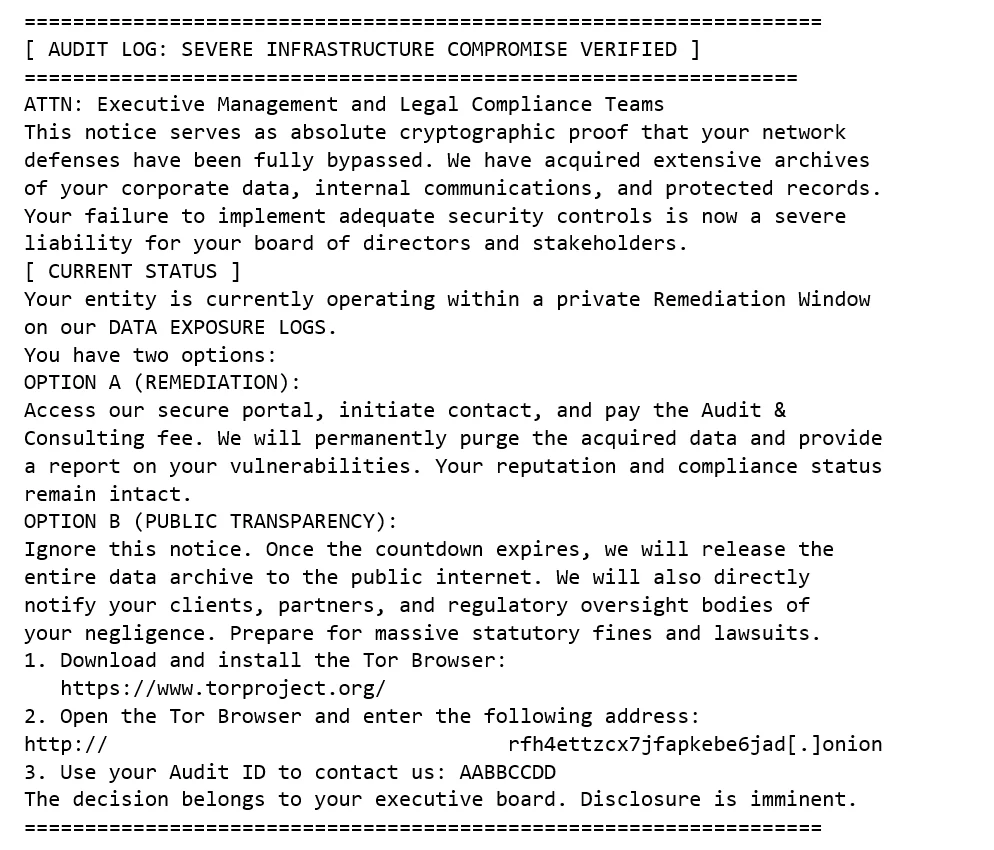
On March 10, 2026, Kaspersky analysts detected a previously unknown modular framework attacking an organization in Hong Kong. According to a technical report on AuditTeam’s OpsAgent framework from Kaspersky Labs, GitHub commit logs show the campaign actually started on January 5, 2026. The group frames its extortion as a paid security assessment. They promise to delete stolen data and deliver a vulnerability report if victims pay.
“While the note does not mention file encryption, it is left by the cryptor module. Therefore, if a victim sees the note, their files are already encrypted,” Kaspersky researchers wrote. The ransom note directs executives to a Tor portal and warns of regulatory fines and lawsuits if they ignore the countdown.
From C++ to Rust and CloudFront C2
The core implant, OpsAgent (version 5.2.8), rivals Cobalt Strike in features. It supports file management, keylogging, screenshot capture, privilege escalation, and network pivoting over WebSocket connections. Early C and .NET loaders injected shellcode into msiexec.exe using OLLVM obfuscation. However, in September 2026, researchers uncovered a Rust loader that decrypts and runs the payload inside its own process, avoiding remote process injection alerts.
To find its Amazon CloudFront command-and-control (C2) subdomains, OpsAgent read encrypted strings from a public GitHub repository (RonaldCMalcolm1983/staticPage). In August 2026, the group deployed a Rust rewrite dubbed OpsAgent-rs. This newer version upgraded its configuration encryption to AES-GCM, added interactive shells, and shifted from HTTP POST polling to persistent TLS WebSockets. In addition, Kaspersky noted uniform code structures and plaintext API names left in memory. These details suggest the developers used large language models to help build the framework.
BYOVD Killer and Destructive Cryptor
Two specialized modules handle defense evasion and encryption. First, an antivirus and EDR killer installs a digitally signed Beijing Jiangmin Antivirus driver (kvcore.sys). This driver terminates roughly 220 security, logging, and backup processes, including Microsoft Defender, Sysmon, Splunk, and Veeam. Second, the cryptor module stops SQL Server, Oracle, MySQL, MongoDB, and Redis databases. It deletes shadow copies, overwrites deleted files with random data, and encrypts files using AES-CBC or ChaCha20 with X25519 key exchange.
Who Is Behind the Activity
Kaspersky attributes the AuditTeam OpsAgent ransomware operations to AuditTeam with high confidence. This assessment relies on the group’s unique “Audit & Consulting fee” ransom note format, its Tor leak site, and its claimed mission to educate companies through forced remediation reports.
Independent threat trackers corroborate this timeline. Open-source portal dbdigest.com first documented AuditTeam in March 2026. DeXpose reported in June 2026 that the group claimed an attack on a Russian organization. “AuditTeam shows that a ransomware crew can build comparable tooling. This shift may be enabled by AI-assisted development tools lowering the barrier to creating functional, multi-module implant architectures,” Kaspersky noted.
Impact and Global Scale
Between January and October 2026, Kaspersky confirmed dozens of infections across Russia, Italy, the Philippines, Hong Kong, Senegal, Finland, and China. Additionally, AuditTeam’s leak site claims victims in Turkey, Thailand, Ukraine, Argentina, South Korea, Japan, and Spain. As Brandefense analysts noted in their review of the campaign, leak-site listings remain unverified claims until victims or regulators confirm them.
How Organizations Can Stay Protected
Although GitHub took down the group’s C2 repository in November 2026, the latest Rust implants have the GitHub lookup feature disabled. Therefore, defenders must assume the AuditTeam OpsAgent ransomware campaign remains active. Security teams should enable Microsoft’s vulnerable driver blocklist and alert on any unauthorized loads of the Jiangmin kvcore.sys driver.
As Wizard Cyber advised in its hunting guidance, defenders should watch for msiexec.exe processes holding outbound connections to CloudFront subdomains without an .msi installer argument. Finally, administrators should monitor for sudden stops across database, backup, and logging services. In addition, they should maintain offline immutable backups and brief executives to treat unsolicited “audit fee” demands as ransomware extortion.
Support Our Threat Intelligence
Find our threat intelligence and malware analysis helpful? Support our work today and unlock a 100% ad-free reading experience!
 Buy Me a Coffee
