BlueHammer: Researcher Drops Functional 0-Day Exploit Targeting Windows Defender
 Do Son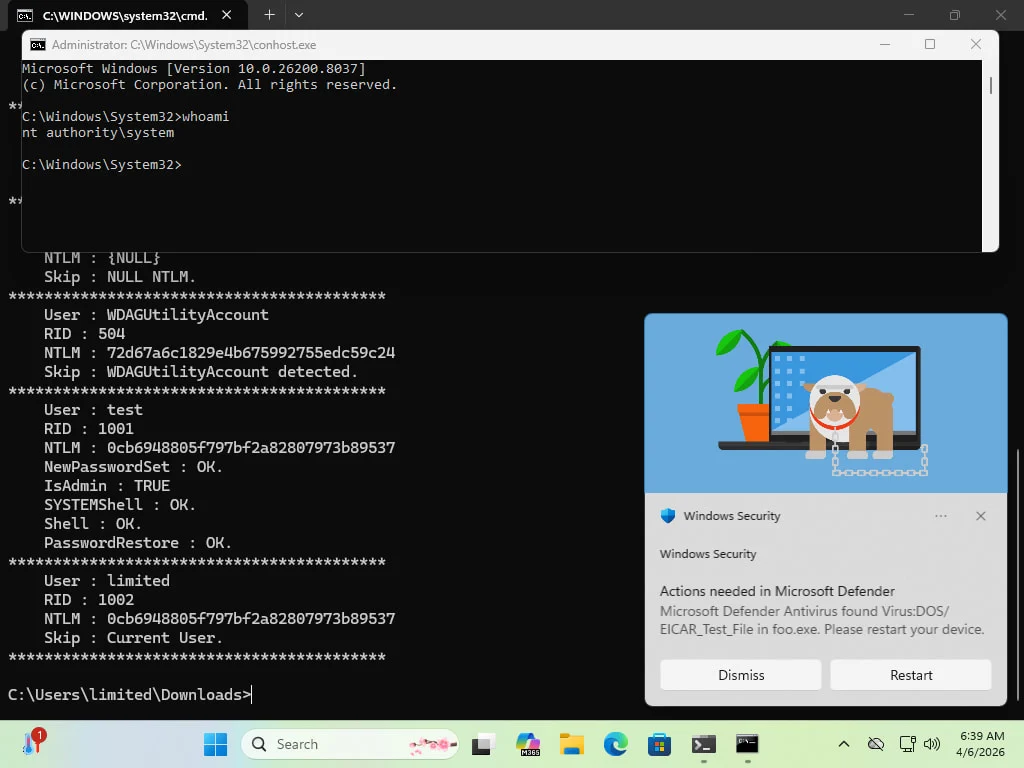
Image: Will Dormann
A researcher has publicly disclosed a functional zero-day exploit targeting the internal signature update mechanism of Windows Defender. The flaw, dubbed “BlueHammer,” allows a local attacker to achieve SYSTEM-level privilege escalation by manipulating how the antivirus software handles its own engine updates.
The disclosure comes with a pointed message to Microsoft, with the researcher stating, “I’m not explaining how this works, yall geniuses can figure it out”.
The BlueHammer exploit is a sophisticated chain that turns Windows Defender’s own high-privilege service against the operating system. The attack begins by connecting directly to Defender’s internal RPC interface (IMpService) and triggering the same method used for legitimate signature updates.
By hijacking this process, an attacker can redirect Defender’s SYSTEM-level operations to a directory under their control. As the report details, “The PoC then abuses NTFS symlinks/junctions via undocumented NT APIs (NtCreateSymbolicLinkObject, NtSetInformationFile) to redirect Defender’s SYSTEM-context file operations to attacker-controlled locations.”.
To ensure the exploit succeeds, BlueHammer utilizes a “Time-of-Check to Time-of-Use” (TOCTOU) race condition. The researcher employs highly creative synchronization primitives to “win” this race, including the Windows Cloud Files API (cfapi) and Volume Shadow Copy structures.
By using cloud file placeholders as a timing mechanism, the exploit can swap files at the exact microsecond required to trick the system into executing malicious code or granting unauthorized permissions.
The “BlueHammer” Execution Chain
- RPC Hijack: The attacker triggers an internal update command via the
ServerMpUpdateEngineSignaturemethod. - Path Redirection: Using NTFS junctions, the update process is pointed toward an attacker-controlled directory.
- Signature Spoofing: The PoC downloads a real update from Microsoft but extracts it in-memory, allowing for potential tampering via the offreg (offline registry) library.
- Race Victory: Through Cloud Files API callbacks, the attacker wins the race condition to achieve Local Privilege Escalation (LPE).
While the original reporter suggests the disclosure is a response to frustrations with the Microsoft Security Response Center (MSRC), independent experts have already begun verifying the threat. Will Dormann, a principal vulnerability analyst at Tharros, confirmed that the BlueHammer exploit is functional and effectively combines path confusion with a TOCTOU flaw.
However, the exploit may not be a “universal” threat just yet. Initial testing by other researchers suggests the code is currently unsuccessful on Windows Server, indicating there may be version-specific bugs that prevent it from working on all platforms.
At the time of this report, the BlueHammer vulnerability remains unpatched. Because the attack exploits the very mechanism intended to keep the system secure—the antivirus update engine—it poses a unique challenge for defenders.
Administrators are advised to monitor for unusual RPC calls to the IMpService interface and keep a close eye on unauthorized NTFS junction creations in system directories until an official security update is provided by Microsoft.
Support Our Threat Intelligence
Find our vulnerability reports and weekly recaps helpful? Support our work today and unlock a 100% ad-free reading experience!
 Buy Me a Coffee
