Critical WooCommerce Plugin Flaw (CVE-2025-12493, CVSS 9.8) Allows Unauthenticated RCE, 100,000+ Sites Affect
 Do Son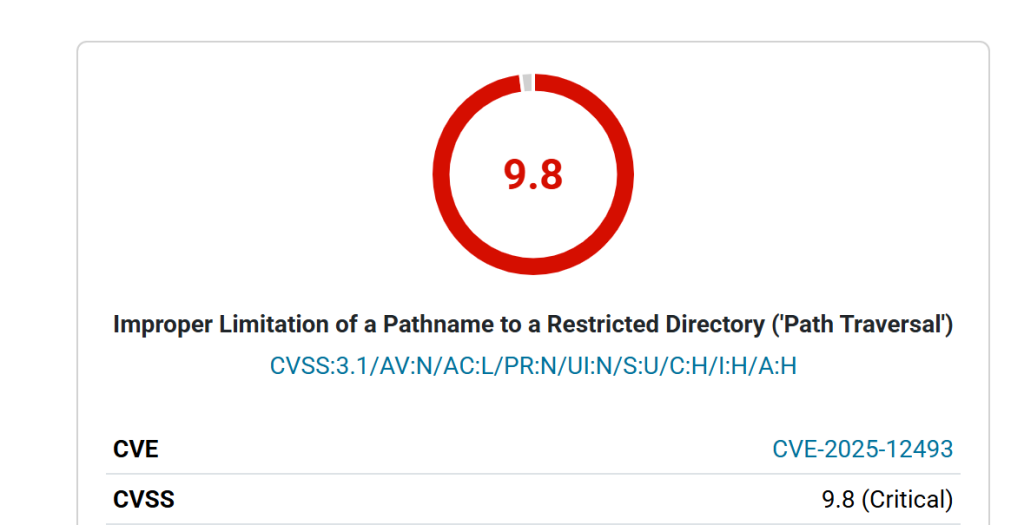
A critical-severity Local File Inclusion (LFI) flaw in the popular WordPress plugin ShopLentor – WooCommerce Builder for Elementor & Gutenberg +21 Modules – All in One Solution (formerly WooLentor) allows unauthenticated attackers to include and run arbitrary .php files on affected sites. The vulnerability (CVE-2025-12493, CVSS 9.8) affects all plugin versions ≤ 3.2.5 and was fixed in 3.2.6. The plugin has 100,000+ active installations, putting a large number of e-commerce sites at risk.
An LFI in the plugin’s load_template logic permits an unauthenticated request to force the WordPress/PHP runtime to include attacker-supplied .php files. If an attacker can upload or otherwise place a .php file on the server (for example, via misconfigured uploads, another plugin, or a writable directory), the vulnerable include will execute that file — yielding remote code execution and full site compromise.
If you operate WordPress sites using ShopLentor, treat this as urgent.
- Update NOW — Upgrade the ShopLentor plugin to version 3.2.6 immediately on every affected site (test first on staging if you must, but prioritize live e-commerce sites).
- If you cannot update immediately:
- Deactivate the plugin until you can apply 3.2.6.
- Or restrict access via a WAF / server rule to block requests that exploit
load_templateparameters.
- Check logs for suspicious requests and indicators of exploitation (see detection section). Look for requests containing unusual
templateorload_templateparameters or attempts to include../../paths or paths underwp-content/uploads.
Related Posts:
- Hackers are Exploiting Critical Security Vulnerability in WooCommerce Payments Plugin
- 90k+ Users at Risk: Unauthenticated LFI Vulnerability Affects Porto Theme
- CVE-2025-46619: LFI Vulnerability Affects Multiple Versions of Couchbase Server for Windows
- Exploited Zero-Day: Gladinet/Triofox Flaw CVE-2025-11371 Allows RCE via LFI
- Shield Security Plugin Hit by Severe LFI Vulnerability, 50,000+ Sites Affect
Support Our Threat Intelligence
Find our vulnerability reports and weekly recaps helpful? Support our work today and unlock a 100% ad-free reading experience!
 Buy Me a Coffee
