DeepMind’s WeatherNext 2: AI Model Forecasts Global Weather Two Weeks Ahead, 8X Faster
 Do Son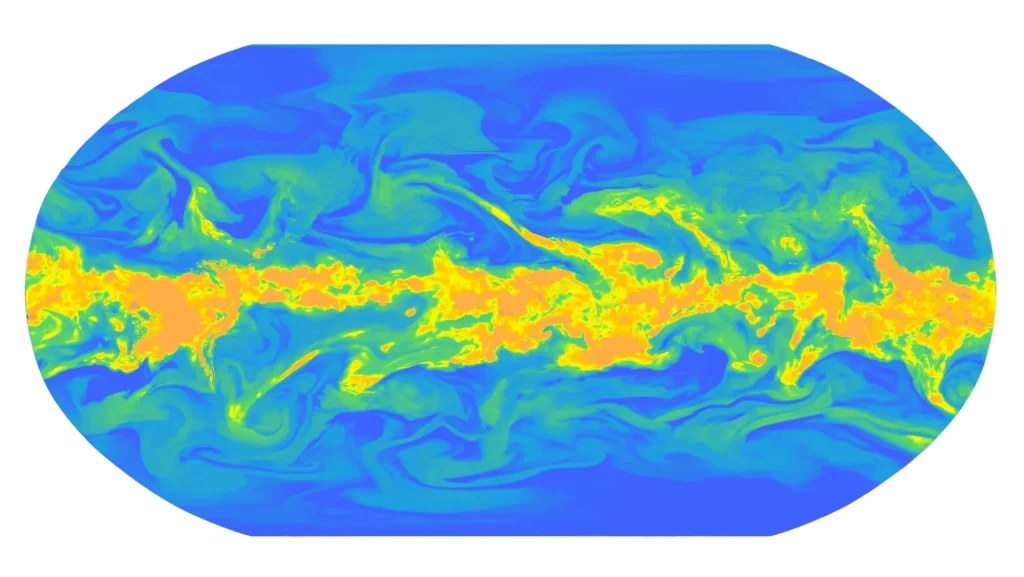
Google’s AI research division, DeepMind, has unveiled the latest iteration of its AI-driven weather forecasting model, WeatherNext 2. The company emphasizes that the new version delivers improvements in efficiency, accuracy, and resolution. It now offers global weather forecasts up to two weeks in advance — including temperature, atmospheric pressure, and wind patterns — and performs computations eight times faster than its predecessor, enabling industries such as energy trading to make far more precise decisions.
The defining enhancement of WeatherNext 2 lies in its significantly more granular forecasting capabilities.
To begin with, the new model introduces hourly forecasts. According to DeepMind researcher Akib Uddin, many industries rely on hour-level predictions to strengthen their operational resilience in the face of shifting weather conditions.
In the realm of disaster forecasting, WeatherNext 2 can now predict the trajectories of tropical storms — including hurricanes — with reliable accuracy up to three days in advance, extending the previous limit of two.
The dramatic performance gains stem from a fundamental redesign of the model’s methodology. As described in the accompanying research paper, earlier approaches relied on machine-learning techniques originally designed for generating images and video, which required repeated processing cycles to ensure correctness.
WeatherNext 2, by contrast, achieves its results through a single processing step, sharply reducing its dependence on costly AI computing infrastructure.
Although AI has begun to outperform traditional supercomputing methods in meteorology, Google acknowledges that WeatherNext 2 still has limitations.
DeepMind research scientist Ferran Alet notes that gaps in the training data mean the model may continue to struggle when predicting extreme rain or snow events.
The field of AI-powered weather forecasting has rapidly become a competitive frontier, with NVIDIA, Microsoft, AccuWeather, and Huawei all investing heavily in this domain.
Related Posts:
- ChatGPT’s New Feature Allows Hackers to Steal Your Data
- Knight: The Next-Gen Ransomware Targeting Multiple OS
- RocketMQ Vulnerability Exploited by DreamBus Malware
Support Our Threat Intelligence
Find our tech and OS security coverage helpful? Support our work today and unlock a 100% ad-free reading experience!
 Buy Me a Coffee
