StreetViewAI: Google’s Multimodal AI Brings Conversational Street View Navigation to the Visually Impaired
 Do Son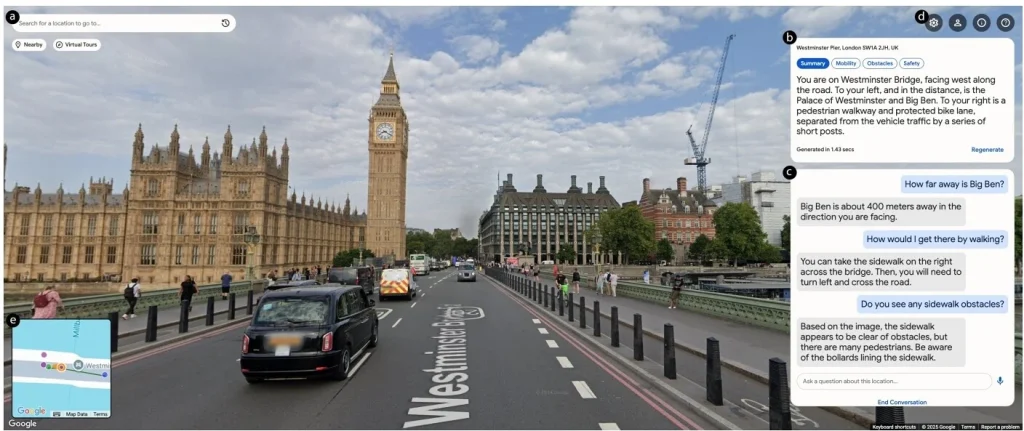
Google Research and DeepMind have recently unveiled a groundbreaking study introducing an innovative system called “StreetViewAI,” designed to overcome the long-standing “visual dependency” of street view maps — a major barrier for visually impaired individuals. The system enables users to explore Google Street View’s vast repository of over 220 billion images across more than 100 countries through natural, conversational AI interaction.
Traditional street view services rely heavily on immersive 360-degree imagery, which offers intuitive spatial awareness for sighted users but remains largely inaccessible to those who depend on auditory cues or assistive technologies.
StreetViewAI seeks to change that paradigm. Built upon the Google Gemini Flash 2.0 multimodal model, the research team developed three core subsystems — AI Describer, AI Chat Agent, and AI Tour Guide.
The AI Describer provides real-time verbal descriptions of objects, spatial relationships, and navigational cues within a scene. The AI Chat Agent allows users to ask natural-language questions such as “Is there shade along this sidewalk?”, “Is the café entrance wheelchair-accessible?”, or “Are there any interesting landmarks on this route?” — and the AI responds based on previous viewpoints and conversational context.
Meanwhile, the AI Tour Guide enriches the experience with historical, cultural, and architectural insights, turning exploration into an informative journey rather than mere navigation.
In real-world testing, the researchers invited 11 visually impaired participants, all regular users of white canes and screen readers, to perform two tasks: destination search and free exploration. During the experiment, participants interacted with the AI Chat Agent 917 times, far surpassing the 136 interactions with the AI Describer — a result that highlights the natural appeal and practicality of conversational engagement.
Quantitatively, the AI achieved an impressive 86.3% accuracy rate in its responses, with only 3.9% incorrect answers. The most common question categories involved spatial relationships (27%), object presence verification (26.5%), and real-time scene descriptions (18.4%).
Over 90% of participants chose to communicate via voice commands. Several testers noted that traditional navigation systems often stop a few meters short of the destination, while StreetViewAI not only “leads you to the door” but also describes its appearance and accessibility — offering a far more precise and empowering form of guidance.
This research underscores Google’s ambitious vision for multimodal AI, demonstrating how artificial intelligence can transcend entertainment or productivity to become a vital tool for inclusivity. As StreetViewAI continues to evolve — improving accuracy, expanding coverage, and refining its conversational depth — it may not only transform the digital experience for the visually impaired, but also pave the way for broader applications in education, tourism, and smart city navigation.
Related Posts:
- Indian government rejects Google Street View service
- OpenAI Unveils AI-Powered Browser: ChatGPT Integration to Revolutionize Web Browse & Challenge Chrome
- ChatGPT Search Gets Major Upgrade: Smarter Responses, Better Context & Image Search
Support Our Threat Intelligence
Find our tech and OS security coverage helpful? Support our work today and unlock a 100% ad-free reading experience!
 Buy Me a Coffee
