 Do Son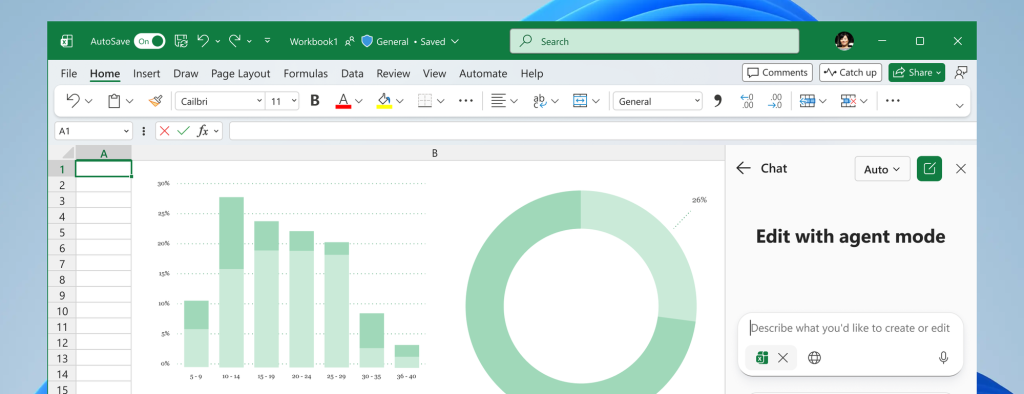
The AI Agent framework, underpinned by Microsoft Copilot, has previously graced the web-based iteration of Excel. This AI-driven workflow is meticulously engineered to provide an “agentic” experience, empowering the system to execute complex tasks autonomously upon the provision of coherent prompts.
Following its multi-month tenure on the web, Microsoft has finally extended these capabilities to Excel for Windows and macOS. The agent integrates seamlessly with the Copilot interface, featuring a sophisticated model selector that allows users to designate their preferred computational “brain.” At present, the primary offerings include GPT-5.2 and Claude Opus 4.5. To access these advanced utilities, a Microsoft 365 subscription—encompassing Business, Personal, and Family tiers—is required, though usage quotas may vary across plans.
Microsoft asserts that this evolution is a direct response to user feedback, which indicated that specific models excel at resolving structured, rapid-fire inquiries, while others are better suited for exhaustive, task-oriented exploration. To alleviate user complexity, the AI Agent defaults to an “Automatic” setting, intelligently selecting the optimal model for the task at hand.
The AI Agent further distinguishes itself by its capacity to exfiltrate data from the internet to synthesize visualizations, orchestrate entire workbooks, and rectify formulaic anomalies with remarkable celerity. Users need only articulate their specific requirements for the agent to manifest the desired results.
To avail yourself of these features, ensure your installation of Excel for Windows or Mac is current, select the Microsoft Copilot icon, and engage “Agent Mode” from the utility menu. Microsoft provides a suite of pre-configured templates—such as a loan calculator—whereby the user simply inputs the principal, interest rate, and duration to derive monthly amortization schedules.
Owing to regional regulatory constraints, these functionalities are currently withheld from users within the European Union and the United Kingdom. Historically, Microsoft tends to deploy specialized versions with enhanced data sovereignty protections in these jurisdictions following a developmental hiatus of several months.
Related Posts:
Support Our Threat Intelligence
Find our tech and OS security coverage helpful? Support our work today and unlock a 100% ad-free reading experience!
 Buy Me a Coffee
