 Do Son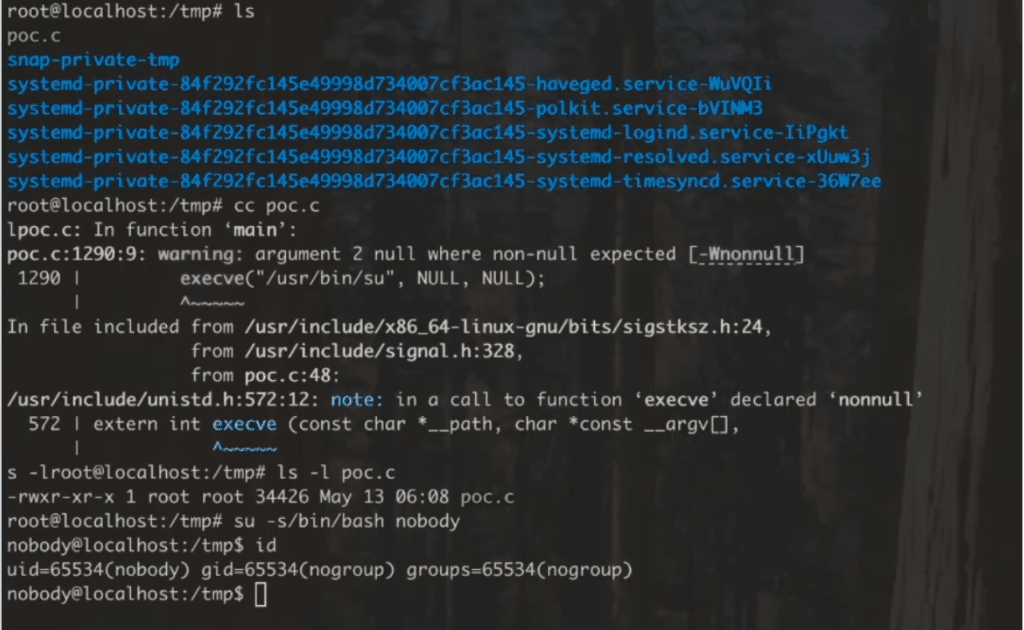
The Linux security landscape has been rocked by the public disclosure of Fragnesia, a universal local privilege escalation (LPE) exploit that allows any unprivileged user to seize full root control of a system. Discovered by William Bowling and the V12 team, this vulnerability is a potent new member of the “Dirty Frag” class, targeting a logic flaw deep within the Linux kernel’s networking subsystem.
The full technical details and a one-line proof-of-concept (PoC) exploit have been released to the public.
The name “Fragnesia” stems from a specific failure in kernel memory management. As the researchers explain, the core issue is that “the skb ‘forgets’ that a frag is shared during coalescing”.
This allows the exploit to abuse a logic bug in the ESP-in-TCP subsystem. By transitioning a TCP socket to a specific mode after data has been “spliced” from a file, the kernel can be tricked into treating legitimate file pages as encrypted data.
Unlike many high-caliber exploits, Fragnesia does not require a complex race condition. Instead, it uses a surgical approach to modify files that should be read-only.
The exploit targets the VFS page cache—the temporary storage the operating system uses to speed up file access. By carefully selecting cryptographic nonces, the attacker can XOR specific values directly into cached file pages.
The V12 team demonstrated this by writing a small, malicious code stub over the first 192 bytes of the /usr/bin/su binary while it sits in memory. “The page cache modification is not backed to disk; the on-disk binary is untouched,” the report notes. However, when the system tries to run that cached version of su, it executes the attacker’s code instead, dropping them into a root shell.
The most alarming aspect of this disclosure is the ease of execution. The researchers provided a simple command-line sequence that automates the entire process, from cloning the repository to firing the exploit.
One-line special:
The exploit leaves the system in a compromised state. “After the exploit runs, /usr/bin/su in the page cache contains the injected stub”. Anyone else using the su command on that machine will continue to spawn a root shell until the cache is manually cleared or the system is rebooted.
Fragnesia affects a wide swath of Linux environments.
- Affected Versions: All versions of the Linux kernel released before May 13, 2026, are considered vulnerable.
- Mitigation: If you cannot update your kernel immediately, researchers recommend disabling specific modules: rmmod esp4 esp6 rxrpc.
As the details of Fragnesia circulate through the developer and attacker communities alike, the “universal” nature of this bug makes immediate patching the only viable defense for Linux-based infrastructure.
Update:
This flaw is tracked as CVE-2026-46300.
Support Our Threat Intelligence
Find our vulnerability reports and weekly recaps helpful? Support our work today and unlock a 100% ad-free reading experience!
 Buy Me a Coffee
