Details and PoC Exploit Released for Jackson-Databind Flaw CVE-2026-110879 (CVSS 9.8)
 Do Son
TL;DR
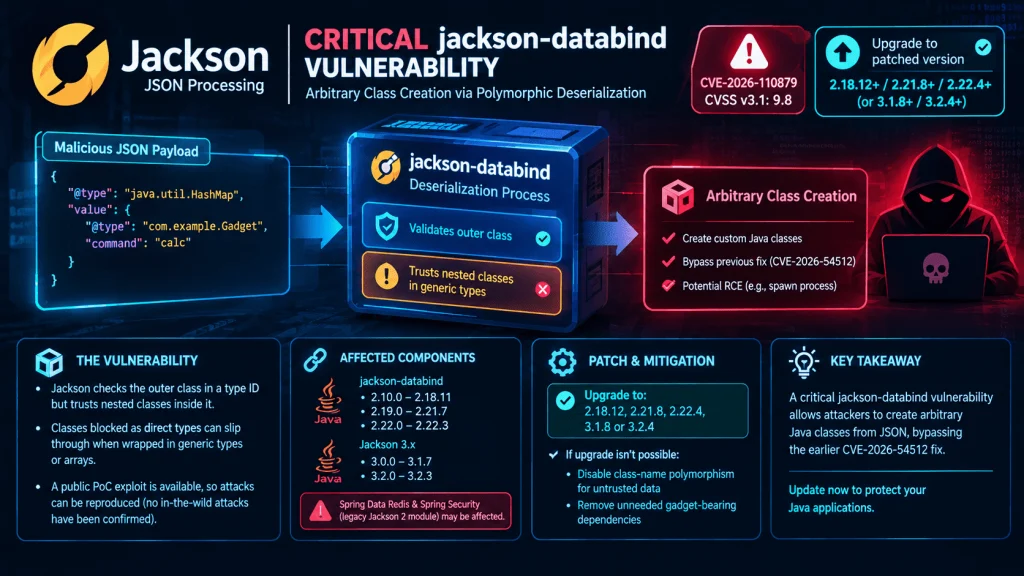
FasterXML has published full details and a proof-of-concept exploit for CVE-2026-110879, a critical jackson-databind vulnerability. The flaw scores 9.8 on CVSS v3.1. It bypasses the fix for an earlier bug, CVE-2026-54512, and lets attackers create arbitrary Java classes from JSON.
Jackson checks the outer class in a type ID but trusts the classes nested inside it. The public advisory includes a standalone reproducer, so the PoC exploit is now available to anyone. Upgrade to a patched jackson-databind release.
- Product: FasterXML jackson-databind
- Vulnerabilities: 2 flaws (CVE-2026-110879, CVE-2026-54512)
- Highest severity: 9.8 (Critical · CVSSv3)
- Worst impact: PolymorphicTypeValidator bypass via generic type arguments and array element types allows arbitrary class instantiation (incomplete fix for CVE-2026-54512)
- Status: No confirmed exploitation yet; patches available
- Action: Update to 2.18.12, 2.21.8, 2.22.4, 3.1.8 (+1) now
| CVE | CVSS (CVSSv3) | Type | Fixed in | Status |
|---|---|---|---|---|
| CVE-2026-110879 | 9.8 | CWE-502 | 2.18.12, 2.21.8, 2.22.4 (+2) | Not exploited |
| CVE-2026-54512 | 8.1 | CWE-184 | — | Not exploited |
Why It Matters
Jackson is a core JSON library in the Java world, so this jackson-databind vulnerability reaches many apps. Moreover, the advisory names Spring components that expose the vulnerable path. These include Spring Data Redis and Spring Security’s legacy Jackson 2 module.
According to the advisory, “An unauthenticated attacker who controls polymorphic JSON in an affected network-facing deployment can select classes to instantiate.” With Spring present, the demonstrated chain starts a new process “under the application account.”
How the Attack Works
The advisory explains that Jackson “accepts attacker-selected classes inside its generic arguments even when they violate the declared type.” In other words, a class blocked as a direct type ID slips through when wrapped inside a generic type. Array element types had the same gap.
Notably, the fixed releases for CVE-2026-54512 still “accept the remaining path.” However, exploitation depends on the app’s polymorphism settings and the classes on its classpath. The public PoC exploit shows these effects with test resources. So far, no attacks in the wild have been confirmed.
Affected Versions
- jackson-databind 2.10.0 through 2.18.11, 2.19.0 through 2.21.7, and 2.22.0 through 2.22.3
- Jackson 3.x: 3.0.0 through 3.1.7, and 3.2.0 through 3.2.3
Patch and Mitigation
Install jackson-databind 2.18.12, 2.21.8, 2.22.4, 3.1.8 or 3.2.4. The fix now validates “every class named in a type ID, including type parameters and array element types.”
If you cannot upgrade, disable class-name polymorphism for untrusted data. Also, remove unneeded gadget-bearing dependencies. See the jackson-databind advisory GHSA-m8xf-2cr7-77ph for every affected setup tied to this jackson-databind vulnerability.
Support Our Threat Intelligence
Find our vulnerability reports and weekly recaps helpful? Support our work today and unlock a 100% ad-free reading experience!
 Buy Me a Coffee
