 Do Son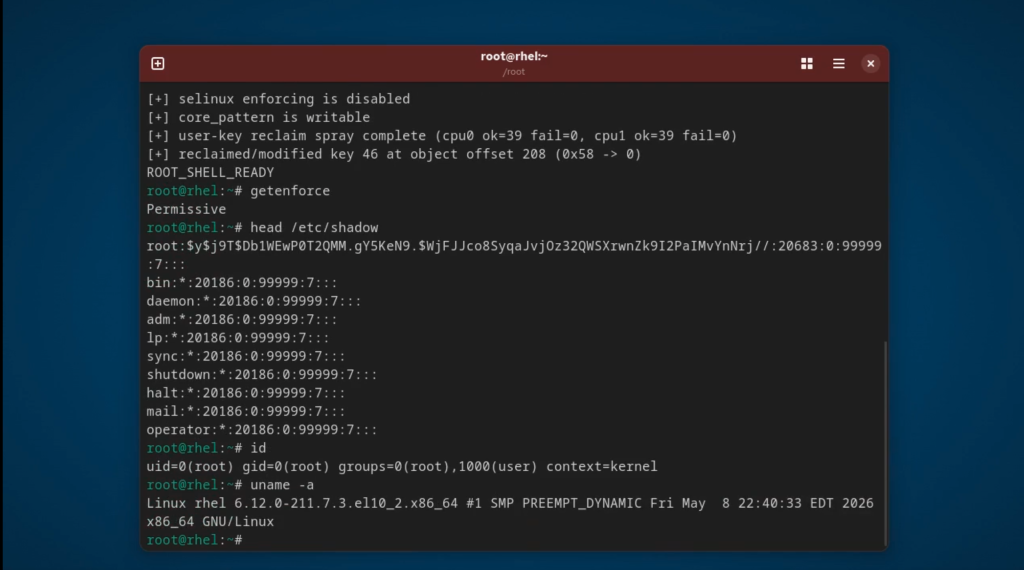
A newly disclosed flaw in the Linux kernel enables local Linux kernel privilege escalation. Tracked as CVE-2026-74480 and rated CVSS 9.8, the bug lives in the network bridge module. Researchers from Nebula Security have already published proof-of-concept exploit code and a demo video.
TL;DR
CVE-2026-74480 is a use-after-free in the Linux kernel bridge code. It carries a CVSS score of 9.8. Public exploit code exists, and researchers demonstrated root privilege escalation. No in-the-wild exploitation has been confirmed yet.
- CVE: CVE-2026-74480
- CVSS: 9.8 (Critical · CVSSv3)
- Product: Linux
- Affected: 6db6f0eae6052b70885562e1733896647ec1d807, 4.11
- Impact: net: bridge: stop fast-leave after deleting a port group
- Status: No confirmed exploitation yet
- Patched in: d6c32e2e25a9a06ba021030e26b6d602a277eb72, 482bcb85139addb4e8ac8ed10baeda3e0aad4031, 1a109cc9890d017c41d77e6c82da739579c49f0b, 159ad90cb929c033308bb39a2c5f8fbf393b77aa (+12 more)
- EPSS: 0.6% (30-day)
- Action: Update to d6c32e2e25a9a06ba021030e26b6d602a277eb72, 482bcb85139addb4e8ac8ed10baeda3e0aad4031, 1a109cc9890d017c41d77e6c82da739579c49f0b, 159ad90cb929c033308bb39a2c5f8fbf393b77aa (+12 more) now
Why It Matters
The Linux kernel bridge module runs on countless servers and appliances. A local attacker could turn this flaw into full root access. That outcome hands over complete control of the host.
The high CVSS 9.8 rating reflects that severity. Now that exploit code is public, the barrier to abuse drops sharply.
How the Attack Works
The bug sits in the multicast fast-leave path. During a fast leave, the code can access a port group after deletion. This creates a stale pointer, or use-after-free.
The condition triggers when multicast-to-unicast is enabled and then disabled. As a result, the bridge may hold duplicate port groups matched by port only. That memory corruption can crash the system or, per the researchers, allow privilege escalation. Nebula Security shared a demo video of the root privilege escalation on X.
Today's exploit is for the latest Red Hat Enterprise Linux 10.2, a UAF in net bridge, CVE-2026-74480.
It was introduced in Jan 2017 and fixed upstream in Jul 2026.
Discovered and exploited by the NebuSec security pipeline.
Exp source code: https://t.co/YJAXvWHzCn pic.twitter.com/XXSIDNtalX
— Nebula Security (@nebusecurity) August 24, 2026
Affected Versions
The flaw dates back to January 2017. Therefore many long-lived kernel branches are affected. Upstream developers fixed it in July 2026.
Patch and Mitigation Steps
Update to a patched kernel as soon as possible. The upstream fix breaks the loop after deleting a matching port group. Distribution vendors are shipping updates now, so apply them promptly.
Nebula Security published its proof-of-concept exploit code in a GitHub research repository targeting RHEL 10.2. Review it to build detections and confirm your exposure.
Support Our Threat Intelligence
Find our vulnerability reports and weekly recaps helpful? Support our work today and unlock a 100% ad-free reading experience!
 Buy Me a Coffee
