Beyond Email: Attackers Hijack Microsoft Teams External Access to Launch Deep Network Compromise
 Do Son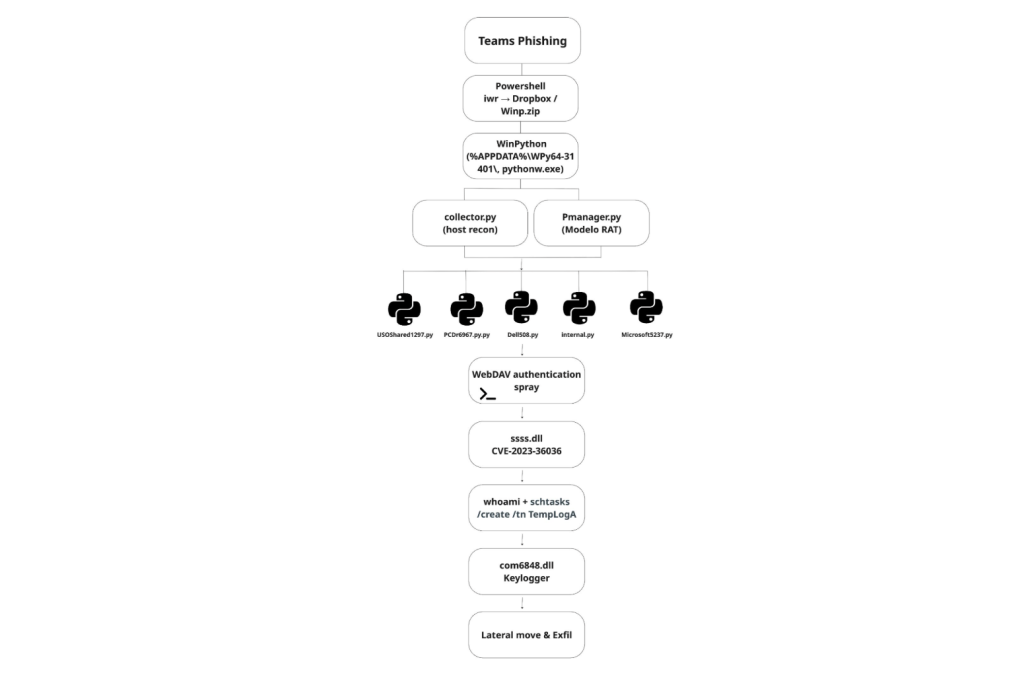
Attack chain from Teams phishing | Image: Rapid7
A newly detailed incident response investigation highlights a critical reality for corporate security teams: the perimeter of the modern enterprise is no longer defined solely by firewalls and email gateways. Collaboration platforms have quietly emerged as a high-value, friction-free entry point for advanced threat actors.
A technical report published by Rapid7 Labs has exposed the anatomy of an intrusive corporate breach that bypassed standard defensive boundaries using simple social engineering on collaboration applications. The attack quickly expanded from a single user interaction into a full-scale network compromise.
The attacker initiated the intrusion by exploiting Microsoft Teams external access configurations, which allow users from outside organizations to message internal corporate accounts. Posing as an internal IT support technician, the attacker convinced an employee to open a link to a malicious payload hosted on Dropbox.
Because the employee trusted the context of a live internal chat workspace, the social engineering barrier was significantly lower than a traditional email phishing attack. Rapid7 Labs notes the alarming strategic effectiveness of this entry point:
“The incident illustrates a critical risk for modern enterprises: Collaboration platforms have become part of the attack surface, and when combined with identity abuse and Living-off-the-Land techniques, they can provide attackers with a low-friction path into the environment.”
Once the victim clicked the link, a Python-based payload executed silently on the endpoint, establishing a persistent command-and-control (C2) channel and pulling down secondary backdoors to map the organization’s internal directory architecture.
With a stable foothold established on the compromised endpoint, the threat actor shifted focus toward high-level privilege extraction. The attacker weaponized CVE-2023-36036, a known Windows privilege escalation vulnerability, to instantly vault their execution context from standard user permissions to local SYSTEM authority.
Rather than relying purely on technical exploits to harvest domain passwords, the attacker turned to a deceptively simple human-in-the-loop psychological trick: deploying a realistic, full-screen fake Windows lock screen overlay directly over the user’s active session. Believing their machine had simply timed out or locked automatically, the employee re-entered their corporate domain password, inadvertently logging it directly into the attacker’s data cache.
Armed with legitimate domain credentials, the attacker transformed the endpoint compromise into an active identity-driven threat. The very same evening, the threat actor initiated lateral movement across the network:
“The same evening, the attacker used harvested credentials to authenticate via RDP to another workstation in the network. DNS logs showed connections to Dropbox and some internal systems. Additionally, they also performed Kerberoasting against service accounts, requesting vulnerable Kerberos tickets in an attempt to expand access within the environment.”
By executing Kerberoasting attacks, the adversary sought to pull down offline-crackable service tickets, hunting for broader administrative access across corporate database and identity domains.
The following morning, the attacker returned to the secondary host via Remote Desktop Protocol (RDP) to finalize their exfiltration routine. Using the workstation’s built-in Microsoft Edge browser, the attacker pulled down the Comae security toolkit, which includes Dumpit, a legitimate memory acquisition utility.
The threat actor ran Dumpit.exe to scrape the endpoint’s active physical RAM. This targeted look at live system memory is a high-value tactic:
“Dumpit captures physical RAM, including LSASS process memory, which can contain cleartext passwords, NTLM hashes, and Kerberos tickets.”
To slip the resulting heavy memory dump out of the corporate network without triggering data loss prevention (DLP) flags, the attacker turned to anonymous web services. Browser history logs revealed the attacker carefully evaluated their options, searching via Bing to check if “Swiss Transfer” was a safe site for large files before ultimately uploading the stolen RAM archive straight to uploadnow[.]io, a free anonymous file-hosting portal.
The Rapid7 Labs investigation demonstrates how easily classic security silos can be chained together by an adversary to achieve speed and operational efficacy.
To contain these risks, modern enterprises must aggressively manage identity boundaries. Defenders are urged to restrict or disable Microsoft Teams external access policies for unauthorized outside domains, strictly audit local systems for unpatched privilege escalation pathways like CVE-2023-36036, monitor process trees for unexpected memory imaging utilities like Comae/Dumpit, and block network access to anonymous file-sharing applications at the perimeter firewall.
Support Our Threat Intelligence
Find our threat intelligence and malware analysis helpful? Support our work today and unlock a 100% ad-free reading experience!
 Buy Me a Coffee
