 Do Son
The digital ink had barely dried on the disclosure of CVE-2026-21962 before threat actors began a relentless campaign to weaponize it. A recent high-interaction honeypot study conducted between January 22 and February 3, 2026, has revealed a disturbing reality: the gap between vulnerability disclosure and full-scale exploitation has practically vanished.
See a Oracle CVE's exploit risk spike before it becomes a headline.
Get EPSS spike alertsThe report highlights a “zero-day-like” scenario where attackers didn’t wait for organizations to test their patches. According to the findings from CloudSEK:
“Attack attempts targeting this zero-day-like flaw were observed immediately following the public release of its exploit code, demonstrating the rapid weaponization of critical Oracle WebLogic vulnerabilities”.
The first recorded attempt occurred on January 22, 2026—the exact same day the public exploit was released on GitHub. While a single IP address led the charge on day one, a broader wave of automated scanning across the internet followed by January 27.
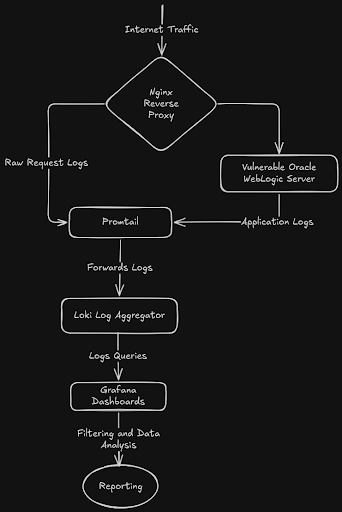
The vulnerability, which carries a maximum CVSS score of 10.0, is an unauthenticated Remote Code Execution (RCE) flaw residing in the WebLogic Server Console. It allows an attacker to bypass security entirely and “execute arbitrary operating system commands on the vulnerable server”.
The study observed that threat actors aren’t just looking for the “new shiny object.” They are simultaneously cycling through a “small set of highly-effective, simple-to-exploit vulnerabilities” to compromise environments, including older flaws like CVE-2017-10271 and CVE-2020-14882.
Most of this malicious traffic is being launched from rented Virtual Private Servers (VPS), with providers like DigitalOcean and HOSTGLOBAL.PLUS being the top choices for maintaining high-volume, automated scanning operations.
While the honeypot was specifically designed to mimic an Oracle WebLogic environment, it acted as a magnet for a wide variety of “background noise”. Attackers utilized a “spray and pray” approach, targeting everything from Hikvision cameras to PHPUnit vulnerabilities.
The data confirms that the root path (/) remains the most probed endpoint for generic reconnaissance, but attackers are increasingly hunting for configuration files like /.env and source code secrets in /.git/config.
The severity of an unauthenticated RCE cannot be overstated, as it grants an attacker “full control over the compromised WebLogic instance and its host system”. To mitigate this risk, the report suggests a multi-layered defense strategy:
- Immediate Patching: Apply the latest Oracle Critical Patch Updates (CPUs) immediately, prioritizing the fix for CVE-2026-21962.
- Restrict Access: The administrative console “should never be exposed directly to the internet”. Access should be strictly limited to VPNs or internal networks.
- Disable Unused Protocols: Restrict or disable sensitive protocols like IIOP/T3 and WLS-WSAT if they are not required for operations.
- Implement WAF Filtering: Use a Web Application Firewall to block specific path traversal sequences and known exploit patterns targeting the ProxyServlet.
As the report concludes, the speed of modern exploitation means that “the data underscores the critical and immediate need for organizations to prioritize the patching of CVE-2026-21962” before the next automated wave hits.
Support Our Threat Intelligence
Find our vulnerability reports and weekly recaps helpful? Support our work today and unlock a 100% ad-free reading experience!
 Buy Me a Coffee
