
 Do Son
Check Point Research (CPR) has published new findings on Nimbus Manticore, an Iranian state-aligned APT group overlapping...
Latest news

Shortly after the release of Windows 11 version 24H2, users began reporting irregularities with the Windows Hello...

Perplexity has announced the launch of its new “Email Assistant” service, an AI-powered tool designed to streamline...

The Mozilla Foundation has recently announced the launch of a rollback/restore feature for Firefox Add-ons, enabling developers...

 cybernewswire
Pittsburg, United States, 23rd September 2025, CyberNewsWire

Google has officially announced that its generative AI assistant, Gemini, will be fully integrated into the Google...

Apple is currently pushing a broad wave of automatic upgrades to iOS 26, and while some users...

Ten years ago, the European Union amended its internet regulations and, through a revised ePrivacy Directive, imposed...

Numerous reports have begun to surface on Apple’s official forums and other online communities regarding intermittent Wi-Fi...

A PoC code for a macOS CVE-2023-32364 vulnerability could be exploited to escape a sandbox and execute code within the Terminal

CVE-2023-20109 could allow an authenticated, remote attacker to execute arbitrary code on an affected device or cause the device to crash
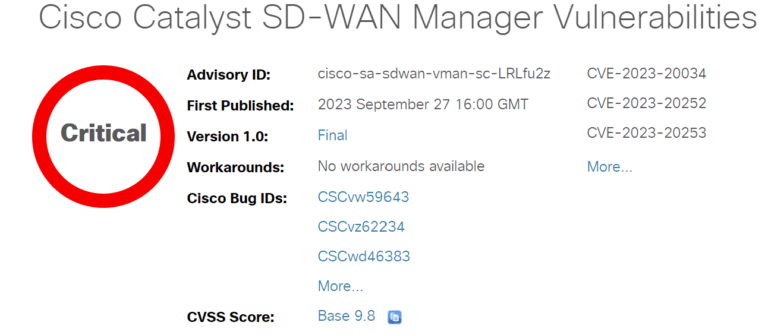
The CVE-2023-20252 vulnerability resides in the Security Assertion Markup Language (SAML) APIs of Cisco Catalyst SD-WAN Manager

Google recently revealed in a security advisory that a zero-day vulnerability, designated as CVE-2023-5217, is being actively exploited.

CVE-2023-40044 (CVSS: 10) is a pre-authenticated remote command execution vulnerability that affects versions prior to 8.7.4 and 8.8.2

An attacker could exploit CVE-2023-3767 to execute arbitrary commands on the affected system by sending a specially crafted HTTP request.

CVE-2023-5002 vulnerability has been discovered in pgAdmin, a popular graphical user interface (GUI) management tool for PostgreSQL databases

PoC exploit code has been released for a critical CVE-2023-29357 allowing the elevation of privilege in Microsoft SharePoint Server products

Recognizing the depth of this security flaw, Google has assigned a fresh identity: CVE-2023-5129, alongside a daunting 10/10 severity rating

Unlock the power of data labeling in machine learning with our comprehensive guide. Learn how to navigate the world of labeled data, from its significance to its real-world applications.

CVE-2023-41993 provided the opening gambit, allowing RCE in Safari. CVE-2023-41991 facilitated the bypass of signature validation.

The CVE-2023-0625 vulnerability enables RCE, granting unauthorized parties potential full control over the victim's system.

JetBrains acted promptly. In the subsequent release, TeamCity version 2023.05.4, the CVE-2023-42793 vulnerability was patched

CVE-2023-42810 is a critical command injection bug in systeminformation, a popular Node.js library for retrieving system information

A closer examination of the affected versions reveals that Linux kernel versions 6.1, 5.15, and 5.10 are vulnerable to CVE-2023-42753

Researcher, @nguyendt016, announced the development of a proof-of-concept (PoC) exploit for the CVE-2023-41892 vulnerability.

An attacker could exploit the CVE-2023-3341 vulnerability by sending a specially crafted message to a vulnerable server, causing it to crash

The technical detail and proof-of-concept (PoC) exploit code has been published for a Chrome zero-day vulnerability tracked as CVE-2023-4863

The CVE-2023-23363 vulnerability could be exploited by attackers to execute malicious code on affected devices.

CVE-2023-42660 could serve as a backdoor for authenticated malefactors to sneak into the MOVEit Transfer database

WebKit powers Apple's Safari browser. CVE-2023-41993 allowed cyber attackers to execute arbitrary codes through maliciously crafted web pages

CVE-2023-43495 allows attackers to inject malicious JavaScript code into Jenkins build logs, which can then be executed by users viewing those logs