 Do Son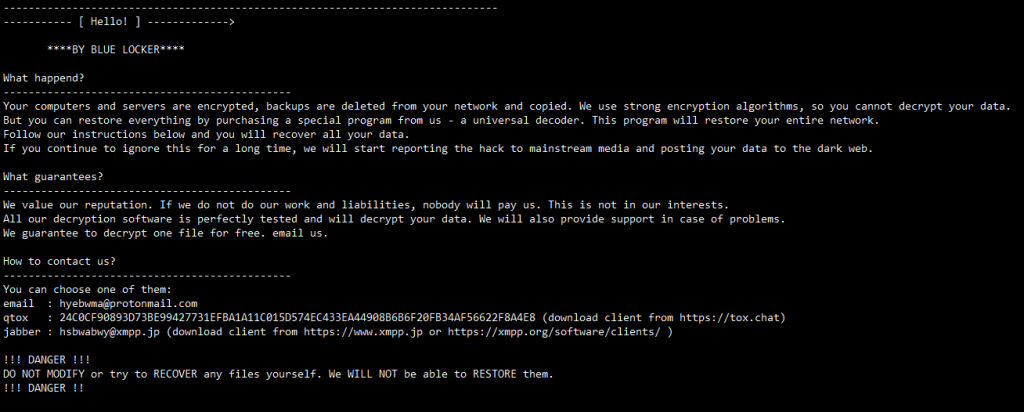
Image: Resecurity
Pakistan has found itself in the crosshairs of a sophisticated ransomware campaign, as the country’s National Cyber Emergency Response Team (NCERT) warns of “severe risk” from an emerging strain known as Blue Locker. The advisory, sent to 39 key ministries and institutions, highlights how this ransomware is actively targeting government services, energy, and technology sectors.
The attacks coincided with Pakistan’s Independence Day celebrations on August 14—a timing that investigators see as far from coincidental. As Resecurity notes:
“This ransomware attack could be considered significant, as it targeted major enterprise in the country’s oil and gas sector (Pakistan Petroleum Limited), which is critically important to the economy.”
Pakistan Petroleum Limited (PPL) confirmed a serious disruption, with its IT systems paralyzed for two days and operations suspended while forensic analysis and recovery protocols were activated.
Resecurity describes Blue Locker as a PowerShell-delivered ransomware capable of disabling defenses, escalating privileges, and spreading across networks. It appends extensions such as “.blue” or “.bulock16” to encrypted files and leaves behind a ransom note titled HOW_TO_BACK_FILES.html.
The malware demonstrates advanced persistence and evasion tactics. For example, researchers observed that it terminates Chrome processes in order to encrypt browser-stored passwords, a maneuver that makes credential recovery virtually impossible. According to the report:
“During our analysis, we observed that ‘Blue Locker’ searches for a unique obfuscated string… an XOR-encoded variant of ‘Chrome.exe.’ Upon locating this target process, ‘Blue Locker’ forcibly terminates it to bypass file locks and gain access to Chrome’s local password database.”
It uses a blend of AES and RSA encryption algorithms to lock files and carefully avoids system-critical directories to keep the infected host stable—ensuring ransom negotiations can take place.
While NCERT initially connected Blue Locker with the Shinra malware family, Resecurity’s deeper analysis uncovered links to the Proton ransomware lineage, which has been associated with Iranian operators in the past. However, attribution remains murky.
Resecurity cautions that:
“It would be incorrect to attribute responsibility for the past attack solely based on its historical context – actors from any other geography could easily reuse and reproduce its samples.”
The group highlights that Proton ransomware source codes have circulated on the Dark Web, opening the door to third-party actors leveraging the malware for geopolitical or financially motivated operations.
Beyond the malware itself, researchers noted disinformation campaigns amplifying the breach. Some dark web actors falsely claimed large-scale leaks from Pakistan Petroleum, designed to spread panic and undermine trust.
Resecurity interprets these narratives as psyops:
“Such tactics could be interpreted as part of a psyop (psychological operation) aimed at generating fear, panic, and increased attention.”
This complicates attribution further, with potential false flags inserted to obscure the true origin of the campaign.
Blue Locker represents a dangerous evolution of ransomware, merging Proton-family sophistication with modern evasion and extortion tactics. Its targeting of Pakistan’s ministries and critical oil and gas sector underscores the rising trend of state-aligned or nation-state-like groups masquerading as cybercriminals to blur attribution.
As Resecurity concludes:
“’Blue Locker’ ransomware is a sophisticated and highly dangerous threat… it also exhibits advanced evasion techniques like obfuscation, anti-analysis, and potential data exfiltration, which makes it a significant threat to both individual users and enterprises.”
Related Posts:
- Pakistan bans financial institutions from participating in cryptocurrency transactions
- Proton Launches Standalone Authenticator: Separating MFA from Passwords for Ultimate Security
- Microsoft Shuts Down Pakistan Office After 25 Years, Citing Global Restructuring
- Smishing Triad Targets Pakistan with Large-Scale Banking Scam
- iOS Update: Proton Authenticator Bug Leaked TOTP Secrets in Plaintext Logs
Support Our Threat Intelligence
Find our threat intelligence and malware analysis helpful? Support our work today and unlock a 100% ad-free reading experience!
 Buy Me a Coffee
