Pay to Post: Meta Tests 2-Link Monthly Limit for Unverified Facebook Creators
 Do Son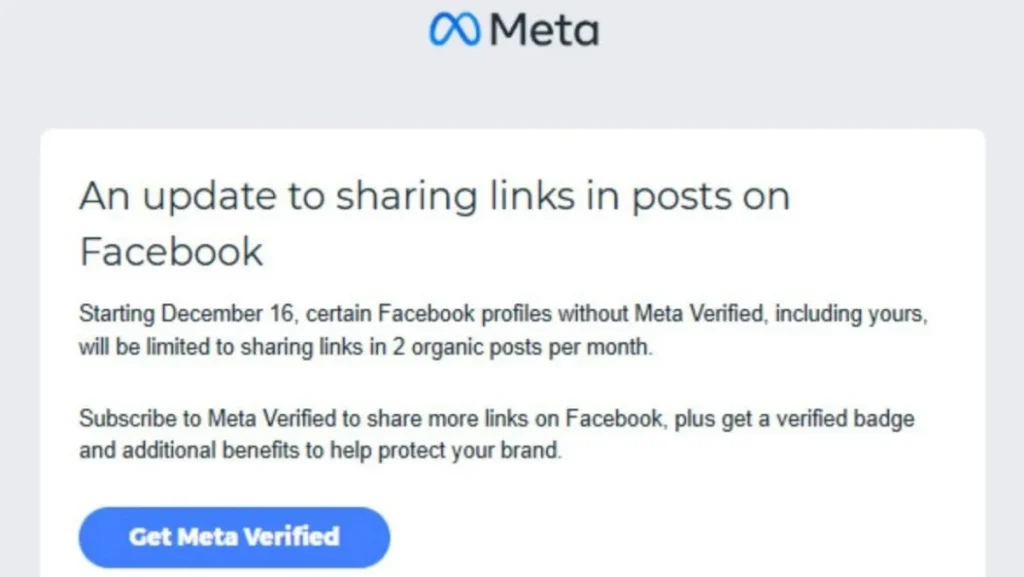
Reports suggest that Meta is quietly testing a highly controversial policy on Facebook: turning link sharing into a paid feature. Under this experiment, creators, bloggers, and group-buy organizers who rely on Facebook for traffic may be limited to just two external links per month unless they subscribe to Meta’s blue-check verification.
The test was first uncovered by social media consultant Matt Navarra, who shared screenshots of the notification. Several creators using Facebook’s Professional Mode have since reported receiving alerts stating that, without a paid verification subscription, they will be restricted to publishing only two organic posts containing links each month.
In practice, this means that creators attempting to direct followers to YouTube channels, blog posts, podcasts, or online stores could see their posts blocked once they exceed the two-link threshold—unless they agree to pay. A Meta spokesperson later confirmed the existence of the test, stressing that it is currently a limited experiment aimed primarily at creators and pages using Professional Mode, while traditional news publishers are, for now, excluded.
As for the rationale, Meta explains that the goal is to assess whether “enhanced link-posting capabilities” can deliver additional value to verified subscribers. In other words, the company is openly testing whether traffic itself can be monetized—and whether users are willing to pay for the privilege.
Meta’s verification subscription currently starts at $14.99 per month, and if this model is formalized, it could become a meaningful new revenue stream. To my mind, however, it signals that Meta’s tolerance for “traffic leakage” has reached a breaking point.
For years, anyone running a Facebook page has known that the algorithm strongly disfavors external links: posts containing them often suffer dramatic drops in reach. At least, however, they could still be published—if largely unseen. Now, Meta appears ready to replace algorithmic suppression with hard limits enforced by policy.
This move reflects not only Meta’s growing anxiety about subscription-based monetization—after all, even basic support features are now tied to paid plans—but also the most extreme expression yet of a pay-to-play ecosystem. While smaller creators may be able to absorb a modest monthly fee, the idea that one must pay a toll simply to lead audiences away from Facebook may well accelerate the exodus from an increasingly closed platform.
The cost of maintaining a social presence, it seems, is only going in one direction—and there is no turning back.
Related Posts:
- API Security in 2025: Top Best Practices Every Security Team Must Know
- End of Anonymous Sideloading: Google to Require Developer Verification on Android
- Fortinet: Critical Unverified Password Change Flaw in FortiSwitch
- Android AI Scam Defense Blocks 10 Billion Monthly Threats; Users 58% More Likely to Avoid Scam Texts Than iOS
- YouTube Unveils AI-Powered Creator Tools to Revolutionize Content Creation
Support Our Threat Intelligence
Find our tech and OS security coverage helpful? Support our work today and unlock a 100% ad-free reading experience!
 Buy Me a Coffee
