PHANTOMPULSE Malware Analysis: Advanced Cryptographic Implants Exploiting Blockchain Networks
 Do Son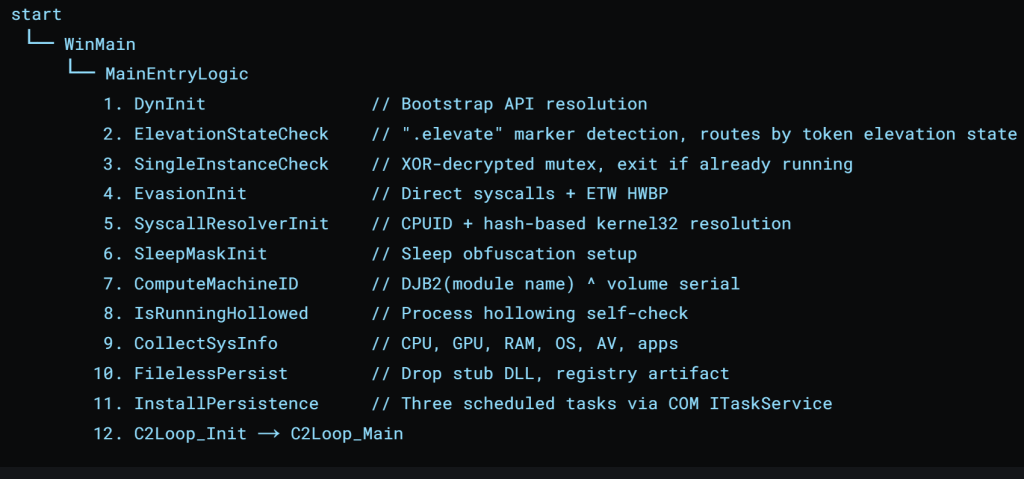
Execution chain
Unveiling a Highly Sophisticated Process Injection Framework
Security researchers recently uncovered a highly intricate software implant targeting digital financial platforms. Recently, Elastic Security Labs published a comprehensive PHANTOMPULSE malware analysis highlighting advanced evasion strategies. This automated threat variant originates from sophisticated espionage campaigns linked to North Korean cyber operators. To achieve its malicious objectives, the implant leverages unique process manipulation tricks alongside deep defensive bypasses. Consequently, corporate threat response teams must update their network tracking configurations immediately to block these hidden execution paths.
Strong Fingerprints of AI Assisted Coding
To begin with, the underlying software compilation process exhibits unusual technical characteristics. Automated language models likely played a large role in refining the codebase structure. For instance, the binary files contain extensive logging strings and organized step numbers. According to the published report, “PHANTOMPULSE bears strong fingerprints of Al coding assistance, visible throughout the debug strings.”
Furthermore, these debugging messages reveal a repetitive template structure that humans rarely implement manually. The documentation notes that developers embedded “ENTER/DONE function tracing: [HEIS] encrypt_text_only ENTER / [HEIS] encrypt_text_only DONE, Keylog ResolveAPIs: ENTER. The diagnostic style LLMs default to when generating new functions.” Therefore, these verbose diagnostic traces provide an excellent blueprint for behavioral detection engines.
Exploiting a Decentralized Blockchain C2 Channel
Sourcing Addresses via Blockscout Providers
Subsequently, the threat architecture utilizes an unconventional command and control methodology. The malicious agent retrieves its primary operational server locations through a decentralized blockchain C2 channel. Specifically, the program queries public L1 and L2 ledger platforms to harvest encoded transaction inputs. The system targets three distinct blockscout hosting providers to maintain network fallback resiliency. For example, the code routinely interacts with Ethereum, Base, and Optimism networks.
Weaknesses inside the De-XORing Validation Core
However, the underlying transaction parsing logic contains a significant structural vulnerability. The internal parsing module fails to verify the cryptographically signed source of incoming blockchain records. Instead, the routine only validates that the decrypted output string mimics a regular web address layout. The technical brief outlines this operational flaw clearly. “The resolver does not verify the sender of the transaction. It only checks that the latest decoded input starts with http.” Consequently, network defenders can exploit this oversight to override malicious configurations seamlessly. This simple process facilitates full infrastructure sinkholing via a single public transaction.
Advanced Defense Evasion and Hardware Breakpoints
Bypassing Security Controls via Context Spoofing
In addition, the implant deploys severe protection mechanisms to defeat local endpoint monitoring software. The application disables the Anti-Malware Scan Interface (AMSI) and Event Tracing for Windows (ETW) concurrently. To accomplish this, the binary crafts a unified hardware breakpoint primitive across active runtime threads.
The analysis reveals that “AMSI, WLDP, and ETW are bypassed via a single shared HWBP primitive planted on each API entry, intercepted by a vectored exception handler that fakes the return value without inline patching.” Therefore, the local logging libraries record a false success state while the threat runs completely unhindered.
Evading User Mode Detour Hooks
Furthermore, the malware bypasses user-mode API monitoring by constructing private syscall structures dynamically. The system resolves internal system service numbers by parsing the main system library files directly. Because the application uses private wrappers instead of standard exports, it completely avoids hooking traps. This stealthy implementation shields disk operations from detection by major endpoint protection platforms.
Three Way Process Injection Strategies
Subsequently, the command dispatcher supports three functional injection techniques tailored to distinct payload formats. The first method leverages module stomping into legitimate system libraries using file-backed sections. This approach hides active memory regions under trusted file headers like dbghelp.dll. Alternatively, the second path executes executable formats using the native Windows debugging programming interface. This advanced mechanism replicates a public technique known as DbgNexum to drive execution via exceptions. Finally, the third pipeline manually maps library payloads into remote process boundaries completely.
Attributing Tradecraft to State Sponsored Groups
Ultimately, extensive system artifacts establish a firm link to highly structured threat syndicates. The custom blockchain integration patterns mirror previous campaigns documented by international security groups. Specifically, the automated presence checking list focuses heavily on harvesting cryptocurrency wallets and messaging databases. The analysis clarifies that these patterns directly match known state-sponsored behaviors. “PHANTOMPULSE’s tradecraft, targeting, and infrastructure choices align with the DPRK-aligned crypto-targeting intrusion clusters that include Lazarus, BlueNoroff, UNC5342 (Contagious Interview), and APT38.”
Hardening Recommendations for Enterprise Systems
To conclude, performing a thorough PHANTOMPULSE malware analysis emphasizes the critical need for behavior-based threat hunting. Security administrators cannot rely solely on simple file path tracking. Instead, technology teams must monitor unusual hardware breakpoint registrations across core application processes. They should also audit outward HTTPS requests traveling to known public ledger providers. In conclusion, establishing deep visibility into cross-platform execution states remains the single best defense against advanced persistent threats.
Support Our Threat Intelligence
Find our threat intelligence and malware analysis helpful? Support our work today and unlock a 100% ad-free reading experience!
 Buy Me a Coffee
