PoC Exploit Publicly Disclosed: 20-Year-Old PostgreSQL pgcrypto Flaw (CVE-2026-2005) Grants Full Superuser RCE
 Do Son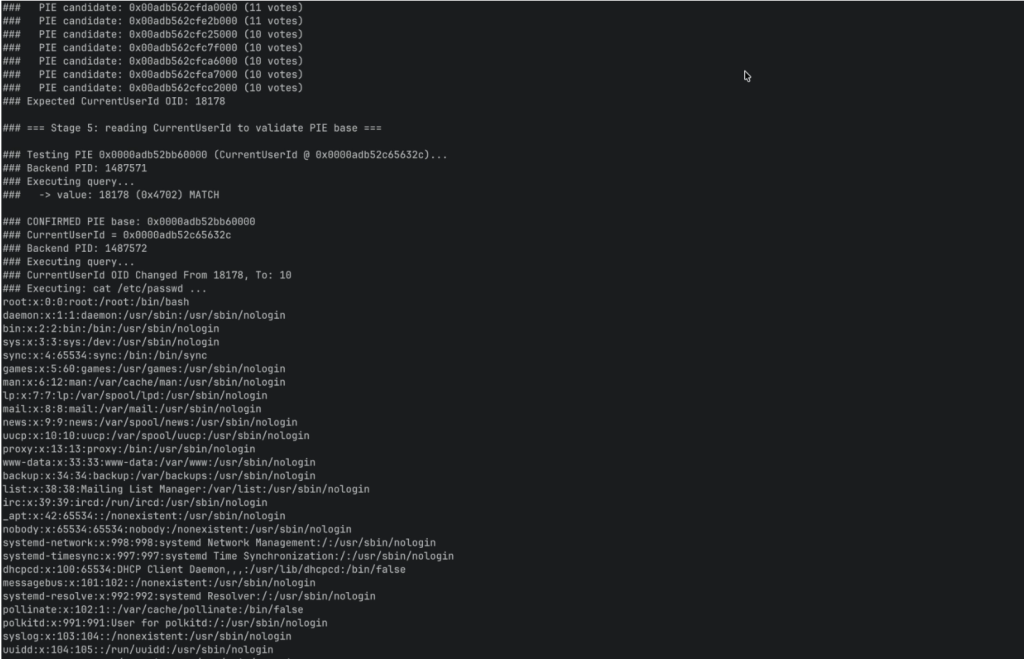
A critical heap buffer overflow vulnerability lurking in PostgreSQL’s core cryptographic extension for over two decades has been publicly exposed, complete with fully functional proof-of-concept (PoC) exploit code that grants remote attackers absolute superuser privileges.
Tired of noisy CVE feeds? Set your own EPSS/CVSS alert threshold.
Try free for 14 daysThe security flaw, tracked as CVE-2026-2005, impacts a massive portion of the global database footprint. Discovered by an autonomous AI-powered analysis platform, the vulnerability was demonstrated live at the ZeroDay.Cloud 2025 conference in London and subsequently patched across all supported major versions of PostgreSQL in February 2026.
However, with full technical inner workings and weaponized exploitation scripts now hosted publicly on GitHub, organizations running unpatched database clusters face an immediate and severe risk of total server takeover.
The vulnerability resides within pgcrypto, a trusted, native extension used extensively by developers to handle cryptographic operations directly inside SQL statements.
“The vulnerable code has been present since pgcrypto was first contributed in 2005, more than 20 years ago,” the analysis states.
What makes CVE-2026-2005 exceptionally dangerous is how easily the vulnerable code path can be triggered. Because pgcrypto is classified as a “trusted extension,” any database role possessing standard CREATE privileges on a database can install it without requiring high-level administrative or superuser access.
In typical enterprise architectures, application backend roles are routinely granted these baseline permissions to spin up tables and extensions. Consequently, the defensive perimeter separating an authenticated database session from an unconstrained code execution sink is virtually non-existent.
According to the published analysis, the underlying bug targets pgp_pub_decrypt_bytea(), the OpenPGP public-key decryption routine. When a maliciously structured OpenPGP packet is passed to this function, it triggers a classic heap buffer overflow.
The newly public proof-of-concept exploit automates a complex multi-stage pipeline to subvert the database memory space:
- Information Leakage: The exploit uses custom packet construction to trick the server into leaking sensitive data pointers.
- ASLR / PIE Bypass: The tool executes an automated voting mechanism, checking candidate addresses against known symbol offsets to calculate the server’s Position-Independent Executable (PIE) base address.
- Privilege Escalation: By forging headers inside memory buffers, the exploit performs an arbitrary write to overwrite the database’s internal CurrentUserld pointer.
With CurrentUserld overwritten to 10 (bootstrap superuser), COPY FROM PROGRAM executes the specified OS command as the postgres system user.
By instantly turning a low-privileged SQL connection into a superuser shell, an adversary can leverage PostgreSQL’s native administrative tools to execute arbitrary operating system commands, install persistent backdoors, and pivot laterally into deeper cloud infrastructure.
The vulnerability was fixed upstream by the PostgreSQL Global Development Group on February 8, 2026, and officially shipped on February 12, 2026. Security administrators must immediately verify that their active instances match or exceed the following patched baselines:
- PostgreSQL 18: Patched in version 18.2
- PostgreSQL 17: Patched in version 17.8
- PostgreSQL 16: Patched in version 16.12
- PostgreSQL 15: Patched in version 15.16
- PostgreSQL 14: Patched in version 14.21
If production environments require validation testing that delays immediate patching, security teams must deploy aggressive perimeter workarounds to reduce the active blast radius:
- Isolate Network Access: Strictly ensure that PostgreSQL servers are never exposed directly to the internet. Perimeter firewalls and security groups must restrict inbound database traffic solely to specific application subnets and trusted administrator jump boxes.
- Enforce Strict Credential Hygiene: Immediately rotate broadly-distributed database credentials, particularly those utilized by applications or automated CI/CD pipelines. Transition toward isolated, per-service identities and enforce short-lived, ephemeral database tokens to ensure that an external compromise of an app token cannot be easily traded for a stable entry point.
Support Our Threat Intelligence
Find our vulnerability reports and weekly recaps helpful? Support our work today and unlock a 100% ad-free reading experience!
 Buy Me a Coffee
