ROMULUS ClickFix Attack Chains MSI, LegionLoader, and Warden Stealer in Multi-Stage Intrusion
 Do Son
| At a glance | |
| Malware family | ROMULUS (ClickFix delivery), LegionLoader, Warden Loader, and Warden Stealer |
| Threat actor | Unknown; eSentire has not attributed the intrusion |
| Targets | Windows users; eSentire analyzed one intrusion |
| Delivery vector | ClickFix lure that tricks users into pasting a command into the Windows Run dialog |
| Key capabilities | Layered encrypted stages, sandbox and VM evasion, process hollowing, theft of browser, wallet, and messenger data |
TL;DR
In November 2026, eSentire’s Threat Response Unit traced a ROMULUS ClickFix lure to a Warden Stealer infection. The chain ran through a malicious MSI, PowerShell, C# loaders, shellcode, and LegionLoader. Each stage decrypted the next, and the shellcode checked for sandboxes before going further.
Delivery
A fake fix on the clipboard
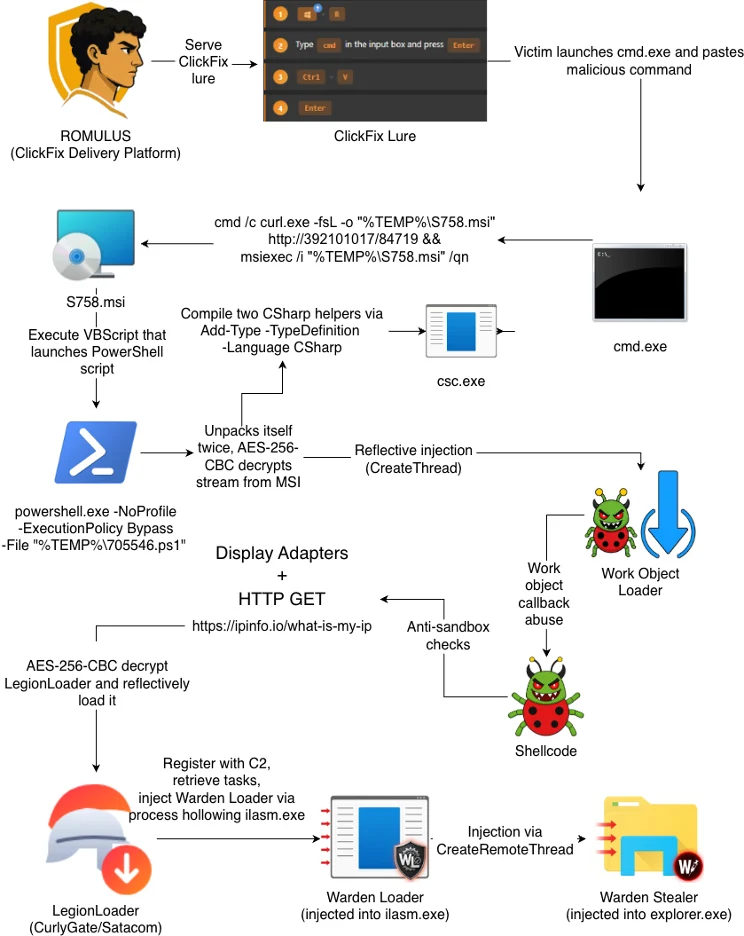
ROMULUS is a ClickFix delivery platform. Forescout first reported it in October 2026. Like other ClickFix lures, it copies a command to the victim’s clipboard. Then it tells the user to open the Run dialog and paste it.
In this case, the command downloaded an MSI installer to a temp folder and ran it silently. The download link hid its server behind a decimal-format IP address, a trick that can dodge simple URL filters.
The MSI also carried fake vendor and product metadata. That metadata matched a ClickFix campaign that Black Hills Information Security documented on October 14. This overlap suggests the ROMULUS ClickFix operation reuses the same installer kit.
Infection chain
From installer to PowerShell
The MSI ran a custom action that launched an embedded VBScript. That script wrote out an obfuscated PowerShell file. After two layers of deobfuscation, the PowerShell decrypted another stream hidden inside the MSI. It used AES-256 for this step.
Next, the script compiled two small C# programs on the fly. The first pulled the encrypted payload out of the MSI with Microsoft’s own installer library. The second loaded the decrypted file straight into memory.
eSentire flags this as a detection point. Defenders can watch for “suspicious use of msi.dll APIs,” it says, “particularly when those calls originate from high-risk processes such as PowerShell.”
Shellcode with a sandbox test
The in-memory loader decrypted shellcode and ran it through a Windows thread pool callback. This approach avoids more obvious ways of starting code. The shellcode then ran two checks before going further.
First, it looked at the names of display adapters. It searched for strings linked to VMware, VirtualBox, Hyper-V, Parallels, and other virtual machines. Second, it asked IPInfo, a legitimate IP reputation service, whether the public IP belonged to a hosting provider.
Many sandboxes run on hosting networks. So the check helps the malware skip analysis systems. In eSentire’s words, “display adapter artifacts are difficult for researchers to spoof.” If both checks passed, the shellcode decrypted and loaded LegionLoader.
Command-and-control and data exfiltration
LegionLoader takes orders
LegionLoader hides its API calls behind CRC32 hashes. It also uses junk code to slow down analysts. On startup, it registers with its C2 server over HTTP POST.
The registration carries the Windows version, a hashed disk serial number, and a campaign ID. LegionLoader encrypts the data with RC4 and encodes it in Base64. eSentire says it saw the same hard-coded RC4 key “across numerous LegionLoader samples.” It also notes that every observed sample used the same registration path, which gives defenders a network signature.
The server replies with a task list. After each task, the loader reports results back through a second endpoint.
Process hollowing delivers the stealer
In this intrusion, one task told LegionLoader to fetch Warden Loader. The loader downloaded it to a random temp file. Then it started a legitimate .NET Framework tool in a suspended state. It swapped that process’s code for Warden Loader and resumed the thread.
Warden Loader is the precursor to Warden Stealer. Gen Digital has profiled that stealer in depth. It targets web browsers, crypto wallets, messaging apps, and many other programs. The exact data it takes depends on each operator’s settings.
Attribution
No attribution applies here, either confirmed or suspected. eSentire does not name a threat actor. It ties the ROMULUS ClickFix lure to a known platform and the installer to a known ClickFix kit, but not to a specific group.
Defense and detection guidance
Based on its findings, defenders should:
- Train users never to paste commands from a website into Run or a terminal.
- Restrict the Windows Run dialog where business needs allow.
- Alert when command-line tools download an MSI and launch it silently.
- Watch PowerShell for calls into msi.dll and for on-the-fly C# compilation.
- Flag non-browser processes that query IP reputation services.
- Monitor for .NET Framework utilities started in a suspended state by unusual parents.
- Look for repeated encrypted HTTP POST traffic to rarely seen hosts.
In short, the ROMULUS ClickFix chain shows how one pasted command can unlock a long, layered infection. Stopping that first paste remains the cheapest way to keep Warden Stealer out.
Support Our Threat Intelligence
Find our threat intelligence and malware analysis helpful? Support our work today and unlock a 100% ad-free reading experience!
 Buy Me a Coffee
