 Do Son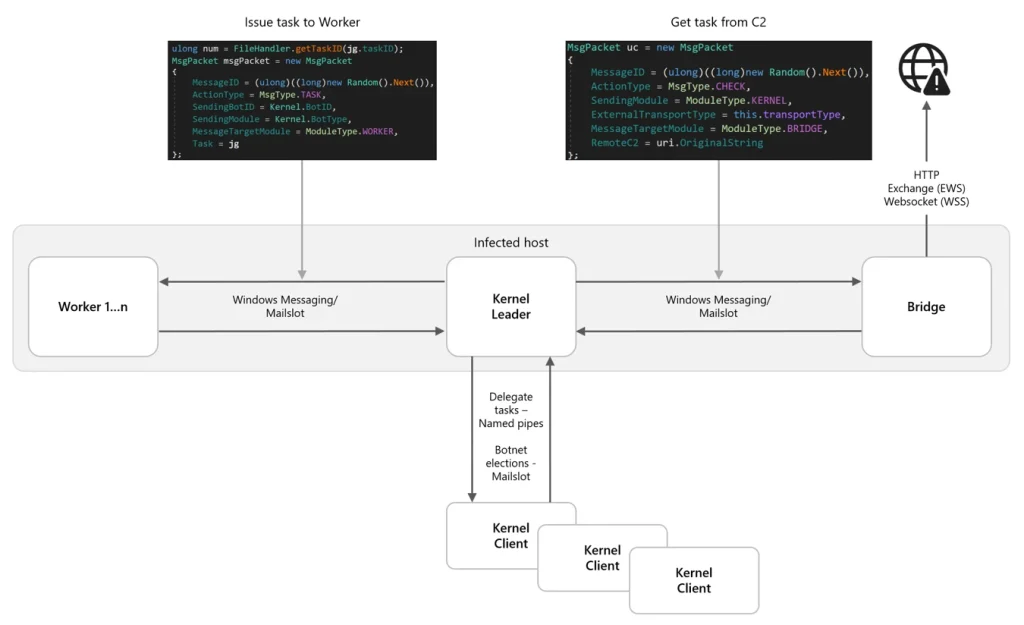
High-level module messaging map showing how the Kernel leader coordinates Worker tasking and uses the Bridge module for external C2 communications | Image: Microsoft
The Russian state-sponsored cyber-espionage threat group widely known as Secret Blizzard is fundamentally rewriting its technical playbook. In a massive architectural overhaul detailed by Microsoft Threat Intelligence, the adversary has successfully evolved its flagship implant, Kazuar, from a traditional standalone backdoor into an elusive, multi-tiered peer-to-peer (P2P) botnet ecosystem.
Historically recognized for its targeted campaigns against European and Central Asian government offices, embassies, and defense departments, Secret Blizzard’s operational focus remains locked on long-term intelligence gathering. However, its software engineering strategy has taken a sharp turn toward structural resilience. While rival threat groups increasingly lean on native operating system tools—commonly referred to as living-off-the-land binaries (LOLBins)—to escape notice, Secret Blizzard is engineering stealth straight into the bone structure of its custom malware.
As Microsoft Threat Intelligence explains in the analysis: “By separating responsibilities across Kernel, Bridge, and Worker modules and restricting external communications to a single elected leader, Kazuar reduces its observable footprint.”
The deployment phase relies on multi-stage execution models carefully designed to bypass Endpoint Detection and Response (EDR) platforms. In one delivery pattern, a variant known as the “Pelmeni” dropper introduces the secondary implant as an heavily obfuscated byte array embedded directly inside itself. To thwart sandboxes and prevent analysts from detonating the sample in a controlled research lab, the payload is often contextually restricted: “The payload is often bound to the target environment (for example, encrypted using the target hostname) so it only decrypts and executes on the intended host.”
In an alternative delivery technique, the initial dropper places a lightweight, legitimate-looking .NET loader onto the disk alongside the final payload, calling it via a COM object to slide the core Kazuar modules directly into memory.
Once inside an enterprise environment, the malware abandons the legacy “monolithic” architecture of past generations, instead spinning up three distinct module types, each assuming highly specialized operational roles.
The Kernel acts as the central brain of the host node. It executes exhaustive sandbox and anti-analysis checks, handles over 150 configurable options across eight functional domains, schedules file harvesting, and logs system telemetry.
The Bridge handles the network perimeter. It abstracts external communications entirely, acting as a dedicated proxy between the Kernel module and the remote C2 infrastructure using HTTP, WebSockets, or Exchange Web Services (EWS) email tunneling.
The Worker runs entirely in asynchronous threads beneath the Kernel’s direction. It handles active surveillance, including hooking window events, clipboard checking, system info collection, and continuous credential logging.
The defining factor of Kazuar’s new stealth model is its localized peer-to-peer hierarchy. To prevent networks from triggering security alerts due to massive volumes of simultaneous external traffic from multiple compromised hosts, Kazuar restricts out-of-band communication by enforcing a single localized node leader.
When multiple compromised machines exist on a local subnet, an automated election takes place over Windows Mailslots. The modules calculate an algorithm dividing the individual module’s total uptime by its historical interrupts (such as system reboots or logoffs) to determine the strongest host.
Once the winning Kernel establishes its dominance, it suppresses its neighboring nodes: “Once a leader is elected, it announces itself as the leader and tells all other Kernel modules to set SILENT.”
These client Kernels transition immediately into a passive SILENT state, ceasing all direct contact with the Bridge module or external C2 endpoints. They register themselves on the leader’s agent list and interact exclusively through secure, AES-encrypted internal Named Pipes (\\.\pipe\) to accept delegated tasks or feed harvested data back to the leader for batched exfiltration.
The structural transformation of Kazuar proves that State-sponsored actors are prioritizing resilience over simple execution velocity. Because data staging is decoupled from immediate exfiltration using localized directory structures (such as separating collected files into folders like PEEPS or AUTOS), the malware can survive long periods without calling home. Defenders must adapt by shifting focus away from volatile domain IOCs, looking instead for structural indicators like Google Protocol Buffers (Protobuf) messaging footprints between local modules, the unexpected creation of high-frequency Mailslot namespaces, and unauthorized outbound email traffic passing through Exchange Web Services.
Support Our Threat Intelligence
Find our threat intelligence and malware analysis helpful? Support our work today and unlock a 100% ad-free reading experience!
 Buy Me a Coffee
