 Do Son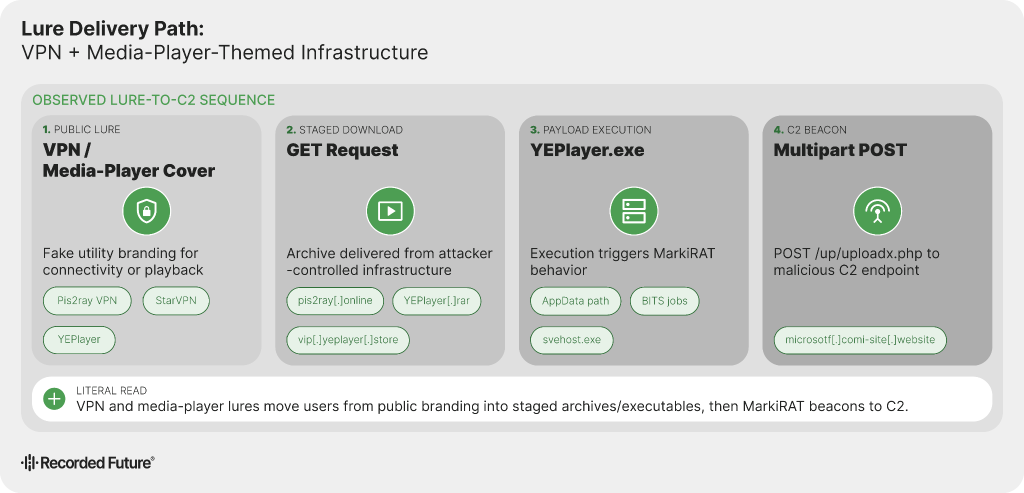
TAG-182 routes targets from fake VPN and media-player lures through staged archives to MarkiRAT file execution, which ends in surveillance access (Source: Recorded Future)
At a glance:
- Actor/Group: TAG-182 threat cluster (suspected Iran-nexus)
- Activity Type: Cyber surveillance and malware distribution
- Targets/Victims: Iranian citizens and dissidents worldwide
- Scale: Unknown exact number of infected devices
- Jurisdiction: No official charges; state-aligned espionage
- Source: Insikt Group (Recorded Future)
TL;DR
Insikt Group researchers identified new infrastructure tied to the TAG-182 threat cluster. The group allegedly uses fake VPN tools and media players to distribute MarkiRAT malware. These operations target Iranians worldwide to conduct state-aligned digital surveillance.
What Happened
Threat actors set up custom websites to host fake software applications. They advertise tools like “YESHICA YEPlayer” and “Pis2ray VPN” to lure victims. A hidden staging process begins secretly when a victim downloads these fake applications. The initial payload extracts and executes the core malware on the target machine.
Following execution, the malware connects to attacker-controlled infrastructure. It sends stolen data to malicious domains using multipart POST requests. Insikt Group notes, “The MarkiRAT sample identified during this research shares notable tradecraft overlaps with historical variants.” For example, the malware manipulates Windows Background Intelligent Transfer Service jobs. This mechanism allows the attackers to maintain stealthy communication.
Additionally, the malware drops an executable named “svehost.exe” into an AppData directory. It removes hidden file attributes and kills existing processes with the identical name. This step lets the operator update or replace the running surveillance instance easily.
Who Is Behind It
Researchers suspect the TAG-182 threat cluster operates within Iran’s broader surveillance ecosystem. Currently, analysts cannot confidently attribute the activity to a specific government body. However, the group shares distinct infrastructure patterns with the Ferocious Kitten threat group. Both groups deploy MarkiRAT malware against similar civil targets.
The report states, “It is almost certain that the majority of targets are located in Iran or are associated with Iranian anti-government movements based in Europe or North America.” The TAG-182 threat cluster relies on shared hosting providers like 23M GmbH and CrownCloud. They also use Let’s Encrypt certificates across their fake domains.
Impact and Scale
The exact number of infected devices remains publicly unknown. However, the threat actors maintain a clear focus on Farsi-speaking internet users. Attackers actively promote these fake applications on social platforms. Specifically, researchers observed Instagram threads advertising the fake VPNs shortly after recent street protests.
The advertising language exploits internet outages in Iran to manipulate desperate users. Operators promise stable connections during critical network blackouts. The primary goal is to spy on perceived dissidents. The report explains, “As the kinetic conflict with the United States and Israel has subsided since April 2026, Iran’s security apparatus is likely redirecting its focus toward intensified cyber surveillance.”
What Comes Next
Security experts expect Iranian digital surveillance operations to increase. Authorities want to monitor citizens closely following periods of internal unrest. Users must remain cautious when downloading any utility software. You should only install applications from verified sources like the Google Play Store.
Do not click download links posted by unknown social media accounts. Use caution during regional internet blackouts, as attackers exploit the demand for connectivity tools.
Support Our Threat Intelligence
Find our threat intelligence and malware analysis helpful? Support our work today and unlock a 100% ad-free reading experience!
 Buy Me a Coffee
