Tax Season Terror: Phishing Campaigns Weaponize Urgency to Deliver Remote Access Tools
 Do Son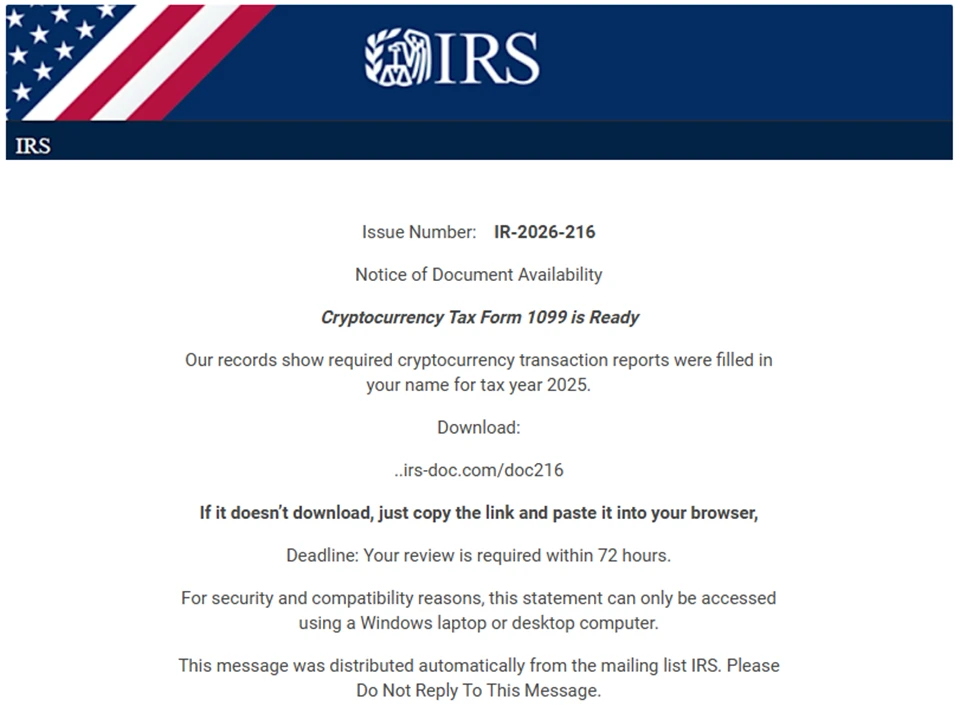
A mail impersonating IRS
As the April 15 tax deadline looms in the United States, a familiar digital predator has resurfaced. Researchers at Microsoft Threat Intelligence have identified a significant uptick in sophisticated email campaigns designed to exploit the “urgency and familiarity of time-sensitive emails” associated with tax season.
While these seasonal lures are a yearly occurrence, this year’s campaigns are characterized by a dangerous shift toward abusing legitimate tools to maintain a foothold in victim systems.
The current wave of phishing is not a monolith; instead, it utilizes a wide array of themes to cast the broadest possible net. Microsoft has observed lures centered around W-2 forms, refund notices, and payroll updates, often posing as government agencies or recognized financial institutions.
Crucially, the targeting is becoming more surgical. While many campaigns aim for general financial data theft, “others specifically target accountants and other professionals who handle sensitive documents” and are conditioned to receive high volumes of tax-related correspondence during this period.
To achieve such high levels of realism, threat actors are increasingly turning to Phishing-as-a-Service (PhaaS) platforms. These services enable “highly convincing credential theft and multifactor authentication (MFA) bypass campaigns through tailored tax-themed social engineering lures”.
One particularly crafty campaign identified in the report uses a multi-stage redirection chain:
- The Initial Email: A victim receives an email referencing a tax transcript.
- The Tracking Link: Clicking the “Review” button sends the user through an Amazon SES click-tracking URL.
- The Look-alike Domain: The user is then landed on
smartvault[.]im, a malicious domain “mimicking SmartVault, a well-known tax and document-management service”.
To protect their malicious payloads from security researchers, the attackers have integrated defensive measures into their landing pages. The smartvault[.]im site uses Cloudflare for bot detection, ensuring that “only visitors who resembled human users would be able to reach the final phishing payload”.
Users who pass this check are shown a fake “verification” animation, tricking them into believing the IRS is conducting an automated connection check. This psychological “vibe coding” builds trust just before the final blow is delivered.
The final stage of the attack is the delivery of a file named TranscriptViewer5.1.exe. Far from being a legitimate IRS tool, this file is a “maliciously repackaged ScreenConnect remote access tool (RAT)”.
Upon execution, this payload grants the attacker complete remote control over the victim’s system. This allows for silent, long-term post-exploitation activity, including:
- Credential Harvesting: Stealing passwords as they are entered.
- Data Theft: Exfiltrating sensitive tax documents and financial records.
- Network Pivoting: Using the compromised machine as a jumping-off point to infect the rest of the organization.
By abusing legitimate remote monitoring and management tools (RMMs), attackers are making it harder for traditional antivirus software to distinguish between an admin’s daily task and a criminal’s silent takeover.
Support Our Threat Intelligence
Find our threat intelligence and malware analysis helpful? Support our work today and unlock a 100% ad-free reading experience!
 Buy Me a Coffee
