The End of SCSI: Windows Server 2025 Unlocks 70% Faster Storage with Native NVMe I/O
 Do Son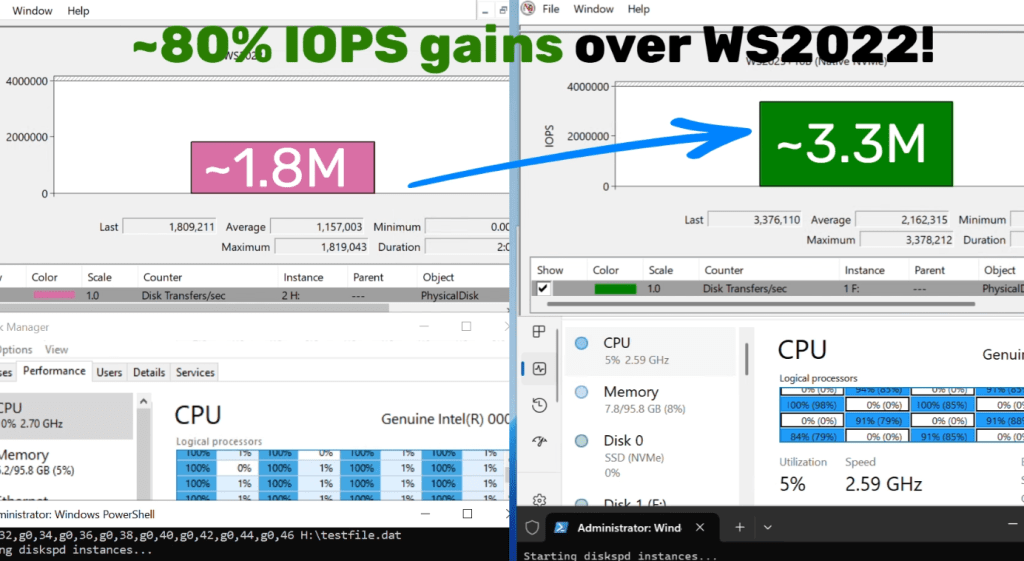
For IT administrators running Windows Server 2025 on systems equipped with NVMe SSDs, Microsoft’s latest enhancement may deliver a substantial performance uplift for latency-sensitive workloads such as databases. The feature in question is native NVMe I/O.
Introduced with the cumulative update released in October 2025, native NVMe I/O is not enabled by default. Administrators must activate it manually via registry changes or group policy. Once enabled, Microsoft projects performance gains of up to 70% in IOPS under heavy I/O loads, alongside CPU utilization reductions of as much as 45%.
Previously, NVMe SSDs relied on compatibility layers built around SCSI and SATA protocols. NVMe commands had to be translated and encapsulated along the way, meaning that under extreme workloads—such as millions of I/O operations per second—the legacy stack could impose significant CPU interrupt overhead.
The new native NVMe I/O path fundamentally rewrites this logic, creating a streamlined, pass-through channel designed specifically for high-performance, enterprise-grade NVMe SSDs. I/O requests now reach the hardware through a shorter, more direct path, while also exploiting the parallelism of modern multi-core servers. Each core can process I/O queues independently and efficiently, rather than contending for global system locks.
Data presented by Microsoft at the Ignite conference illustrates the potential impact. In testing limited to Windows Server 2025—support is not available for Windows 10 or 11—a dual-socket Intel server with 208 logical cores, 128 GB of memory, and a Solidigm D7-PS1010 3.5 TB PCIe 5.0 SSD achieved striking gains. Even with a single I/O thread, IOPS increased by 45%. With eight threads, performance rose by 78%, and with sixteen threads by 71%, underscoring that the gains do not scale linearly with thread count.
In 4K random read workloads, CPU utilization dropped by 41% at eight threads and by 47% at sixteen threads. Microsoft’s engineering team emphasized that the entire I/O processing pipeline was redesigned with maximal performance as the primary objective.
Early community testing, however, has produced mixed results. Some administrators on Reddit report little to no measurable improvement, leading others to speculate that only PCIe 5.0 NVMe devices can fully capitalize on the revamped I/O stack. In the consumer space, some users have even observed performance regressions with certain Western Digital drives, suggesting that older firmware or legacy design assumptions may prevent these SSDs from benefiting from the new architecture.
In terms of use cases, Microsoft’s new capability appears particularly well suited to artificial intelligence workloads and other data-intensive scenarios, such as high-throughput model training and large-scale database storage, where sustained read and write performance is critical.
For consumer environments, however, the outlook is less certain. Given the wide variability in consumer SSD firmware quality, extending similar functionality to Windows 11 would likely require extensive validation. As a result, Microsoft is unlikely to bring native NVMe I/O to consumer versions of Windows in the near term.
Related Posts:
- Windows 11 Gaming Guide: Microsoft’s Recommended PC Specs for 1080p to 4K
- SanDisk Unveils World’s Largest SSD: The 256TB UltraQLC Drive Built for the AI Era
- Google Quietly Updates Logo with Gradient Colors Before Google I/O
- Google Unveils Flow, Veo 3, Imagen 4: New Era of AI Media Creation
Support Our Threat Intelligence
Find our tech and OS security coverage helpful? Support our work today and unlock a 100% ad-free reading experience!
 Buy Me a Coffee
