The Frictionless Frontier: Microsoft Launches “Copilot Checkout” at NRF 2026
 Do Son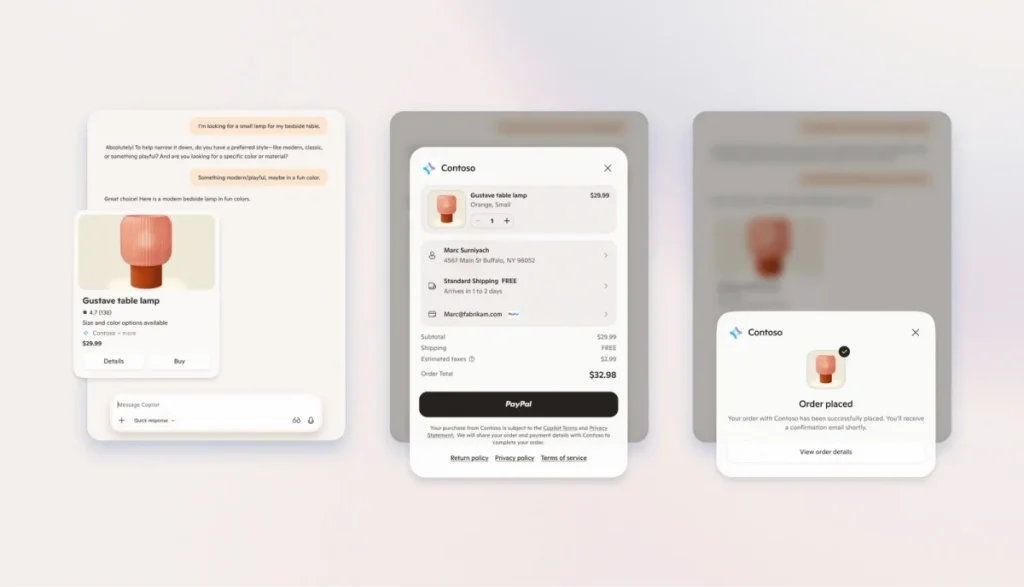
At the NRF 2026 retail exhibition held concurrently with CES 2026, Microsoft inaugurated “Copilot Checkout,” a feature that seamlessly integrates a digital shopping cart directly into the Copilot interface. This initiative seeks to ensure that a consumer’s impulsive acquisition is no longer hindered by the cumbersome friction of webpage redirections.
The fundamental premise of Copilot Checkout is elegantly simple: to attenuate the distance between desire and possession. By forging deep integrations with payment and e-commerce titans such as PayPal, Shopify, Stripe, and Etsy, the system allows users who discover an appealing item during a dialogue with the AI to finalize the procurement and payment within the AI’s own interface, thereby circumventing the need to navigate to external retail domains.
Current collaborators include prestigious brands such as Urban Outfitters, Anthropologie, and Ashley Furniture. Microsoft asserts that while it maintains control over the user interface, the actual merchant of record remains the retailer; thus, businesses retain access to vital customer analytics rather than being marginalized by the platform. This is not the inaugural attempt to infuse AI into the retail journey—OpenAI debuted a comparable shopping assistant months prior, though it advised users to return to the merchant’s site to verify pricing and inventory, a precaution designed to mitigate the risks of AI “hallucinations.”
In contrast, Microsoft exhibits a more robust confidence in its holistic integration, championing an experience that entirely bypasses the merchant’s website. Nevertheless, skeptics have raised poignant questions regarding accountability: should the AI succumb to a hallucination and mistakenly procure a sprawling “bounce house” instead of the requested “Bounce dryer sheets,” where does the liability reside? Microsoft has yet to furnish a granular explanation of its fail-safe mechanisms or specific capital-handling protocols. Currently, Copilot Checkout is commencing its rollout across the United States. While critics may perceive this as a sophisticated AI repackaging of the decade-old Amazon Dash Button concept, it undeniably represents a strategic pivot for Microsoft as it seeks to monetize Copilot’s substantial traffic through the ascent of conversational commerce.
Related Posts:
Support Our Threat Intelligence
Find our tech and OS security coverage helpful? Support our work today and unlock a 100% ad-free reading experience!
 Buy Me a Coffee
